ADDAC System ADDAC816 (2023–)
A tiny percussive powerhouse that turns any sound into a drum with just a gate and a twist.
Overview
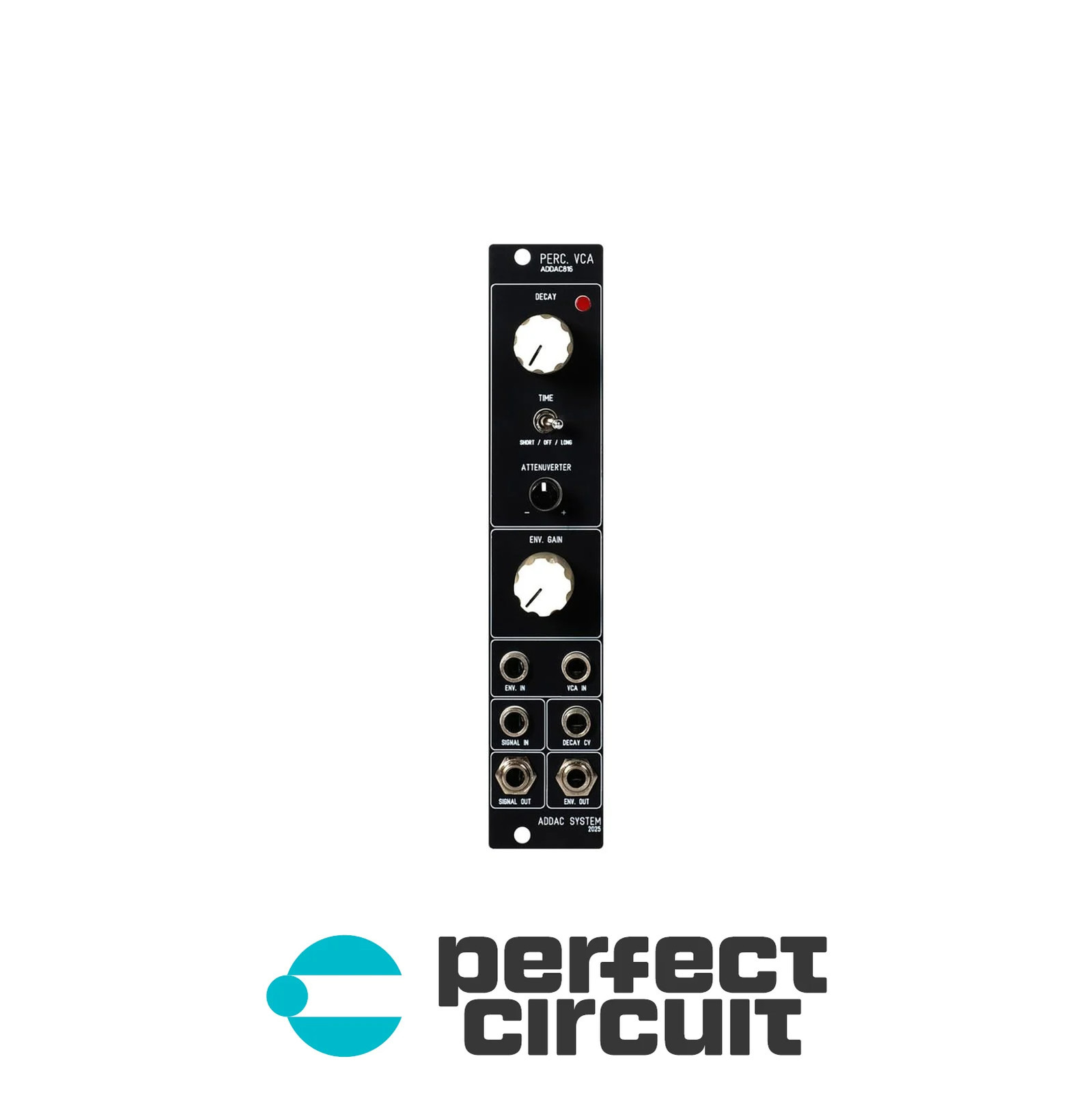
Plug in a sine wave, hit it with a gate, and suddenly you’ve got a kick drum. Feed it a square wave and it becomes a snappy toms. That’s the magic of the ADDAC816 Percussion VCA—it doesn’t just shape volume, it makes rhythm. At first glance, it looks like another modest Eurorack utility: 5HP of black front panel, minimal knobs, no flashy displays. But fire it up and you realize this module cuts straight to the pulse of electronic music. It’s not trying to be a full envelope generator or a multi-mode dynamics processor. It’s built for one job—making things percussive—and it does it with surgical precision and analog grit.
The core idea is simple: combine a fast attack, variable decay (AD) envelope with an exponential VCA in a single module. The attack is fixed short—just enough to eliminate the nasty click you get when slamming a VCA open with a gate—while the decay knob lets you dial in anything from a tight tick to a lingering thud. Want to modulate the decay time? There’s a CV input with an attenuverter, so you can morph decay lengths on the fly from sequencers, LFOs, or random sources. That internal envelope is permanently wired to the VCA, so no patch cables needed—just route your audio in, send a gate, and boom, you’ve got rhythm.
But don’t mistake simplicity for limitation. The ADDAC816’s VCA is no clean, transparent follower. Drive it hard and it starts to saturate, adding a gnarly bite that chews through your signal with analog aggression. It’s the kind of overdrive that makes a noise source feel like a slapped surface or a VCO burst sound like a distorted cowbell. That character comes from its exponential response curve, which mimics the natural attack of acoustic instruments and gives transients that organic “pop.” And because the signal path is DC-coupled, you can use it to shape not just audio, but control voltages too—making it a sneaky tool for percussive modulation or rhythmic control shaping.
Positioned in the ADDAC800 series as an “Analog Sound Utility,” the ADDAC816 sits alongside other compact, focused modules like the ADDAC801 Dual VCA and ADDAC802 Dual LFO. It’s not the flagship, nor the budget option—it’s the sweet spot for drum synthesis and rhythmic texture. Compared to modular workhorses like the Mutable Instruments *Plaits* or *Befaco* *Dual Atten* + *SLOD* combos, the ADDAC816 is more specialized, but far more immediate. You don’t need to dive into menus or patch multiple modules to get a usable drum sound. It’s the kind of module that earns its place in a system not because it’s flashy, but because you find yourself reaching for it every time you want to add a transient punch.
Specifications
| Manufacturer | ADDAC System |
| Model | ADDAC816 Percussion VCA |
| Production Years | 2023–present |
| Original Price | 110€ (excl. VAT) |
| Format | Eurorack |
| HP | 5 |
| Depth | 40mm |
| Current Draw | 60mA @ +12V, 20mA @ -12V |
| Function | AD Envelope Generator + Exponential VCA |
| Envelope Type | Fixed short Attack, variable Decay |
| Decay Control | Manual knob and CV input with attenuverter |
| VCA Response | Exponential |
| Signal Path | DC-coupled |
| Inputs | Audio In, Gate In, Decay CV In |
| Outputs | Audio Out |
| Power Connection | 16-pin Eurorack power header |
| Weight | 100g |
| Front Panel Material | Anodized aluminum |
Key Features
Integrated AD Envelope for Instant Percussion
The genius of the ADDAC816 is its internal wiring: the AD envelope is hardwired to the VCA’s control input, eliminating the need for a patch cable between envelope and VCA. This turns what’s normally a two- or three-module task—gate source, envelope, VCA—into a one-step process. Send a gate, and the envelope triggers instantly. The fixed short attack ensures no click, while the decay knob shapes the tail. It’s a design that favors immediacy over flexibility, and in a format where patching can become a maze of cables, that simplicity is a feature. The module excels in drum synthesis, letting you convert any oscillator or noise source into a percussive hit with minimal effort. It’s especially useful in compact or travel systems where space and patch cables are at a premium.
Exponential VCA with Saturation Character
Not all VCAs are created equal, and the ADDAC816’s exponential response is key to its sonic personality. Unlike linear VCAs, which open volume in a straight line, exponential VCAs mimic the logarithmic nature of human hearing, giving a more natural, punchy attack. This is critical for percussive sounds, where the initial transient defines the character. But push the input gain or feed it a hot signal, and the VCA begins to saturate, adding harmonic complexity and a gritty edge. This isn’t clean digital clipping—it’s analog saturation that feels alive, like a tube overdriving or a tape head compressing. That “gnarly bite,” as ADDAC puts it, makes it ideal for industrial textures, lo-fi drums, or anything that needs to cut through a mix with attitude.
DC-Coupled Path for CV Shaping
While most users will route audio through the ADDAC816, its DC-coupled signal path opens up creative uses beyond sound. You can feed control voltages into the input and use the envelope to shape modulation contours—say, turning a steady LFO into a rhythmic tremolo effect or gating a random CV to create stepped percussion-like sequences. This flexibility blurs the line between audio and control, a hallmark of thoughtful Eurorack design. It’s not a feature you’ll use every day, but when you need a quick, envelope-shaped CV burst, the ADDAC816 delivers without requiring additional modules.
Historical Context
The ADDAC816 arrived in 2023, a time when Eurorack was deep into both expansion and refinement. After years of rapid growth and digital experimentation, many builders and users were returning to analog fundamentals—modules that did one thing well, with character and reliability. ADDAC System, based in Lisbon, had already built a reputation for blending vintage-inspired circuits with modern usability, seen in modules like the ADDAC712 Vintage Pre and ADDAC714 Vintage Clip. The ADDAC816 fits squarely in that philosophy: no microprocessors, no menus, just discrete analog circuitry focused on musical immediacy.
It emerged in a market crowded with envelope generators and VCAs, but few combined the two with such a specific purpose. Competitors like *Intellijel*’s *Dual ADSR* or *Make Noise*’s *Rene* offered more complex modulation, but required patching and configuration. The ADDAC816 carved its niche by being a “drum in a box”—a concept with roots in classic drum machines like the Roland TR-808, where dedicated analog circuits generated each percussive voice. In that sense, it’s a modular reinterpretation of that philosophy: a dedicated analog path for rhythm, stripped of unnecessary complexity.
At 110€, it positioned itself as a premium utility—more expensive than basic VCAs but justified by its integrated envelope and sonic character. It wasn’t trying to replace full envelope generators or multi-function modules, but to sit beside them as a specialized tool. In a format where many users build systems around workflow and feel, the ADDAC816 offered a tactile, immediate way to inject rhythm without patching a web of cables.
Collectibility & Value
As of 2026, the ADDAC816 remains in production and readily available from ADDAC and authorized dealers. It has not yet entered the vintage secondary market in large numbers, but used units appear on eBay and Reverb with increasing frequency. Prices for used modules typically range from €90 to €130, depending on condition and included accessories. New units still sell for the original 110€ (plus VAT and shipping), making it a stable, accessible investment.
There are no known design flaws or common failure points. The module uses standard through-hole components and a robust power design, with no history of overheating or voltage sensitivity. Service technicians report high reliability, and the 40mm depth ensures compatibility with most skiffs and cases. The only potential issue is mechanical: the potentiometers and jacks are standard quality, so heavy patching or rough handling could lead to wear over time, but no widespread reports of premature failure exist.
For buyers, the main consideration is authenticity. Counterfeit Eurorack modules are rare but not unheard of, so purchasing from reputable dealers or verified sellers is advised. The original packaging includes a user guide and ADDAC branding—missing documentation or inconsistent labeling should raise red flags. Given its straightforward function, there’s little reason to seek out NOS (new old stock) or early production runs; all units perform identically.
The ADDAC816’s collectibility lies not in scarcity, but in utility. It’s the kind of module that earns a permanent spot in a system, not because it’s rare, but because it’s *useful*. It’s the go-to for quick drum sounds, rhythmic gating, or adding analog grit to any signal. As modular systems evolve, modules like this—focused, characterful, and reliable—tend to hold value not through hype, but through daily use.
eBay Listings
As an eBay Partner, we earn from qualifying purchases. This helps support our independent vintage technology research.