ADDAC System 712 (2022–)
A dual-channel preamp that doesn’t just boost your signal—it argues with it, colors it, and sometimes flips it upside down.
Overview
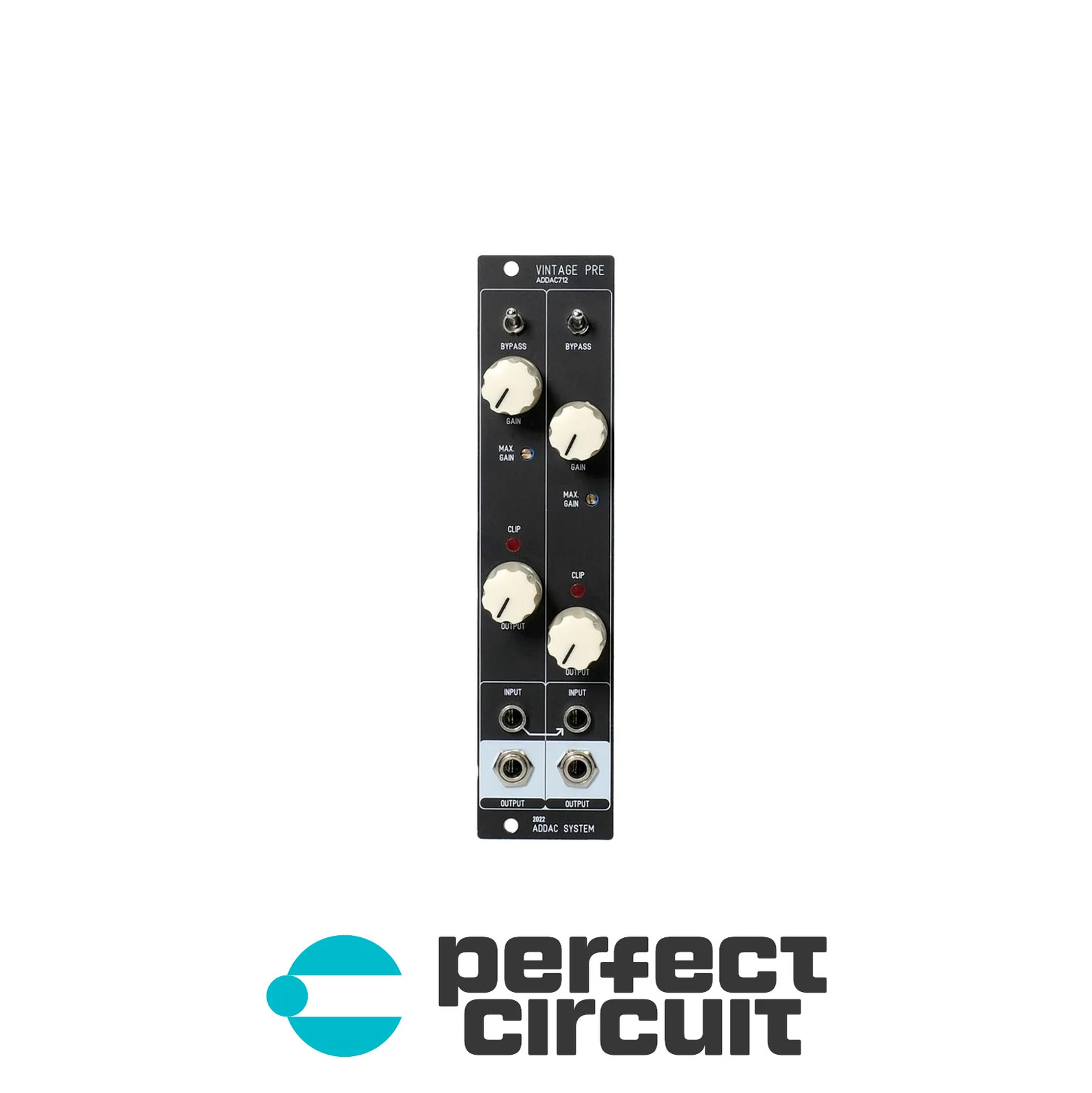
There’s a moment when you turn the gain up too far on the ADDAC 712 and the waveform starts to tilt—like a drunk sailor leaning into a strong wind—and you realize this isn’t just another clean boost with a clipping LED for show. This module bites, and it does so with a distinctly analog snarl that feels more like a rediscovered artifact than a modern Eurorack convenience. Born in 2022 as part of ADDAC System’s 700-series “Analog Heritage” line, the 712 Vintage Pre isn’t modeled on software emulations or vague “vintage vibes.” It’s a deliberate circuit clone of a discrete preamp board from the 1970s, reportedly used in some gear that still commands reverence in high-end studios. ADDAC won’t name names, but the clues point toward a certain class of British console preamps known for their harmonic complexity and slightly unpredictable behavior under stress. That DNA lives on here, shrunk into a 6HP Eurorack module that can either gently warm up a lifeless oscillator or turn your entire mix into something that sounds like it was pulled off a half-demagnetized tape head.
What sets the 712 apart from the sea of overdrive and distortion modules is its dual-stage architecture. It’s not just a single gain stage with a volume knob at the end—this thing has two distinct amplification paths. The first is a discrete transistor-based preamp stage that handles the initial gain and saturation. Push it past ±5.5V and you start to see soft saturation creep in; hit ±6V and you’re in full hard clipping territory, but with a twist. At extreme levels, the clipping doesn’t just flatten the waveform—it drifts the DC offset, shifting the entire signal’s bias upward in a way that mimics a gate or even a rectified wave. It’s an artifact, sure, but one that can be weaponized creatively. Patch a slow LFO into the input, crank the gain, and you’ll get a pulsing, breathing distortion that modulates in intensity and timbre, not just volume.
Then there’s the second stage: an op-amp-based output gain section with its own volume control and a clipping LED that gives you visual feedback on output saturation. This two-stage design is where the 712 earns its keep. You can obliterate the signal in the first stage, let it clip hard and asymmetrical, then pull it back with the output stage to a manageable level—preserving the grit while avoiding downstream overloads. It’s a level of control that’s rare in such a compact module, and it makes the 712 as useful as a mastering tool as it is a sonic mangler.
And let’s not overlook its utility as a real preamp. Despite being marketed in the modular world, the 712 handles line-level and instrument-level signals with ease. Plug in a guitar, a keyboard, or even a turntable (with appropriate loading), and it’ll add that same harmonic richness before the signal ever hits your ADC. It pairs especially well with the ADDAC 711 Balanced Inputs, acting as the tonal engine behind a clean front end. But even standalone, it’s a convincing argument for why not every preamp needs tubes or transformers to sound “vintage.”
Specifications
| Manufacturer | ADDAC System |
| Production Years | 2022– |
| Original Price | 140€ |
| Format | Eurorack |
| Width | 6HP |
| Depth | 40mm |
| Power Consumption +12V | 40mA |
| Power Consumption -12V | 40mA |
| Channels | Dual |
| Circuit Type | Discrete transistor preamp with op-amp output stage |
| Gain Control | Manual [GAIN] knob with user-adjustable [MAX GAIN] trimmer |
| Input Signal Range (Clean) | Up to ±5.5V |
| Clipping Threshold | Approx. ±6V |
| Output Control | [OUTPUT] knob |
| Bypass Switch | Toggle switch (Up: Effect, Down: Bypass) |
| Inputs | Left and Right (Left normalled to Right) |
| Outputs | Left and Right |
| Clipping Indicator | LED on output stage |
| DIY Kit Available | Yes (81€, SMD pre-soldered) |
| Front Panel Options | Custom colors available (Red, Green, Blue, White, Silver Gray, Yellowed Silver, Dark/Light Bronze) |
Key Features
The Discrete Preamp Heart
The core of the 712’s character lies in its discrete transistor gain stage, lifted directly from a 1970s console preamp design. Unlike op-amp-based circuits that tend to clip symmetrically and predictably, this topology introduces asymmetric saturation with a rich blend of even and odd harmonics. The result is a distortion that feels organic—sometimes woolly, sometimes biting—depending on input level and source impedance. Because it’s discrete, there’s also a slight variability between units, especially in how the clipping threshold behaves near the ±6V mark. Some users report a smoother transition into distortion, others a more abrupt snap. This isn’t a flaw; it’s a feature of analog lineage. If you’re chasing consistency, this might give you pause. If you’re after character, it’s a win.
Two-Stage Gain Architecture
Most preamps in Eurorack are single-stage: gain in, volume out. The 712 breaks that mold with its dual-stage design. The first stage is where the magic (and mayhem) happens—this is where you dial in saturation, asymmetry, and that peculiar DC shift at extreme levels. The second stage, built around a standard op-amp, lets you reassert control. You can max out the input gain, let the signal clip hard, then use the output knob to bring it down to a safe level without losing the harmonic complexity. It’s like having a fuzz pedal followed by a clean boost, but in a single, tightly integrated circuit. This flexibility makes the 712 unusually adaptable: use it as a subtle coloration tool on a drum bus, or as a full-on mangler for feedback patches and noise generators.
DC Shift and Gate-Like Behavior
At high gain settings, the 712 does something unusual: it shifts the DC offset of the output signal, effectively lifting the entire waveform above 0V. This isn’t just a quirk—it’s a sonic feature. When applied to audio-rate signals, it creates a kind of half-wave rectification effect, thinning out the sound and giving it a pulsing, gated quality. With slower modulation sources, it can act like a crude envelope follower or even a rudimentary gate generator. It’s not precise, and it’s definitely not clean, but in the right context—say, mangling a sequence through a resonant filter or feeding it into a wavefolder—it adds a layer of unpredictability that feels alive. This behavior is more pronounced on certain units, likely due to component tolerances, so it’s something to listen for if you’re buying used.
Historical Context
The ADDAC 712 didn’t emerge from a vacuum. It arrived in late 2022, right as the Eurorack market was seeing a renewed interest in “analog heritage” modules—circuit clones of classic preamps, compressors, and EQs from the 1960s and ’70s. While brands like Intellijel and Make Noise were exploring digital hybrids, ADDAC leaned into the past with its 700-series, aiming to bring the character of vintage studio gear into the modular realm. The 712 sits alongside the 714 Vintage Clip as part of this initiative, but where the 714 is a dedicated soft-clipping distortion, the 712 is more versatile—a true preamp first, a distortion second.
Its design philosophy echoes that of earlier DIY-friendly clones like the MFOS Discrete Preamp or the PAIA 9700, but in a modern, compact, and power-efficient form. Unlike those kits, though, the 712 is built for the realities of Eurorack: it runs on ±12V, fits in tight cases, and includes features like user-adjustable max gain and LED clipping indicators. It’s a bridge between the homebrew ethos of the 1970s and the precision expectations of today’s modular users. And while it doesn’t carry the brand name of the original console it’s based on, its behavior is close enough to satisfy those who’ve spent time on the real thing.
Competitors in this space include the WMD SCP (a stereo preamp/distortion) and the 4ms Dual Looping Delay’s preamp section, but neither offers quite the same combination of discrete circuitry, dual-stage control, and DC shift artifacts. The 712 isn’t trying to be the cleanest or most transparent preamp—it’s aiming for character, and it hits that mark with confidence.
Collectibility & Value
As of 2026, the ADDAC 712 remains in production and readily available, which keeps prices stable. New units sell for around €140 directly from ADDAC or authorized dealers like Reverb and Perfect Circuit. The DIY kit, which includes all components with SMD parts pre-soldered, goes for €81 and is a solid option for those comfortable with basic soldering. Because the module is relatively simple—no complex surface-mount arrays or firmware—it’s a popular first build for intermediate DIYers.
Used prices hover between €90 and €120, depending on condition and whether the seller includes the original packaging or any custom panel options. There are no known fatal flaws or common failure points—no electrolytic capacitors to dry out, no mechanical switches prone to wear. The toggle switch for bypass is robust, and the PCB layout is clean and well-documented. The only maintenance concern is the trimmer pot for max gain, which can drift slightly if over-tweaked, but it’s easily accessible and stable under normal use.
What to check when buying used: listen for channel imbalance or noise in one channel, which could indicate a cold solder joint (common in DIY-assembled units). Also, test the clipping behavior—if one channel clips at a significantly lower level than the other, it might need recalibration. Otherwise, this is one of the more reliable modules in the ADDAC lineup.
Because it’s still in production and not particularly rare, the 712 isn’t a “collector’s item” in the traditional sense. But its unique sonic character and historical inspiration give it lasting appeal. It’s the kind of module that doesn’t get sold off when systems get reorganized—it sticks around, quietly doing its job in the background, coloring signals you didn’t even know needed color.
eBay Listings
As an eBay Partner, we earn from qualifying purchases. This helps support our independent vintage technology research.