ADDAC System ADDAC712 (2022–)
A dual-channel time machine for your signal path, built to mimic the soulful breakup of 1970s discrete preamps—one knob away from pristine, one twist from holy distortion.
Overview
Plug something in—anything—and the ADDAC712 doesn’t just amplify it, it ages it. That first hit of overdrive isn’t harsh or digital; it’s like pulling a dusty tape machine out of a studio basement and cranking the input until the meters glow red. The 712 isn’t a distortion module in the modern sense. It’s a preamp, yes, but one with teeth. It’s built around a discrete gain stage inspired by a 1970s console design so revered that ADDAC won’t name it outright—probably out of respect, or maybe because they know gear nerds would riot if they dropped the name. Either way, the magic is in the way it saturates: warm, organic, and slightly unpredictable, like analog gear should be.
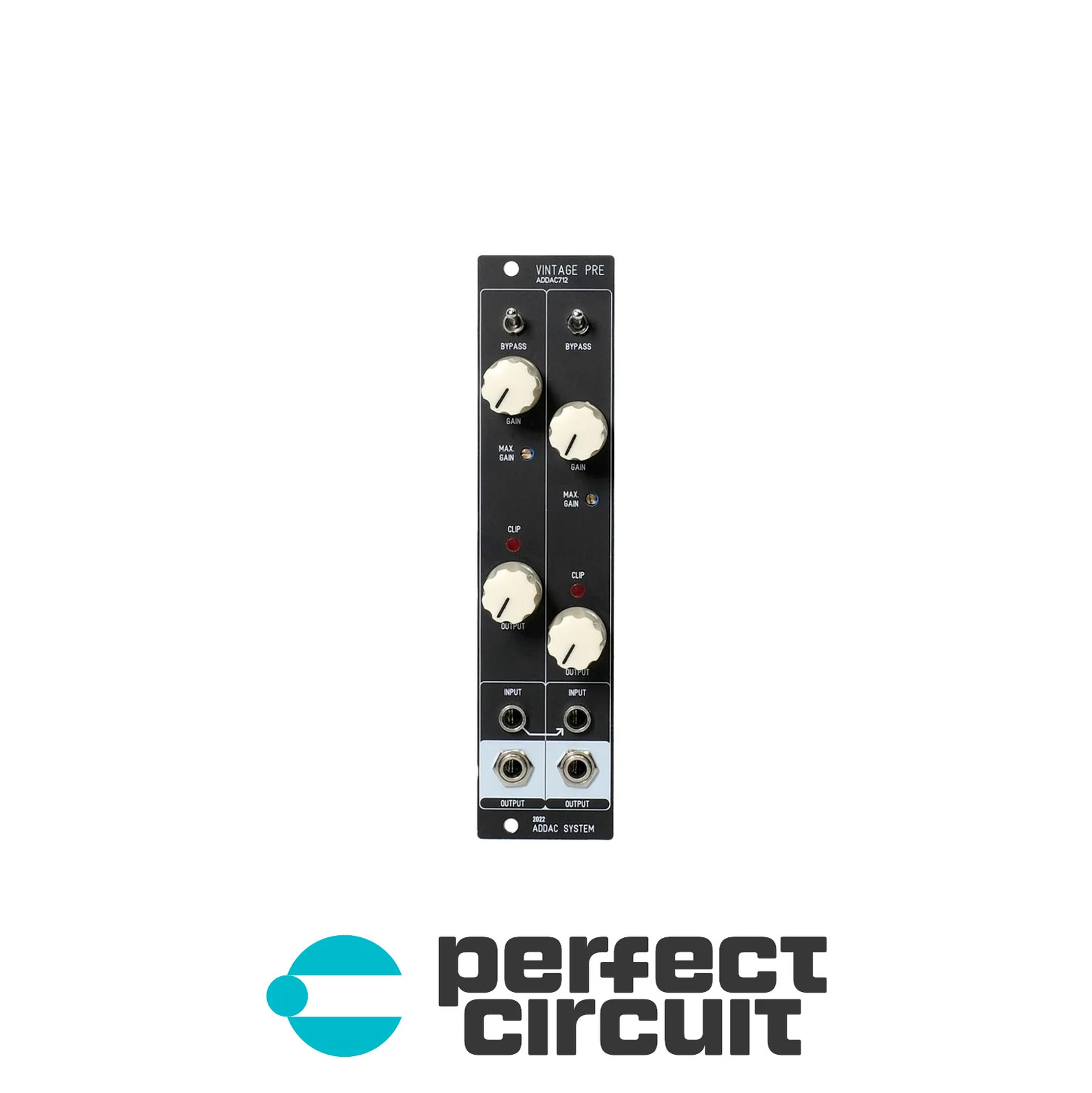
This is a Eurorack module, 6HP wide and skiff-friendly at just 40mm deep, but it doesn’t feel like a compromise. It’s built for real use—dual channels, each with independent bypass, input gain, output gain, and a trim pot for setting maximum input headroom. That last bit is key: you can push the input into wild saturation while using the output stage to reel it back in, keeping levels manageable in a modular rig. It’s not just about distortion—it’s about control. Feed it a clean oscillator, crank the input, and you’ll get everything from subtle harmonic thickening to full-on fuzz. Run a guitar through it, and it behaves like a boutique stompbox with studio-grade headroom. Even line-level sources from drum machines or samplers get a lift, both in volume and character, especially when you cross that ±5.5V threshold where saturation starts to bloom.
And then there’s the clipping. At around ±6V, the signal hits hard clipping, but it’s not a brick wall—it’s more like a slow slide into chaos. The module actually shifts the 0V bias upward at extreme levels, which introduces a gate-like behavior, chopping off the negative half of the waveform. It’s not a flaw; it’s a feature. It gives the distortion a pulsing, almost rhythmic quality when pushed, especially on sustained signals. It’s the kind of happy accident that makes you stop and say, “Wait, what just happened?”—and then immediately patch it into three other things to see what else it can do.
Specifications
| Manufacturer | ADDAC System |
| Production Years | 2022– |
| Original Price | 140€ (assembled), 81€ (DIY kit) |
| Format | Eurorack |
| Width | 6HP |
| Depth | 40mm |
| Power Consumption | 40mA +12V, 40mA -12V |
| Channels | Dual (Left and Right) |
| Input Type | Normalled (Left to Right) |
| Input Gain Control | Per channel |
| Output Gain Control | Per channel |
| Bypass Switch | Per channel (toggle) |
| Max Gain Trimmer | Front-panel accessible |
| Signal Integrity Range | Up to ±5.5V |
| Clipping Threshold | Approx. ±6V |
| Clipping Behavior | Hard clipping with 0V bias shift at extreme levels |
| Output Stage | x2 opamp-based with clipping LED indicator |
| Weight | Not specified |
| Country of Origin | Portugal |
| DIY Option | Available as SMD pre-soldered kit |
Key Features
Discrete Gain Staging with Vintage DNA
The heart of the ADDAC712 is its discrete preamp circuit, modeled after a 1970s design known for its musical breakup and robust signal handling. Unlike opamp-based gain stages that can sound clinical when pushed, this one breathes. The harmonics it generates are rich in both odd and even orders, giving it a full, complex character that sits somewhere between tube warmth and transistor grit. Because it’s discrete, there’s no single IC doing all the work—instead, it’s a network of transistors and resistors working in concert, which means the distortion develops gradually and asymmetrically. That’s why it doesn’t just clip; it transforms. A sine wave comes out lopsided, then squared, then nearly rectified, each stage adding a new layer of texture. It’s not modeling vintage tone—it’s replicating it, component by component.
Dual-Stage Gain Control: Distort First, Tame Later
Most preamps give you one gain knob. The 712 gives you two per channel: input and output. This isn’t just for fine-tuning—it’s a workflow decision. You can drive the input stage into full saturation, creating a signal that’s harmonically rich but potentially too hot for downstream modules. Then, instead of relying on external attenuators, you simply turn down the output knob to bring it back into line. It’s like having a distortion pedal with a master volume that doesn’t kill the tone. This flexibility makes the 712 useful not just as a colorizer, but as a dynamic shaping tool. Want to add grit to a quiet LFO? Boost the input, drop the output. Need to bring a line-level sampler into Eurorack range without fizz? Use the input gain to lift it, then trim the output to avoid clipping your mixer. It’s a simple idea, but one that’s missing from most compact preamps.
Bias Shift Clipping: The Hidden Character Generator
At extreme input levels, the 712 does something unusual: it shifts the DC bias of the signal upward, effectively cutting off the negative half of the waveform. This isn’t a malfunction—it’s a design artifact of the discrete circuit, and it results in a form of asymmetrical clipping that feels almost gate-like. Sustained tones start to pulse, transients get sharpened, and feedback patches take on a stuttering, rhythmic quality. It’s not something you’d want on every signal, but when used intentionally, it can turn a simple drone into a living, breathing texture. Some users report using this behavior to create pseudo-envelope effects or to add movement to static pads. It’s not a feature you’ll find in the manual, but it’s one you’ll remember once you’ve heard it.
Historical Context
The ADDAC712 arrived in 2022, a time when Eurorack was overflowing with digital effects, granular processors, and complex modulation sources. Amid that sea of microprocessors, the 712 stood out by going backward—way backward. It’s part of ADDAC’s 700 Series, labeled “Analog Heritage,” and it makes a clear statement: vintage tone doesn’t need modeling or emulation. If you want the sound of 1970s studio gear, build it the same way they did. This wasn’t a new idea—modules like the 4MS Optical Sub Gen or the Intellijel Triatt had already proven that discrete circuits could thrive in modular—but the 712 made it accessible. At 6HP and with a straightforward layout, it didn’t demand a full row of your case. It just asked for a signal and a little courage.
It also arrived alongside the ADDAC714 Vintage Clip, a related but distinct module focused on soft clipping with switchable bipolar/unipolar modes. Where the 714 is about smooth saturation, the 712 is about transformation. Together, they form a toolkit for analog coloration, but the 712 has broader utility. It can function as a clean preamp, a distortion stage, a level shifter, or even a crude wavefolder. Competitors like the Happy Nerding FX Aid or the WMD SX-1 offered similar functions, but few combined discrete circuitry, dual channels, and input/output gain staging in such a compact format. The 712 wasn’t trying to be everything—it was trying to be good at one thing, and then let users discover what else it could do.
Collectibility & Value
The ADDAC712 isn’t a vintage piece yet—production started in 2022—but it’s already carving out a niche among collectors of modern analog modules. Assembled units typically sell for €130–€160, depending on region and availability, while the DIY kit goes for €81 (excluding VAT). Given ADDAC’s reputation for quality and the module’s unique circuit, it’s unlikely to depreciate quickly. If anything, it may become a sought-after item if ADDAC discontinues it or if the original discrete design becomes harder to source.
Failures are rare, but there are a few things to watch for. The front-panel trim pot for maximum gain is accessible but delicate—over-tightening can damage the PCB. The SMD components are pre-soldered in the DIY version, but the through-hole parts (jacks, switches, knobs) still require assembly, so used kits may have cold solder joints or misaligned controls. The clipping LED is useful but not critical—if it’s burned out, the module still works fine. Power draw is modest (40mA each rail), so it won’t stress most power supplies, but always check for correct polarity before installation.
When buying used, test both channels for consistent gain and clipping behavior. Patch in a sine wave and sweep the input gain: the distortion should build smoothly, not jump or crackle. Check the bypass switches—they should click cleanly and not introduce pops or volume drops. If the module has been heavily modified or repainted, verify that the trim pot still functions and that no traces were damaged during disassembly. Overall, the 712 is a low-risk purchase, especially for those who want analog color without the bulk of a standalone preamp.
eBay Listings
As an eBay Partner, we earn from qualifying purchases. This helps support our independent vintage technology research.