ADDAC System 712 Vintage Pre (2022–)
It doesn’t just amplify your signal—it rewires its soul with the grit and bias drift of forgotten analog boards.
Overview
Plug a clean, lifeless sine wave into the ADDAC System 712 Vintage Pre and turn the gain up past 5.5 volts—you’ll hear it first as a warm bloom, then a controlled growl, and finally a full-bodied snarl that starts to warp the very center of the audio signal. That’s the magic trick: this isn’t just clipping, it’s a voltage bias shift that drags the zero point upward, creating a gate-like chopping effect at extreme overloads. It’s unpredictable, slightly unhinged, and absolutely musical in the way only analog circuitry from the 1970s could be—except this one was born in 2022. The 712 doesn’t simulate vintage character; it resurrects the actual topology of a long-lost discrete preamp board, the kind that once lived inside gear so revered that ADDAC won’t even name it, likely to avoid lawsuits or just to preserve the mystique.
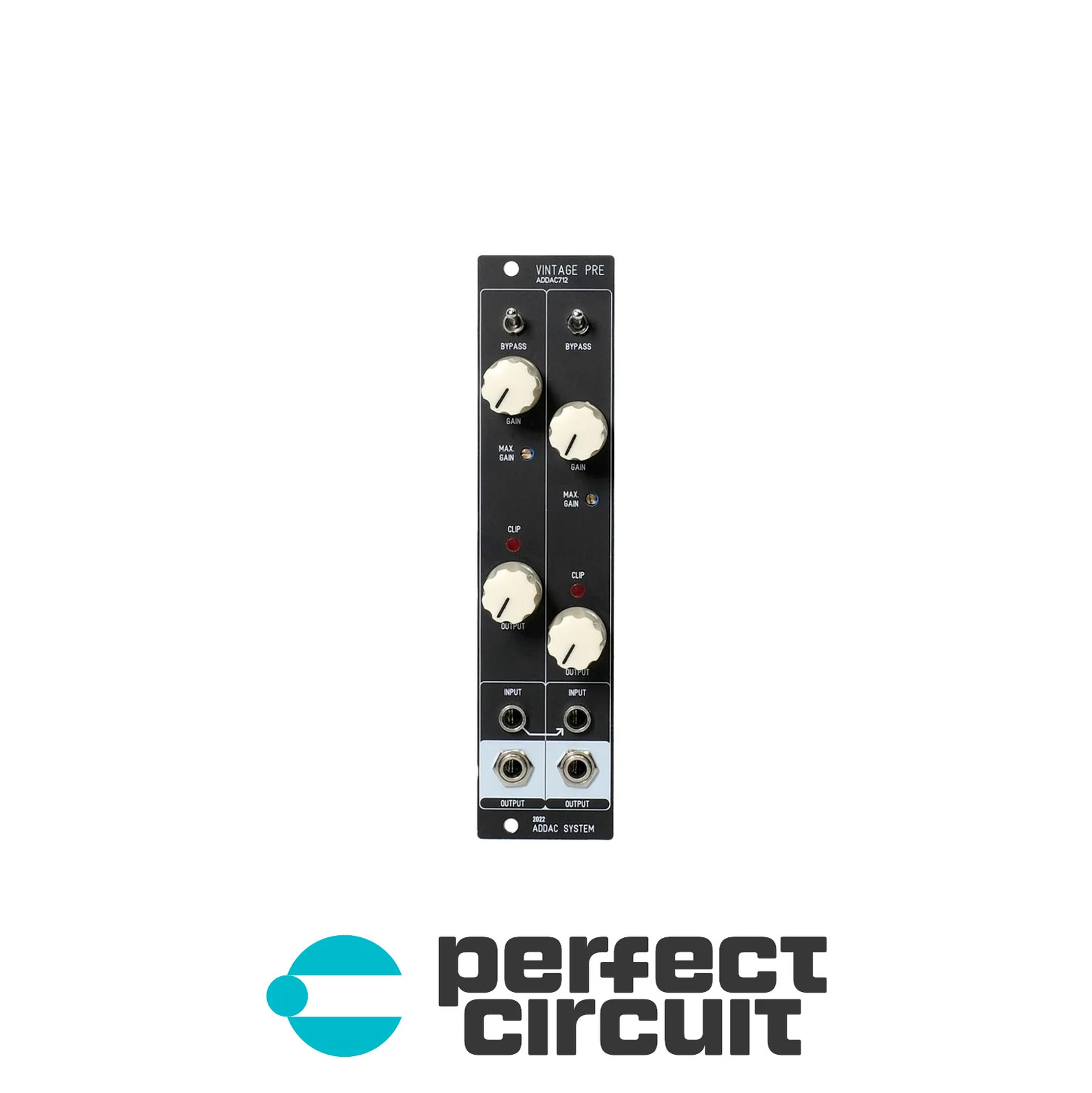
Positioned in the ADDAC 700 Series as a dual-channel analog heritage module, the 712 splits its identity between utility and color. On paper, it’s a gain staging amplifier—something you’d use to boost weak signals before they hit a filter or VCA. But in practice, it’s a distortion engine with surgical precision. Each channel features independent input and output jacks, with the left input normalled to the right, making stereo operation effortless. The front panel is minimal: a bypass switch, gain knob, output knob, and a single LED that glows when the output stage clips. Behind the gain knob sits a trimmer labeled MAX GAIN, letting users recalibrate the input threshold—critical for taming or unleashing the module’s saturation behavior depending on whether you’re feeding it modular-level signals or something line-level from a keyboard or guitar.
What makes the 712 stand out in a market flooded with Eurorack distortion is its dual-stage design. The first stage is the discrete transistor gain amplifier—the heart of the vintage circuit—where the real saturation happens. The second is an op-amp-based output stage that lets you pull back the level after the signal has been thoroughly abused. This two-stage approach gives you surgical control: you can drive the input into full-on fuzz and then dial the output down to line level without losing the harmonic complexity. It’s the difference between a distortion pedal that just blasts your signal and a studio preamp that shapes tone with intention. And because it’s discrete—not op-amp-based from the start—it behaves more like a Neve 1073 or API 312 than a modern op-amp clipper. It’s got weight, body, and a slow, organic breakup that digital models still struggle to replicate.
Specifications
| Manufacturer | ADDAC System |
| Production Years | 2022– |
| Original Price | 140€ (assembled), 81€ (DIY kit, excl. VAT) |
| Format | Eurorack |
| Width | 6HP |
| Depth | 40mm |
| Power Consumption +12V | 40mA |
| Power Consumption -12V | 40mA |
| Channels | Dual |
| Circuit Type | Discrete transistor gain stage, op-amp output stage |
| Input Signal Type | Modular, line, instrument (guitar, keyboard) |
| Input Impedance | Not specified |
| Output Impedance | Not specified |
| Gain Control | Manual [GAIN] knob with user-adjustable [MAX GAIN] trimmer |
| Output Control | Manual [OUTPUT] knob |
| Bypass | Mechanical switch (top position: active, bottom: bypassed) |
| Clipping Behavior | Soft saturation beyond ±5.5V, hard clipping at ±6V with 0V bias drift |
| Clipping Indicator | LED on output stage |
| Normalization | Left input normalled to right input |
| DIY Option | Available as SMD pre-soldered kit (SMD-Kit-1) |
Key Features
The Discrete Heart of the 70s
The 712’s foundation is its discrete transistor amplifier stage, modeled after a “famous discrete preamp board from the 70’s used in some legendary equipment.” ADDAC won’t say which one, but the behavior—especially the bias drift under heavy clipping—strongly suggests it’s inspired by transformer-coupled or Class-A discrete designs common in high-end British and American consoles of that era. Unlike op-amp-based preamps that clip symmetrically and cleanly, this circuit distorts asymmetrically, generating rich even-order harmonics that feel warm and musical rather than harsh. At moderate gain, it adds a subtle thickness, like tape saturation. Push it further, and it starts to compress, then saturate, then finally clip with a character that feels alive—slightly unstable, yes, but in a way that enhances musicality. The bias shift at extreme levels isn’t a bug; it’s a feature. It creates a pulsing, amplitude-modulated effect that can turn a steady drone into something rhythmic, almost like a tremolo or gate, but born purely from analog overload.
Dual-Stage Gain Architecture
Most Eurorack distortion modules are one-trick ponies: you turn a knob, the signal clips, and that’s it. The 712 breaks that mold with its two-stage design. The first stage is all about color and aggression—this is where the discrete circuit lives, where the signal gets bent out of shape. The second stage, built around an op-amp, is purely about level control. It has its own gain knob and a clipping LED, but its main job is to let you tame the output without sacrificing the tonal changes upstream. This means you can fully saturate a kick drum in the first stage, then pull the output down so it doesn’t clip your mixer or ADC, preserving the punch and harmonic content without the digital red. It’s a studio-grade approach to distortion, not just a “fuzz for fun” module. And because the output stage is op-amp-based, it’s cleaner and more predictable, giving you a stable endpoint after the chaos of the first stage.
Bypass That Actually Works
The bypass switch isn’t just a toggle—it’s a signal router. In the up position (“Effect”), the signal runs through the full gain path. In the down position (“Bypassed”), it skips the first stage entirely and routes directly to the output gain stage. That means even in bypass, you still have access to the output level control, which is useful if you’re using the module as a simple line amplifier. This isn’t true “true bypass” in the pedal sense—there’s still a path through the op-amp—but it’s smarter than most Eurorack modules, which either don’t bypass at all or mute the signal completely. Here, you retain level control and signal integrity when the effect is off, making it more versatile as a utility module.
Historical Context
The ADDAC 712 Vintage Pre arrived in late 2022 as part of a wave of “analog heritage” modules aimed at capturing the sound of pre-digital audio electronics. At a time when Eurorack was saturated with digital waveshapers, granular processors, and algorithmic effects, the 712 stood out by going backward—rebuilding a lost analog topology from the transistor era. It shares DNA with modules like the WMD Analog Circuit Path and the Intellijel Rainmaker Preamp, but where those focus on clean gain or subtle color, the 712 leans into the flaws: the bias drift, the asymmetry, the slow transient response. It’s not trying to be transparent; it’s trying to be characterful.
The choice to base it on an unnamed 1970s preamp board speaks to a broader trend in modular synthesis: the fetishization of vintage circuitry. Manufacturers no longer just emulate old gear—they reverse-engineer it, sometimes down to the component level. ADDAC didn’t just “get inspired” by vintage preamps; they cloned a specific topology, likely from a console or recorder that defined the sound of an era. The refusal to name it adds to the allure, but it also suggests legal caution—many of these circuits are still under patent or trademark protection, or at least guarded by companies like Neve or API. By staying vague, ADDAC avoids lawsuits while still delivering the goods.
Competitors in this space include the Happy Nerding FX Aid, which offers multiple clipping types, and the ALM O/A, a dual overdrive with feedback paths. But the 712 is simpler, more focused. It doesn’t have tone controls, feedback loops, or multiple clipping modes. It’s a purist’s tool: gain in, color out. That simplicity is its strength. In a system full of complex modules, the 712 is a grounding force—a reminder that sometimes all you need is a good preamp to make everything sound better.
Collectibility & Value
The ADDAC 712 Vintage Pre is too new to be a vintage collectible, but it’s already gaining cult status among modular users who value analog authenticity over digital flexibility. As of 2026, the assembled module sells for around €140 directly from ADDAC, while the DIY kit goes for €81 (excluding VAT). On the secondhand market, used units trade between €120 and €160 depending on condition and whether they’re assembled by the seller. Because it’s a relatively simple module with no moving parts beyond the switch and pots, failure rates are low—but the DIY nature of the kit version means poor soldering jobs are the most common issue. Buyers should check for cold joints, especially on the power pins, and verify that the MAX GAIN trimmer functions correctly.
One thing to watch for: the bias drift behavior, while musically useful, can cause problems in DC-coupled systems. If you’re using the 712 to process CV signals (which some adventurous users do), the shifted 0V reference can throw off tracking or cause unintended modulation. It’s designed for audio, not control voltage, and pushing it beyond that role risks instability. Also, because it’s a gain stage, it can amplify noise if fed a dirty signal—this isn’t a module that cleans things up. It makes everything louder, including hiss, hum, and crosstalk.
For collectors, the 712’s value lies in its specificity. It’s not a general-purpose distortion; it’s a character module with a very particular flavor. Those who love the sound of overdriven analog consoles—especially the slow, warm breakup of British gear—will find it indispensable. Those looking for tight, modern fuzz or digital-style bitcrushing should look elsewhere. Maintenance is minimal: just keep the jacks and pots clean, and avoid exposing the DIY version to moisture during assembly. No capacitors or active components are known to degrade prematurely, so long as the module is properly built and powered.
eBay Listings
As an eBay Partner, we earn from qualifying purchases. This helps support our independent vintage technology research.