ADDAC System ADDAC714 (2022–)
Two channels of analog warmth that don’t just clip—they color, breathe, and gently throttle your signal like a vintage tape path with attitude.
Overview
Plug a clean, digital oscillator into the ADDAC714 and turn the Gain knob past noon—you’ll feel it before you hear it: a soft resistance, like pushing your hand through warm syrup, followed by a bloom of harmonics that don’t scream “distortion” but whisper “aged.” That’s the magic of this unassuming 6HP module. It doesn’t emulate vintage gear with algorithms or convolution; it just is vintage-sounding, thanks to a passive diode clipping circuit pulled straight from the physics of old-school analog design. No DSP tricks, no menu diving—just silicon and resistors doing what they’ve done since the 1970s. The result? A saturation that feels organic, almost alive, whether you’re barely kissing the clipping threshold or driving it into a warm, woolly overdrive.
Designed as part of ADDAC System’s 700 Series—labeled “Analog Heritage” for good reason—the ADDAC714 sits in a sweet spot between utility and character. It’s not a wild fuzz, not a surgical wavefolder, not a bit-crusher in disguise. It’s a soft clipper, yes, but one with a fixed 3.3kHz low-pass filter that subtly rounds off the top end, giving it a distinctly retro timbre reminiscent of early samplers or overdriven tape preamps. That filter isn’t user-adjustable, and that’s the point: it’s baked into the circuit to shape the tone in a way that feels cohesive and musical, not clinical. You’ll notice it most on crisp hi-hats or FM bells—those high-frequency transients get gently tamed, which can be a blessing or a curse depending on your patch. If you want to blast your mix with digital clarity, look elsewhere. But if you’re chasing the smeared, slightly muddy warmth of an E-Mu SP-1200 or an Akai S1000 pushed into the red, the ADDAC714 gets you there with two knobs and a toggle.
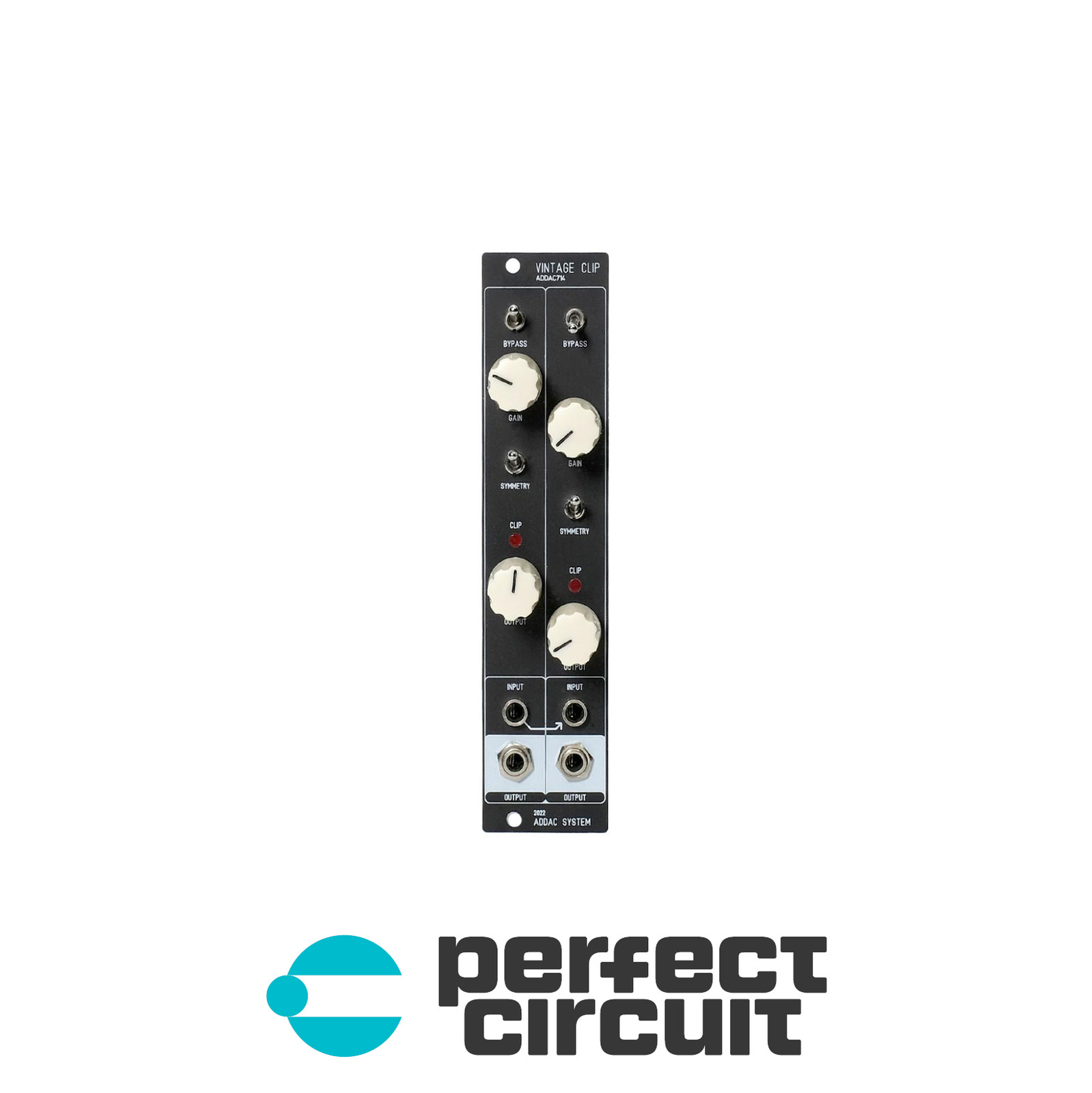
Each of the two channels is identical and normalled, meaning you can run stereo signals or use them independently for dual processing. The topology is elegantly simple: input → bypass switch → gain stage → symmetry toggle → passive diode clipper → fixed low-pass filter → output gain stage with x2 amplification and LED clipping indicator. The gain control acts more like a threshold—you turn it up to push the signal into the diodes, where it gets gently squashed. As the signal clips, its amplitude drops, so ADDAC added a gain compensation stage to keep output levels consistent across the range. That’s thoughtful engineering: you can crank the distortion without suddenly blasting your downstream gear. The output knob then lets you fine-tune the final level, and the LED gives you visual feedback when the output stage itself is clipping—useful for dialing in that sweet spot between warmth and obliteration.
Specifications
| Manufacturer | ADDAC System |
| Production Years | 2022– |
| Original Price | €130 (assembled), €77 (DIY kit, excl. VAT) |
| Format | Eurorack |
| Width | 6HP |
| Depth | 40mm |
| Current Draw +12V | 40mA |
| Current Draw -12V | 40mA |
| Channels | Dual |
| Clipping Type | Passive diode clipping (soft) |
| Symmetry Options | Bipolar (odd and even harmonics), Unipolar (odd harmonics only) |
| Filter | Passive RC low-pass, -3dB at 3.3kHz |
| Gain Compensation | Yes, maintains output level across gain range |
| Output Gain | Op-amp based x2 stage with level control |
| Bypass | Per-channel switch (mechanical bypass) |
| Inputs | Normalled left to right (1/4" TS jacks) |
| Outputs | Per-channel (1/4" TS jacks) |
| Status Indicators | Clipping LED per channel (output stage) |
| DIY Option | Available as SMD kit with pre-soldered surface-mount components |
Key Features
Passive Diode Clipping with Character
The heart of the ADDAC714 is its passive diode clipping circuit—a design choice that avoids active components in the clipping path, relying instead on the inherent nonlinear behavior of silicon diodes to gently limit the signal. This isn’t a hard clipper; it’s a “brick wall” with give, where the knee is soft and the harmonics build gradually. What sets it apart is the lack of op-amps in the clipping stage, which preserves transient detail while still adding warmth. The diodes create a natural compression that feels more like analog tape saturation than digital distortion. Because it’s passive, there’s no headroom to “hit”—instead, the gain knob adjusts how much of the signal spills into the diodes. Turn it up, and the waveform gets softly rounded, adding both second- and third-order harmonics depending on the symmetry setting. It’s subtle at low settings, transformative at high ones, and never harsh.
Symmetry Toggle: Odd vs. Even Harmonic Control
One toggle per channel lets you switch between bipolar (symmetrical) and unipolar (asymmetrical) clipping—effectively choosing between a richer, more complex harmonic profile and a gnarlier, more aggressive one. In bipolar mode, both positive and negative halves of the waveform are clipped equally, generating both odd and even harmonics. This sounds warm, full, and balanced—ideal for thickening pads or adding subtle grit to a mix. Flip it to unipolar, and only the positive half is clipped, producing primarily odd harmonics. This gives a more nasal, mid-forward character, closer to tube overdrive or a fuzz pedal. It’s a simple switch, but it dramatically changes the module’s voice. Patch a sine wave in, flip the toggle, and you’ll hear a fundamental shift from smooth warmth to buzzy bite. It’s rare to see this level of harmonic control in such a compact module, and it makes the 714 far more versatile than its minimal front panel suggests.
Fixed 3.3kHz Low-Pass Filter: The Secret Sauce
Buried in the signal path is a passive RC low-pass filter set to -3dB at 3.3kHz. It’s not advertised as a feature, but it’s arguably the most defining aspect of the 714’s sound. This filter gently rolls off the highs, mimicking the bandwidth limitations of vintage gear. It’s why the module sounds “old” even when you’re not pushing it hard. On percussive sources, it softens transients and tames sibilance; on synths, it rounds off FM edges and smooths out digital oscillators. Some users report it can make complex mixes sound “muddy” if overused—especially in hip-hop or IDM where high-frequency detail matters. But that’s not a flaw; it’s a character trait. Think of it like using a Neve console: you’re not just adding gain, you’re engaging a sonic fingerprint. If you need pristine high end, bypass the 714 or use it selectively. But if you want to make your modular rig sound like it was recorded in 1984, this filter is doing half the work before the clipping even starts.
Historical Context
The ADDAC714 didn’t emerge in a vacuum. It arrived in late 2022, a time when Eurorack was overflowing with digital waveshapers, granular distortions, and multi-mode processors with endless parameters. Against that backdrop, the 714 felt like a quiet rebellion—a return to analog simplicity at a time when “more features” often meant “more menus.” ADDAC System, a Lisbon-based builder known for hybrid digital-analog designs, leaned into their “Analog Heritage” line with this module, clearly inspired by the discrete preamp and clipping circuits of 1970s studio gear. While they haven’t disclosed the exact vintage unit that inspired the design, the sonic DNA points to classic tape machines, tube limiters, and early analog samplers where bandwidth and headroom were limited by physics, not design choice.
Competitors like the WMD Pedals Geiger Counter or the 4ms Dual Looping Delay with Shuffling offered more aggressive, experimental distortion, but the 714 carved its niche by being subtle, musical, and skiff-friendly. It wasn’t trying to be a star; it was trying to be a tool—one that could live in the background, adding warmth to a mix bus or giving a dull oscillator some vintage patina. At a time when many modules were becoming software in hardware form, the 714 stood out by doing one thing well, with no firmware updates, no presets, no USB ports. It was a reminder that sometimes, the best way to sound “vintage” is to just use vintage-style circuits.
Collectibility & Value
The ADDAC714 isn’t a rare bird—yet. Since its release in 2022, it’s been consistently available through ADDAC’s direct store and a network of European and North American distributors. As of 2026, used prices hover between €100 and €130, depending on condition and whether it’s assembled or a DIY kit. The DIY version, priced at €77 (excl. VAT), is popular among builders and comes with pre-soldered SMD parts, making it accessible even to those with moderate soldering skills. The build quality is solid: black anodized aluminum panel, tactile knobs, and reliable jacks. Failures are rare, but the most common issue reported is incorrect assembly in DIY builds—particularly around the power connections. Owners are advised to test for shorts before first use, ideally in a powered test case.
There are no known chronic failures in factory-built units, and the passive nature of the clipping circuit means fewer points of failure compared to active distortion modules. The fixed low-pass filter, while a defining characteristic, is also a limitation—if you need high-frequency preservation, this isn’t the module for you. Some users pair it with the ADDAC712 Vintage Pre, which offers discrete gain staging without the filter, creating a complementary signal chain for coloring and driving external sources. The 714’s collectibility is modest: it’s not a “grail” module, but it’s respected among engineers and performers who value analog warmth without complexity. Its real-world utility—especially for live mix bus saturation—keeps it in rotation, not in a display case.
eBay Listings
As an eBay Partner, we earn from qualifying purchases. This helps support our independent vintage technology research.