ADDAC714 Vintage Clip (2023–)
A dual-channel soft clipper that doesn’t just squash your signal—it seasons it with vintage grit, harmonic depth, and a fixed low-pass filter that feels like dust on an old tape head.
Overview
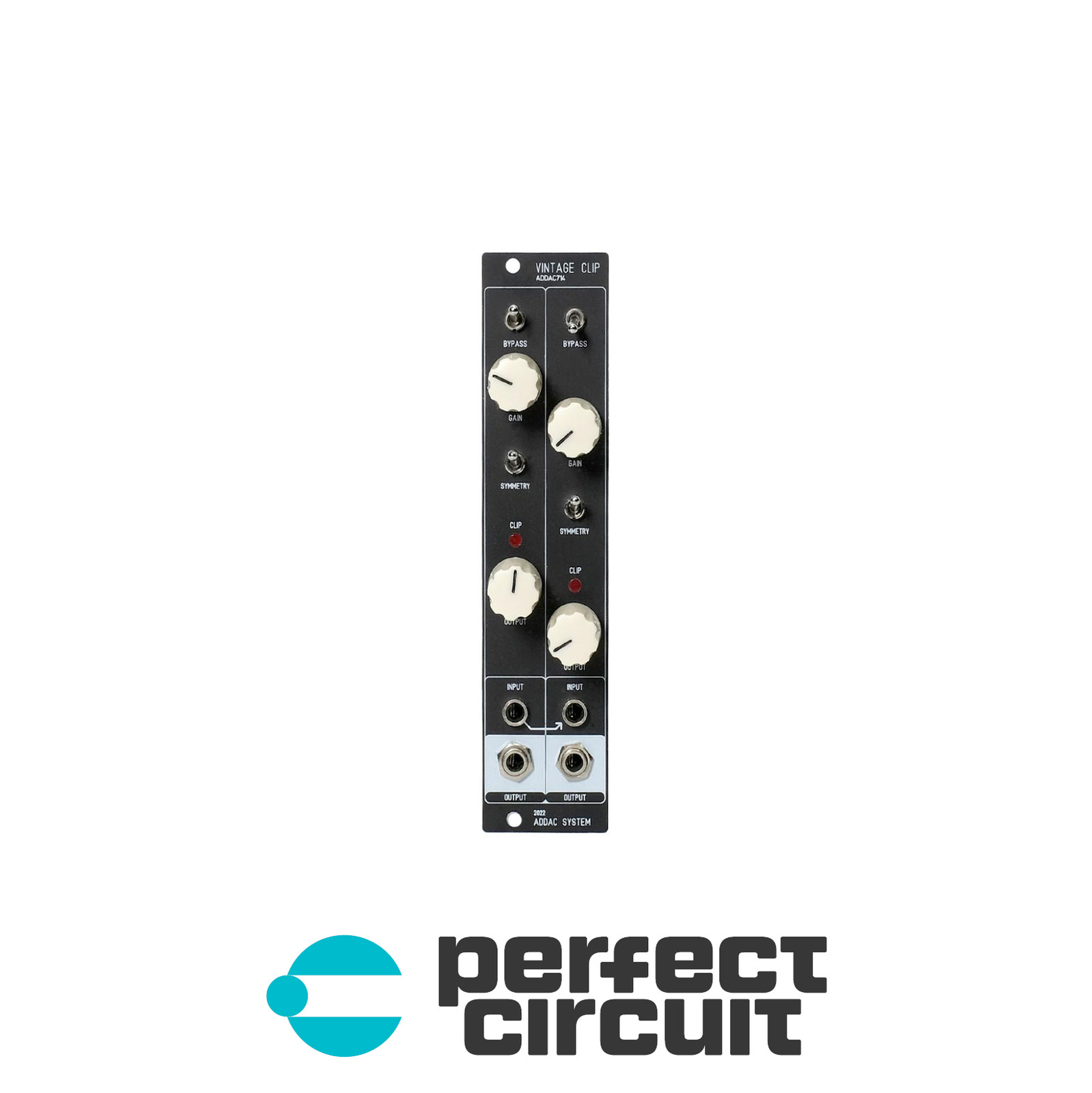
There’s a moment in every modular rack when things get too clean—when the oscillators are pristine, the filters are surgical, and the sequencers click with robotic precision. That’s when you reach for the ADDAC714 Vintage Clip, not because you want to destroy the signal, but because you want to humanize it. This isn’t digital distortion that fizzles and fractures; it’s analog soft clipping with character, built around passive diode circuits that gently round off peaks like a well-worn tube stage. Each of its two channels behaves like a tiny, self-contained saturation engine, complete with gain staging, symmetry switching, and output control—so you can dial in subtle warmth or push into full-on harmonic bloom without losing control of your levels.
What sets the 714 apart from the sea of Eurorack distortions isn’t just its dual-channel flexibility, but its fixed 3.3kHz low-pass filter. There’s no knob for it, no CV control—just a permanent tonal sculptor that rolls off the top end in a way that mimics the natural bandwidth limits of vintage synths and tape machines. It doesn’t just clip; it *ages* the sound. The result is a distortion that never gets harsh, even when driven hard. Instead of turning your patch into a screeching mess, it adds a woolly, rounded saturation that feels like it’s been pulled from a ’70s console buss. And because the channels are normalled, you can easily run a stereo signal or chain them for cascaded clipping—though most users find that one stage is enough to transform a lifeless waveform into something with body and breath.
Despite being released in 2023, the 714 fits the Vintage Technology Archive not because of its age, but because of its intent: it’s a deliberate throwback to the sonic philosophy of older gear, built with passive components and discrete signal paths that prioritize texture over transparency. It doesn’t emulate vintage gear—it *invites* you to think like you’re using it.
Specifications
| Manufacturer | ADDAC System |
| Production Years | 2023– |
| Original Price | €100 (kit), ~£137 (assembled) |
| Format | Eurorack |
| Width | 6 HP |
| Depth | 40 mm |
| Power Consumption | 40 mA on +12V, 40 mA on -12V |
| Channels | Dual, normalled |
| Clipping Type | Diode-based passive soft clipping |
| Clipping Modes | Bipolar (odd and even harmonics), Unipolar (odd harmonics only) |
| Filter | Passive RC low-pass, -3dB at 3.3kHz |
| Controls | Gain, Output, Bypass switch, Symmetry switch per channel |
| Indicators | Clipping LED per channel |
| Inputs | 1/8" (3.5mm) jack, stereo with left normalled to right |
| Outputs | 1/8" (3.5mm) jack per channel |
| Gain Stages | Input gain with clipping, op-amp-based x2 output gain |
| Build Type | Available as DIY kit (SMD pre-soldered) |
| Country of Origin | Portugal |
Key Features
Passive Diode Clipping with Fixed Knee
The heart of the ADDAC714 is its diode-based clipping circuit, which operates passively—meaning no active gain elements are involved in the clipping stage itself. This creates a “brick wall” effect governed by the inherent voltage drop of the diodes, resulting in a smooth, predictable saturation curve. Unlike overdrive circuits that gradually compress, the 714 bites with a firm but musical threshold. Because it’s passive, the signal loses amplitude as it clips, so ADDAC added a compensating gain stage after the clipper to maintain consistent output levels across the gain range. This means you can crank the input for heavy distortion without suddenly blasting your mixer or downstream modules.
Symmetry Switch for Harmonic Control
One of the most expressive features is the symmetry switch on each channel, which toggles between bipolar and unipolar clipping. In bipolar mode (switch up), the waveform is clipped symmetrically on both positive and negative peaks, generating both odd and even harmonics—this produces a richer, more complex distortion that can add warmth or grit depending on the source. Flip it to unipolar (switch down), and only the positive half of the waveform is clipped, emphasizing odd harmonics for a more nasal, aggressive character. This isn’t just a tone switch—it fundamentally changes the harmonic DNA of your sound, making it easy to go from vintage tube-like saturation to something closer to a fuzzed-out bass synth.
Fixed 3.3kHz Low-Pass Filter
While most distortion modules let high-frequency artifacts run wild, the 714 includes a passive RC low-pass filter set at -3dB at 3.3kHz. There are no controls—this is baked into the design. At first, that might seem limiting, but it’s actually the secret sauce. That frequency point is carefully chosen to mimic the natural roll-off of analog tape and older analog gear, preventing the clipped signal from becoming fizzy or fatiguing. It’s why the 714 can handle digital waveforms, FM, or high-pitched noise and still come out sounding organic. It’s not a filter you tweak—it’s a filter you *trust*.
Historical Context
The ADDAC714 Vintage Clip emerged in 2023 as part of a broader shift in Eurorack toward “anti-digital” modules—devices designed to counteract the clinical precision of digital oscillators, sequencers, and effects. At a time when many racks were filled with FM, granular, and wavetable synthesis, the 714 offered a grounding force: analog warmth with no presets, no menus, no firmware updates. It arrived alongside its sibling, the ADDAC712 Vintage Pre, both of which drew inspiration from discrete transistor circuits of the 1970s, particularly those found in classic mixing consoles and outboard gear. ADDAC didn’t model these circuits in software—they built physical analog stages that behave like the real thing.
In this sense, the 714 isn’t competing with digital distortion plugins or DSP-based modules. It’s positioned against the very nature of modern modular synthesis itself. While companies like Intellijel and Make Noise were exploring complex modulation and digital-analog hybrids, ADDAC went the opposite direction: minimalism, transparency, and sonic character through component-level design. The 714 fits alongside modules like the WMD Metasonix-inspired kits or the Industrial Music Electronics Ravioli, but with a more accessible footprint and price point. It’s not the first soft clipper in Eurorack, but it’s one of the few that treats filtering as an inseparable part of the distortion process.
Collectibility & Value
As of 2026, the ADDAC714 Vintage Clip remains in production and is not a rare module, but it has developed a quiet reputation among modular users who value subtlety over spectacle. The DIY kit version sells for around €100, while assembled units typically go for £130–£150, depending on the seller. Because it’s a recent design, it doesn’t carry the premium of vintage-labeled modules from brands like Doepfer or Analogue Solutions, but its build quality and sonic character have earned it a permanent spot in many touring and studio racks.
The most common version found on the secondhand market is the full DIY kit from retailers like Thonk and Exploding Shed. These kits are labeled “SMD-Kit-1,” meaning all surface-mount components are pre-soldered, and only through-hole parts (jacks, pots, switches) require assembly. For hobbyists, this makes it an easy-to-build project; for buyers, it means used units are often well-constructed and reliable. Failures are rare, but service technicians note that the most vulnerable points are the 3.5mm jacks, which can loosen over time with frequent patching. The clipping LEDs are also small surface-mount types, which can fail if the module is subjected to power spikes—though the current draw is modest (40mA per rail), so it’s not a common issue.
When buying used, check that both channels respond evenly to input signals and that the symmetry switch clicks cleanly between modes. Some early units had inconsistent potentiometer taper on the output controls, but this was addressed in later production runs. Because the module has no trimmers accessible from the front panel (aside from an internal gain max trim on the 712, not the 714), there’s little to adjust post-build. What you get is what it does—and that’s part of its appeal.
For collectors, the 714 isn’t a “grail” module, but it’s increasingly seen as a staple—a “desert island” distortion for those who prefer character over control. It won’t fetch hundreds on eBay, but it also won’t disappoint. In a world of over-engineered modules, its simplicity is its legacy.
eBay Listings
As an eBay Partner, we earn from qualifying purchases. This helps support our independent vintage technology research.