ADDAC System 800X (2013–Present)
A hush settles over your modular rig the moment you flip the ground lift switch—suddenly, the hum vanishes, the stereo image snaps into focus, and your outputs sound like they’ve been dipped in studio-grade silence.
Overview
It’s not often you find a module that does one job, does it perfectly, and still manages to feel like a revelation. The ADDAC 800X isn’t flashy. It doesn’t generate sound, modulate it, or sequence it. But plug your modular into it, and you’ll swear your entire system just got a firmware update. This is a high-end output module built like a vintage broadcast piece—transformer-isolated, dead-quiet, and engineered to solve the one problem every modular owner eventually faces: noise. Ground loops, impedance mismatches, RF interference—these aren’t just annoyances, they’re creativity killers. The 800X doesn’t just reduce them; it surgically removes them, leaving behind a clean, balanced, professional-grade signal that behaves exactly as it should when hitting a mixer, interface, or recorder.
At its heart is a pair of nickel-core Hammond 140UEX audio transformers—same lineage as Jensen, same pedigree as the ones found in Neve and API gear from the 70s. These aren’t off-the-shelf parts; they’re chosen for their ability to maintain signal integrity across the full 20Hz–20kHz range while rejecting common-mode noise and DC offset. That’s why the 800X doesn’t just pass audio—it purifies it. The result? Outputs that feel authoritative, neutral, and free from the slight brittleness or veiled character some solid-state output modules impart. Owners report a subtle warmth in the low end, not from coloration, but from the way the transformer preserves transient detail and phase coherence. It’s not “vintage sounding” in the nostalgic sense—it’s accurate in the way a well-calibrated monitor should be.
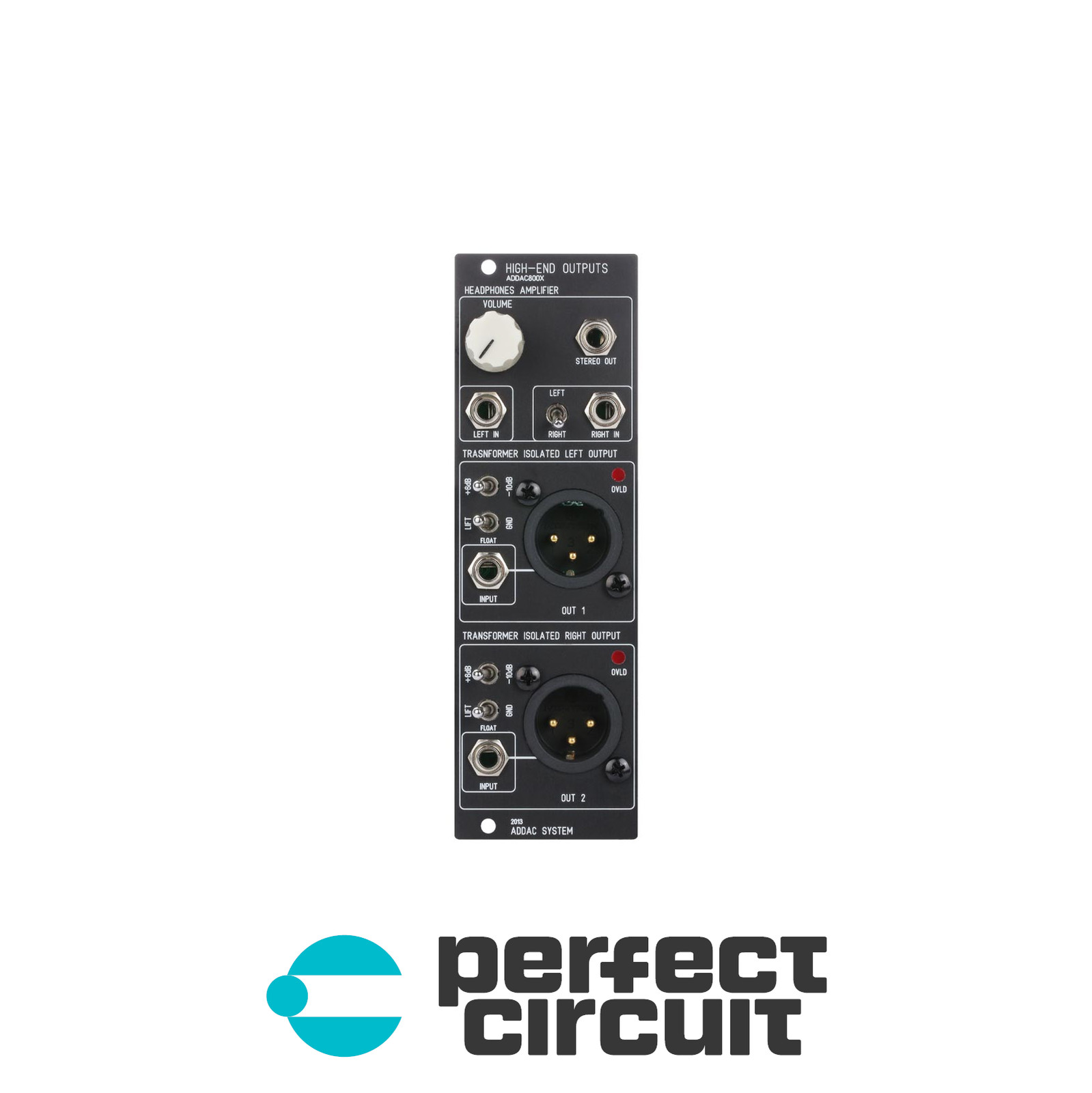
And then there’s the headphone amp. Tucked in the corner with its own volume knob, it’s easy to overlook, but it’s a game-changer for live use or late-night patching. Driven by an OPA2134 op-amp—known for its ultra-low distortion and high output drive—it delivers a clean, dynamic cue signal without coloring what you’re about to send out. No need to patch through a mixer or interface just to check your patch. Just plug in, turn the knob, and listen. It’s the kind of thoughtful detail that suggests this wasn’t designed by committee, but by someone who’s wrestled with ground hum at 2 a.m. and decided enough was enough.
Specifications
| Manufacturer | ADDAC System |
| Production Years | 2013–Present |
| Original Price | €415 / $499 |
| Format | Eurorack |
| Width | 8 HP |
| Depth | 6.7 cm (67 mm) |
| Max Current Draw | 100 mA on +12V, 100 mA on -12V |
| Power Connector | 8-pin IDC (Doepfer style) |
| Inputs | Left IN (1/4"), Right IN (1/4") |
| Outputs | 2x XLR (balanced, transformer-isolated) |
| Headphone Output | 1/4" stereo jack |
| Frequency Response | 20 Hz – 20 kHz |
| Transformer Type | Hammond 140UEX series, nickel core, 1:1 unity ratio |
| Attenuation/Padding | Toggle switches: +6 dB / -10 dB per output |
| Ground Configuration | 3-way toggle per output: Lift, Float, Ground |
| Signal Indicators | Overload LED per output |
| Headphone Amplifier | OPA2134 high-performance audio op-amp |
| Panel Color | Black (standard), custom colors available |
Key Features
Transformer-Isolated Outputs
The 800X’s defining feature isn’t just that it has XLR outputs—it’s that they’re transformer-isolated, which means real galvanic separation between your modular and the outside world. Unlike active balancing or op-amp-based isolation, a transformer physically breaks the electrical connection, stopping ground loops in their tracks. The Hammond 140UEX transformers are the star here: they handle the full audio spectrum without phase shift or high-frequency roll-off, and their shielding is excellent. This isn’t just about noise reduction—it’s about preserving the integrity of your signal path. When you’re dealing with complex, high-impedance modular outputs, impedance mismatches can dull transients or cause frequency anomalies. The 800X’s transformers act as impedance matchers, ensuring your signal arrives at the destination exactly as it left the oscillator or filter.
Flexible Signal Routing & Ground Control
The routing options are deceptively powerful. The LEFT IN feeds both outputs by default, while RIGHT IN only goes to OUT 2—unless you flip the LEFT/RIGHT toggle, in which case RIGHT IN is ignored and LEFT IN is sent to both. This lets you run a stereo signal through both inputs, or use the module as a dual mono output with independent processing. Each output has its own +6 dB / -10 dB pad, which is incredibly useful when interfacing with pro audio gear. Set to +6 dB, the output level matches professional line-level standards, letting you drive a mixer or interface without cranking the input gain and introducing noise. The -10 dB setting is perfect when you’re feeding consumer gear or need to tame a particularly hot signal.
But the real magic is in the 3-way ground toggle: Lift, Float, or Ground. This is where the 800X earns its keep in complex setups. In Lift mode, the ground is connected through a 100k resistor and 10nF capacitor—just enough to prevent static buildup without creating a direct loop. Float completely isolates input and output grounds, which can be crucial in multi-rack systems. Ground ties them together, useful when you’re working in a single, well-bonded system. There’s no “correct” setting—it depends on your rig, your cables, your room. But having the option to audition all three? That’s the difference between guessing and solving.
Integrated Headphone Amplifier
In a world where most output modules make you patch through a mixer or interface to monitor, the 800X’s built-in headphone amp is a quiet luxury. It’s not an afterthought—the OPA2134 op-amp is a studio-grade component, known for its clarity and drive. It handles high-impedance headphones without strain, and the volume knob is smooth and precise. This isn’t just for silent patching; it’s for confidence. You can pre-listen your mix before sending it to a PA or recording interface, catch clipping before it hits the tape, or just enjoy your patch without waking the neighbors. It’s the kind of feature that seems minor until you’ve used it, and then you wonder how you ever lived without it.
Historical Context
The 800X arrived in 2013, right as Eurorack was shifting from boutique curiosity to mainstream force. As more musicians brought modular into studios and live rigs, the limitations of basic output modules became glaring. Many early solutions were simple passive mixers or unbalanced outputs—fine for headphone monitoring, but disastrous when plugged into a mixing console or audio interface. Ground loops, hum, and RF interference plagued recordings, and the modular community started demanding better. Companies like Vermona and Joranalogue responded with transformer-coupled outputs, but few matched the 800X’s combination of vintage-inspired engineering and modern usability.
ADDAC System, a Portuguese company known for its thoughtful, no-compromise designs, didn’t try to reinvent the wheel—they went straight to the source. The Hammond 140UEX transformer has been a staple in high-end audio since the 1970s, prized for its durability and sonic neutrality. By building around it, ADDAC wasn’t chasing hype—they were offering a solution rooted in decades of broadcast and studio practice. At a time when many Eurorack modules were prioritizing novelty over reliability, the 800X stood out as a tool for professionals. It wasn’t the cheapest option, but it wasn’t trying to be. It was built for people who needed their modular to behave like the rest of their studio gear: predictably, quietly, and without compromise.
Collectibility & Value
The ADDAC 800X isn’t a “collector’s item” in the traditional sense—no limited runs, no exotic finishes, no celebrity endorsements. But it’s quietly become a staple in high-end modular systems, and that’s given it a kind of functional collectibility. Used units in good condition typically sell for $350–$425, depending on market availability and whether they’ve been modified. New units still carry the original €415 price tag, though some dealers list them closer to $499, especially in North America. Unlike many Eurorack modules that depreciate quickly, the 800X has held its value well—proof that utility, when executed perfectly, is its own kind of rarity.
Failures are rare, but not nonexistent. The most common issue reported is a malfunctioning ground toggle switch—usually due to dust or oxidation in the contacts. A quick cleaning with contact cleaner usually resolves it. The transformers themselves are nearly bulletproof, but they can be damaged by sustained overvoltage or improper grounding in extreme cases. The headphone amp is solid, but the OPA2134, while robust, can fail if the module is subjected to reverse polarity or power surges. Always check that the power cable is properly seated and that your case’s PSU is stable before blaming the 800X.
When buying used, test all three ground positions with a known noisy patch—if the hum doesn’t change, the transformer or switch may be compromised. Check the headphone output with a pair of high-impedance cans; if the sound is thin or distorted, the op-amp may need replacement. Otherwise, this is one of the most reliable output modules in Eurorack. It doesn’t need recalibration, doesn’t drift, and doesn’t wear out. It just works—quietly, consistently, and without drama.
eBay Listings
As an eBay Partner, we earn from qualifying purchases. This helps support our independent vintage technology research.