ADDAC System 714 (2022–)
A deceptively simple dual-channel soft clipper that imparts vintage warmth and harmonic grit with surgical precision—just don’t expect modern flexibility.
Overview
There’s a moment when you first crank the gain on the ADDAC 714 and your dry, clinical Eurorack mix suddenly sounds like it was pulled from a 1978 basement recording—warm, slightly fuzzy, and alive with second-order harmonics that cling like dust on vinyl. That’s the 714’s magic trick: it doesn’t just distort, it *ages* your signal, folding in the sonic patina of analog saturation without collapsing the dynamic core. This isn’t a module for extreme mangling or digital disintegration. It’s for color, for glue, for that subtle “something” that makes a sequence feel human instead of quantized to death. And despite its modest 6HP footprint, it punches far above its weight—especially if you’re chasing the ghost of E-Mu samplers, tape-saturated drum machines, or tube-driven preamps from the era when “warmth” wasn’t a marketing buzzword but a physical inevitability.
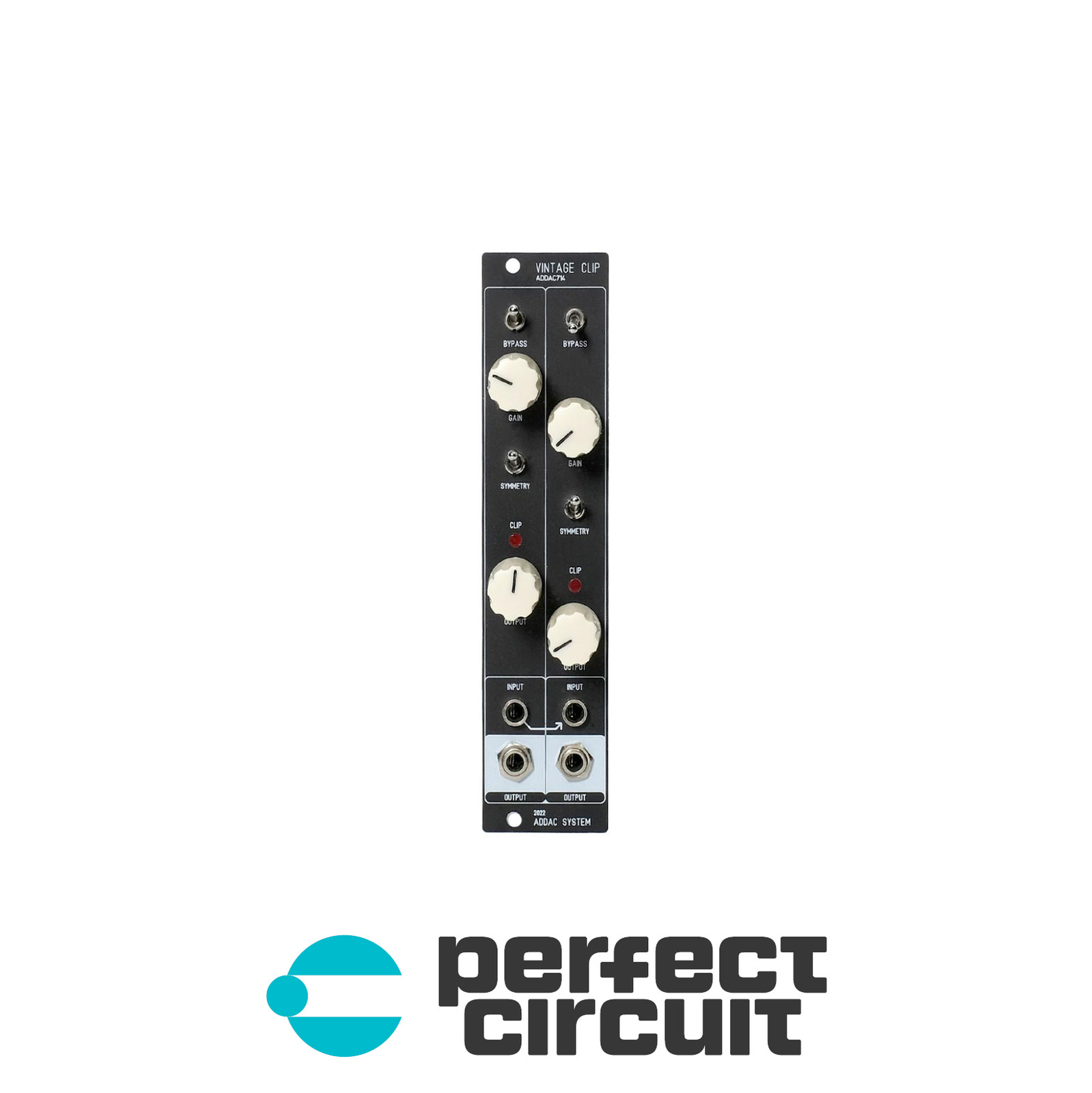
But let’s be clear: the 714 isn’t vintage in the sense of being old. It’s *new* gear designed to emulate a vintage *behavior*—specifically, the soft, diode-based clipping found in classic analog circuits. Built as a dual-channel module, it can run in stereo or dual mono, making it equally useful for processing full mixes or parallel-saturating individual voices. Each channel features independent gain and output controls, a symmetry switch for bipolar or unipolar clipping, and a hard bypass. The real character, though, comes from two behind-the-scenes elements: a passive RC low-pass filter fixed at 3.3kHz (-3dB point), and the diode-based clipping stage that acts as a “brick wall” limiter with a fixed knee determined by the diodes’ inherent physics. That filter is the secret sauce—it rolls off harsh high-mids and fizz before they even reach the clipping stage, ensuring that even at high gain settings, the distortion remains smooth, rounded, and musical rather than splintery or fatiguing.
Still, this is no set-and-forget color box. The 714 demands engagement. Because the gain control acts more like a threshold than a simple drive knob, you’ll need to balance input levels carefully—too hot, and you’ll hit hard clipping with little nuance; too low, and you’ll barely hear the effect. The output stage helps compensate, with a 2x op-amp gain stage that maintains level consistency across the gain range, but it won’t rescue a poorly fed signal. And while the symmetry switch offers meaningful tonal variation—bipolar (up) adds both odd and even harmonics for a fuller, more complex saturation, while unipolar (down) produces only odd harmonics for a leaner, more aggressive bite—it doesn’t change the fundamental character dictated by that 3.3kHz roll-off. If you’re after crisp, high-frequency-rich overdrive for snappy hats or FM textures, this isn’t your module. But if you want to make a digital sequencer sound like it’s breathing through analog lungs, the 714 delivers with rare authenticity.
Specifications
| Manufacturer | ADDAC System |
| Production Years | 2022– |
| Original Price | €100 (kit), €155 (assembled) |
| Format | Eurorack |
| Width | 6 HP |
| Depth | 40 mm |
| Power Consumption (+12V) | 40 mA |
| Power Consumption (-12V) | 40 mA |
| Channels | Dual (stereo or dual mono) |
| Clipping Type | Diode-based passive soft clipping |
| Clipping Modes | Bipolar (odd and even harmonics), Unipolar (odd harmonics only) |
| Low-Pass Filter | Passive RC, 3.3 kHz (-3dB) |
| Gain Control | Per channel, sets clipping threshold |
| Output Control | Per channel, 2x op-amp gain stage |
| Bypass | Per channel, toggle switch |
| Inputs | Left and Right (Left normalled to Right) |
| Outputs | Left and Right |
| Indicators | Clipping LED per channel |
| DIY Kit Type | SMD pre-soldered, through-hole assembly |
| Country of Origin | Portugal / European Union |
Key Features
Diode-Based Soft Clipping with Fixed Knee
The heart of the 714 is its passive diode clipping circuit, which behaves like a “brick wall” limiter with a fixed knee determined by the physical properties of the diodes themselves. Unlike op-amp-based soft clippers that can be tuned or adjusted, this design offers a consistent, predictable response—no surprises, but also no tweaking. The result is a smooth, organic saturation that builds gradually and avoids the harsh crossover distortion common in cheaper clipping circuits. Because it’s passive, it doesn’t add noise or color outside of the clipping behavior, making it transparent when bypassed and focused when engaged. It’s not the loudest or most aggressive distortion in the modular world, but it’s among the most musical, especially for signals that need warmth without chaos.
Integrated 3.3kHz Low-Pass Filter
What sets the 714 apart from other soft clippers is the passive RC low-pass filter baked into the signal path, rolling off at 3.3kHz with a gentle -3dB slope. This isn’t a user-adjustable EQ—it’s a permanent tonal sculptor, and it defines the module’s character. By attenuating high frequencies before they hit the clipping stage, it prevents the fizzy, grating artifacts that often plague overdriven digital sources. The trade-off? It’s not ideal for material that relies on high-end clarity. Hi-hats, FM bells, or crisp white noise will lose sparkle, and in dense mixes, the cumulative low-pass effect can make things sound muddy. But for basslines, pads, or full mixes where you want a cohesive, slightly lo-fi glue, this filter is a feature, not a flaw. It’s why users report success making modern MPCs sound like vintage E-Mu gear—the 714 doesn’t just add distortion, it recreates the bandwidth limitations of older systems.
Dual-Channel Flexibility with Symmetry Switching
With two independent channels, each with gain, output, bypass, and symmetry controls, the 714 offers real routing versatility. Run it in stereo to color an entire mix, or use it in dual mono to process two separate signals—say, a drum bus and a synth lead—with different clipping flavors. The symmetry switch is where tonal nuance lives: engaging bipolar clipping (switch up) generates both odd and even harmonics, creating a richer, more complex saturation reminiscent of tube amps. Flip it to unipolar (switch down), and you get only odd harmonics, yielding a thinner, more nasal grit that cuts through a mix. It’s a subtle but meaningful choice, and one that lets you dial in the harmonic profile to match the source material. The inclusion of a clipping LED on each channel is a small but welcome touch, giving visual feedback on signal intensity without needing a scope.
Historical Context
The ADDAC 714 emerged in late 2022 as part of a broader trend in Eurorack toward minimalist, character-driven utility modules—tools that do one thing exceptionally well rather than trying to be universal processors. At a time when multi-FX modules with endless algorithms dominate digital realms, the 714 stands in defiance: no DSP, no presets, no menus. It’s a return to the philosophy of analog signal processing, where the circuit itself is the algorithm. ADDAC System, based in Lisbon, has long straddled the analog-digital divide, but the 714 is a purely analog statement—a love letter to the discrete preamps and diode limiters of the 1970s, albeit built with modern reliability and Eurorack convenience.
It arrived alongside the ADDAC 712 Vintage Pre, a discrete gain staging amplifier inspired by classic 1970s preamp designs, suggesting a deliberate pairing: the 712 to amplify and color, the 714 to clip and limit. While the 712 draws from specific vintage hardware (though ADDAC hasn’t disclosed which), the 714 feels more like a distillation of an era’s sonic ethos than a direct clone. Competitors like the WMD Metasonix-inspired modules offer more extreme, tube-like distortion, while Make Noise’s Rook or ALM’s SSG-EG provide different flavors of saturation. But few match the 714’s combination of subtlety, stereo capability, and fixed low-pass shaping. It’s not trying to compete with boutique overdrives or granular manglers—it’s aiming for the sweet spot between transparency and character, where a mix gains soul without losing structure.
Collectibility & Value
As of 2026, the ADDAC 714 is too new to be considered “vintage” in the traditional sense, but it’s already carving a niche among collectors who value minimalist, high-character analog circuits. The assembled version sells for around €155 from retailers like SchneidersLaden, while the DIY kit is available for €100 from European vendors like Exploding Shed or £73 from Thonk. Given its simple design and pre-soldered SMD components, the kit is rated as “easy/medium” difficulty—accessible to intermediate builders but not a beginner’s first project. Completed modules in good condition typically resell for €140–€170 on the used market, with little price inflation due to steady production and no scarcity.
Failures are rare but not unheard of. Because the module is mostly passive and uses robust op-amps, long-term reliability is high. The most common issue reported is incorrect assembly in DIY builds—particularly miswired power or cold solder joints on the jacks—which can lead to channel dropouts or noise. Always test a used unit for channel balance, bypass function, and LED response before trusting it in a critical setup. The fixed low-pass filter, while intentional, is a polarizing feature: some users wish it were switchable or steeper, but it’s not user-modifiable without circuit redesign. If you’re buying for maximum flexibility, this limitation matters; if you’re after a specific vintage tone, it’s part of the charm.
For those seeking alternatives, the ADDAC 712 Vintage Pre offers a different kind of color—clean gain with discrete transistor warmth—and pairs beautifully with the 714. The WMD Red Tide is a more aggressive dual-channel distortion with adjustable tone, while the Intellijel Bifold offers dynamic waveshaping with manual and CV control. But none replicate the 714’s combination of fixed low-pass shaping and diode-based soft clipping. It’s a niche product, yes, but for the right user—one who values subtlety over spectacle—it’s indispensable.
eBay Listings
As an eBay Partner, we earn from qualifying purchases. This helps support our independent vintage technology research.