ADDAC 714 (2022–)
A tiny brick wall with a warm heart—this is distortion that doesn’t just crush, it colors.
Overview
Plug a clean, modern Eurorack oscillator into the ADDAC 714 and twist the gain knob just past noon—you’ll feel it before you hear it: a soft, velvety resistance, like pushing your hand into a down jacket. The signal doesn’t snap or splinter; it rounds off, thickens, and blooms with a low-mid warmth that feels like it was pulled from a ’70s console rather than etched onto a 6HP Eurorack panel. That’s the magic of the 714. It’s not a distortion module that wants to mangle your sound into oblivion—it’s a character injector, a subtle alchemist that turns clinical digital sources into something that breathes, something that feels lived-in.
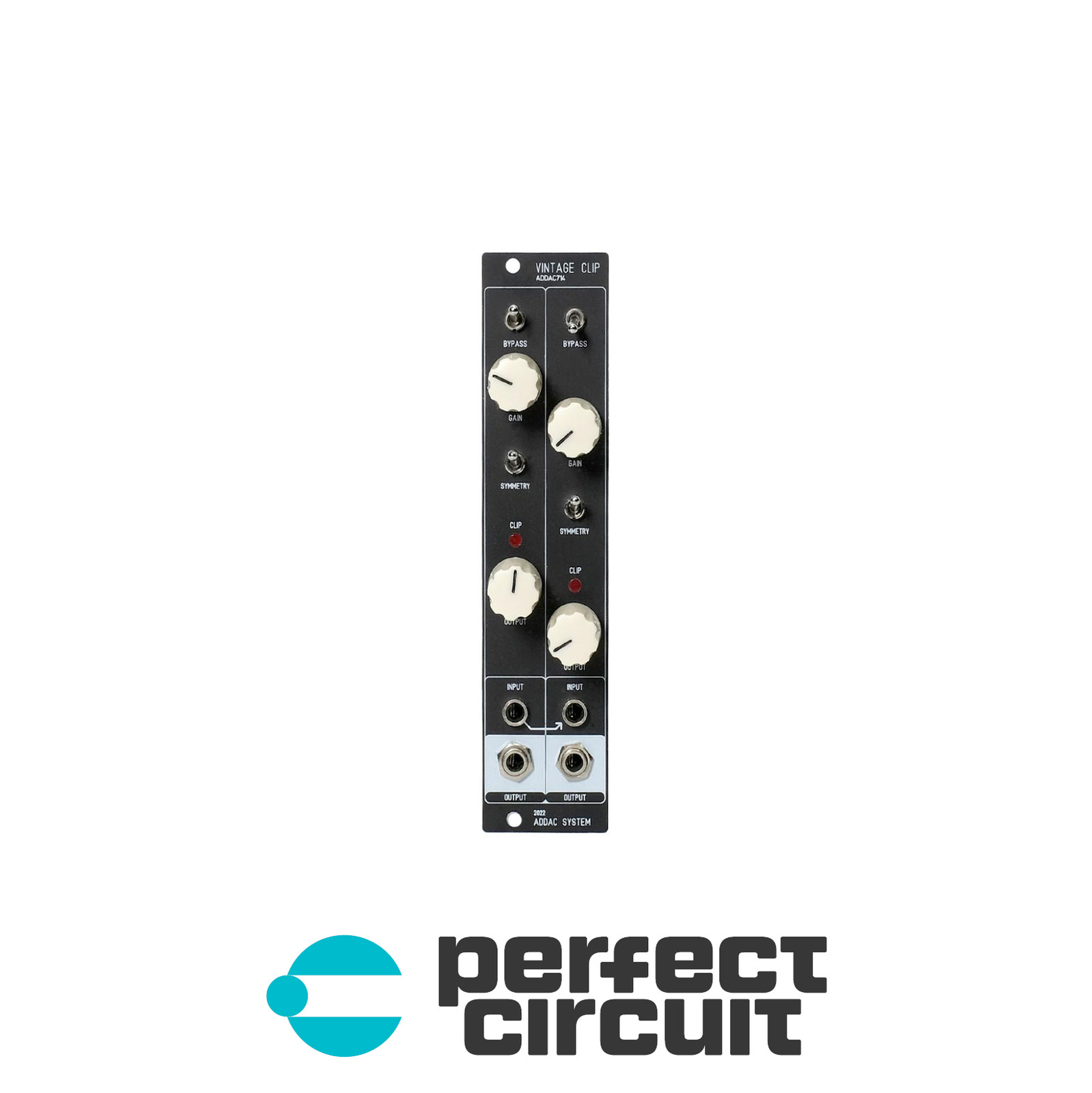
Designed as a dual-channel soft-clipping module, the 714 is built around a diode-based passive clipping circuit that acts like a “brick wall” limiter, but one with a forgiving knee. Each channel features independent bypass, gain, symmetry switching, and output level controls, making it equally useful for stereo processing or dual mono applications. The symmetry switch is where the tonal personality splits: bipolar clipping (odd and even harmonics) delivers a fuller, more balanced saturation, while unipolar (positive clipping, odd harmonics only) leans into a grittier, more asymmetric character. It’s not just a tone switch—it’s a harmonic pivot point, letting you choose between vintage console warmth and lo-fi cassette degradation with a single flick.
But the real secret weapon is the fixed passive low-pass filter sitting at -3dB, 3.3kHz. It’s not advertised as a feature you can tweak—there’s no knob, no switch—but it’s everywhere in the sound. It’s what keeps the high-end fizz at bay when you’re driving the module hard, what gives it that “old sampler” quality users report when running drum machines or full mixes through it. It’s also the reason the 714 can feel slightly limiting in dense, high-frequency-rich material—hip-hop producers using intricate hi-hat patterns or glitch artists relying on crisp transients might find the top end a little too damped. But that’s not a flaw; it’s a design choice. This isn’t a surgical distortion tool. It’s a vibe module. It wants to make your mix sound like it was recorded on a machine that’s seen better days.
Specifications
| Manufacturer | ADDAC System |
| Production Years | 2022– |
| Original Price | €100 (kit), ~£137 (assembled) |
| Format | Eurorack |
| HP Size | 6 HP |
| Depth | 40 mm |
| Power Consumption | 40 mA (+12V), 40 mA (-12V) |
| Channels | Dual |
| Clipping Type | Diode-based passive soft clipping |
| Symmetry Options | Bipolar (odd + even harmonics), Unipolar (odd harmonics only) |
| Low-Pass Filter | Passive RC, -3dB at 3.3kHz |
| Controls | Gain, Output, Bypass switch, Symmetry switch (per channel) |
| Indicators | Clipping LED (per channel) |
| Inputs | Audio input (left normalled to right) |
| Outputs | Audio output (per channel) |
| Build Option | Available as DIY kit (SMD pre-soldered) |
Key Features
Diode-Based Soft Clipping with Harmonic Control
The core of the 714’s sound lies in its diode clipping circuit, a design choice that immediately distances it from digital or op-amp-heavy distortion modules. Diodes introduce a natural compression and soft saturation that feels organic, even when pushed. Unlike hard clipping that creates harsh upper harmonics, the 714’s passive clipping gently rounds off waveform peaks, producing a warm, musical distortion that enhances rather than obliterates. The symmetry switch adds a rare level of harmonic sculpting for such a compact module—bipolar mode fills out the sound with even-order richness, ideal for basslines or full mixes, while unipolar delivers a more nasal, vintage fuzz that cuts through on leads or percussion.
Fixed Low-Pass Filtering: A Feature, Not a Bug
That 3.3kHz low-pass filter isn’t something you’ll find on most distortion modules, and it’s not something you can turn off. But it’s also not an oversight—it’s integral to the 714’s identity. By gently rolling off the extreme highs, it prevents the fizz and digital harshness that often plague overdriven signals in modular systems. This makes the 714 especially effective on sources like digital samplers, FM synths, or computer audio outputs, where high-frequency artifacts can be fatiguing. The result is a sound that feels aged, like it’s been run through a tape machine or an old console path. It’s not transparent—it’s transformative.
Compact, Skiff-Friendly Design with Flexible Gain Staging
At just 6 HP and 40mm deep, the 714 slips into even the most crowded skiff without issue. But despite its size, it doesn’t skimp on functionality. The two-stage gain structure—input gain feeding into a separate output gain—gives users real control over drive and level independently. You can crank the input for maximum saturation and then dial back the output to match your system’s levels, a setup that’s especially useful when processing line-level signals from external gear. The clipping LED provides visual feedback, letting you see when the diodes are active, which is helpful when balancing subtle saturation against full-on destruction.
Historical Context
The ADDAC 714 arrived in 2022, a time when Eurorack was saturated with digital effects, granular processors, and complex multi-FX units. In that landscape, the 714 stood out by going analog, passive, and focused. It wasn’t trying to be a Swiss Army knife—it was a single, well-crafted tool for a specific job: adding vintage warmth to overly clean signals. ADDAC System, based in Lisbon, has long been known for bridging analog and digital worlds, but with the 714 (and its sibling, the 712 Vintage Pre), they leaned hard into analog authenticity. The design philosophy echoes classic ’70s console circuits—think Neve or API-style coloration—but distilled into a modular format that doesn’t require a rack full of iron to achieve.
It competes not with high-end multi-effects, but with modules like the WMD Red Tide, the Happy Nerding FX Aid, or the Intellijel Triatt—units that prioritize character over flexibility. But unlike some of those, the 714 doesn’t rely on complex filtering or voltage control. It’s hands-on, immediate, and deterministic. What you turn is what you get. That simplicity is part of its appeal: no menus, no presets, no firmware updates. Just gain, symmetry, and output. In a world of increasingly complex modular gear, the 714 feels like a reset button.
Collectibility & Value
The ADDAC 714 is still in production, so it’s not a vintage item in the traditional sense—but it’s already gained a quiet reputation among modular users who value subtle coloration over extreme effects. Assembled units typically sell for between £130 and £160 on the secondhand market, while DIY kits from Thonk or Exploding Shed go for around €100. The kit version is rated “easy/medium” difficulty, with all SMD components pre-soldered, making it accessible to intermediate builders. Given its simple circuit, failure rates are low—no moving parts, no complex ICs—though service technicians note that incorrect assembly (especially power polarity) is the most common cause of issues.
Because it’s a passive clipping design, there’s little to wear out over time. The main things to check when buying used are clean solder joints (if kit-built), proper power draw, and whether the bypass switches click cleanly. The clipping LEDs should illuminate predictably with signal, and the potentiometers should sweep smoothly without crackle. Given its fixed filter and lack of CV control, the 714 isn’t a module that will appeal to everyone—but for those who want a “set it and forget it” warmth booster, it’s become a cult favorite. It’s not rare, but it’s respected.
eBay Listings
As an eBay Partner, we earn from qualifying purchases. This helps support our independent vintage technology research.