ADDAC 712 Vintage Pre (2022–)
Two channels of 1970s-style discrete grit, reborn in Eurorack—where saturation isn’t simulated, it’s wired in.
Overview
Plug in a clean sine wave, crank the gain, and listen as the edges start to fray—not with the brittle fizz of digital clipping, but with the slow, warm bleed of analog overload. That’s the 712 Vintage Pre doing its thing: a dual-channel preamp module that doesn’t just boost signal, it transforms it, using a circuit topology lifted from the guts of 1970s studio gear so revered that ADDAC won’t even name it. There’s something almost rebellious about its design in a world full of pristine, DSP-modeled distortion—this isn’t an emulation. It’s a transplant. The 712 doesn’t pretend to be neutral; it wants to color, to saturate, to push your signal into harmonic territory that feels lived-in and slightly unpredictable.
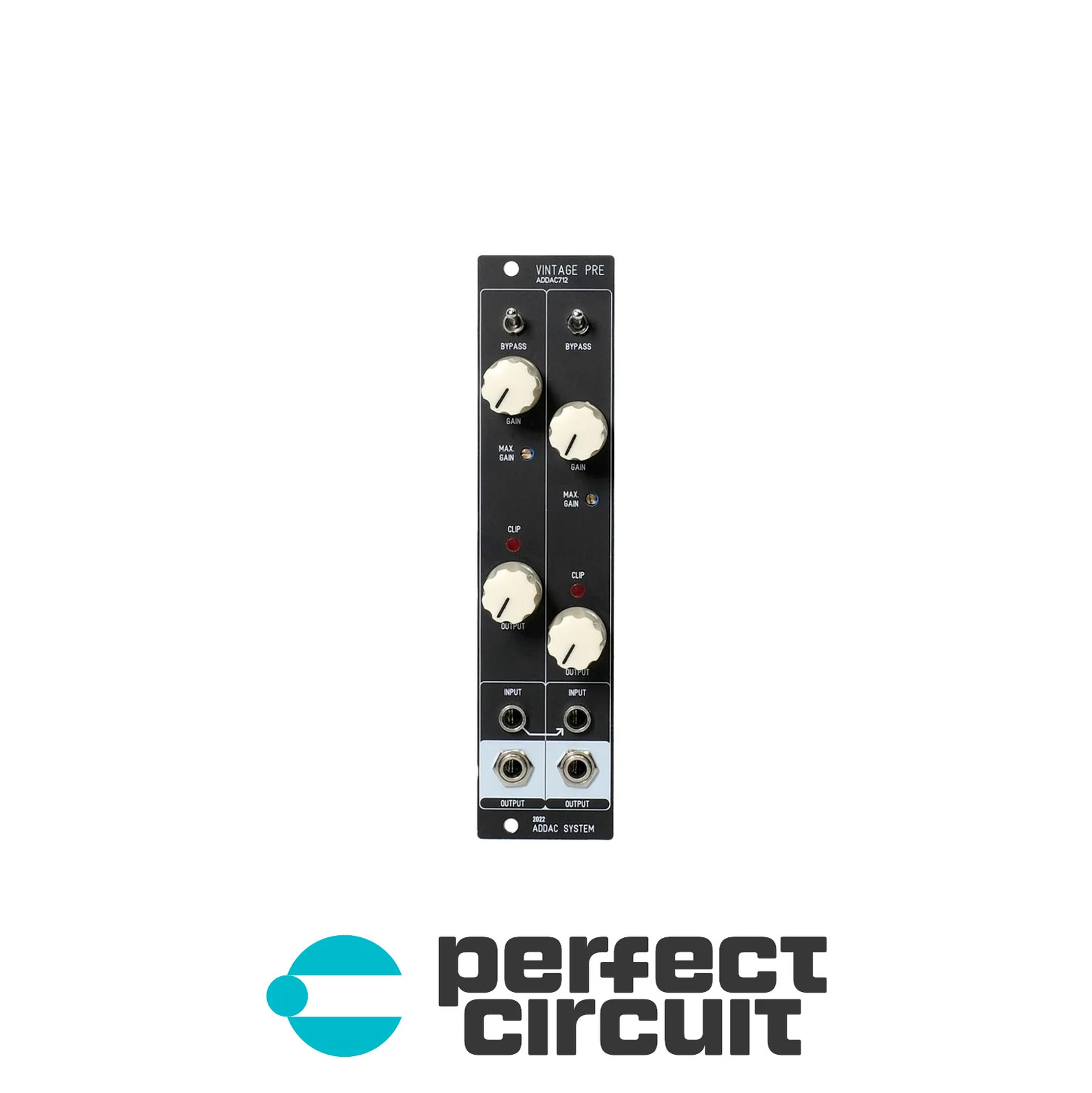
Each channel gives you input gain, output level, a bypass switch, and a clipping LED—simple, but deceptively powerful. The real magic lies in the dual-stage gain structure: you can drive the input hard into saturation while using the output stage to pull the level back down, avoiding runaway voltages that could clip the next module in your chain. It’s a thoughtful design for actual patching, not just theoretical tone shaping. And because the left input normalles to the right, you can run a stereo signal through it with just one cable, making it a compact solution for fattening up drum machines, samplers, or external synths. It’s also a natural partner to ADDAC’s own 711 Balanced Inputs, turning line-level sources into full-fat Eurorack monsters with a single row of modules.
But here’s the twist: when you really push it—past ±5.5V—the 712 starts to do something odd. The audio bias shifts upward, creating a kind of gate-like effect where the signal seems to lift off the zero line. It’s not a flaw, exactly, but a behavioral quirk, a side effect of the discrete transistor design that gives it character. Some users report this drift adds a pumping, almost rhythmic quality to heavily distorted signals, like the module is breathing with the music. Others find it unpredictable, especially in precise sequencing contexts. Either way, it’s a reminder that this isn’t a clinical tool. It’s alive, in the way old analog gear used to be—responsive, a little wild, and never quite the same twice.
Specifications
| Manufacturer | ADDAC System |
| Production Years | 2022– |
| Original Price | €140 (assembled), €81 (DIY kit) |
| Format | Eurorack |
| Width | 6 HP |
| Depth | 40 mm |
| Power Consumption | 40 mA (+12V) |
| Power Consumption | 40 mA (-12V) |
| Channels | 2 |
| Input Type | Audio (normalled: Left to Right) |
| Output Type | Audio |
| Gain Stages | Input gain, output gain (per channel) |
| Max Gain Adjustment | Rear-panel trimmer (user-adjustable) |
| Signal Integrity Range | Up to ±5.5V |
| Hard Clipping Threshold | Approx. ±6V |
| Clipping Indicator | LED per channel (output stage) |
| Bypass | Toggle switch per channel |
| Construction | Discrete transistor preamp design |
| DIY Availability | Yes (SMD pre-soldered kit) |
Key Features
Discrete Circuitry with Vintage DNA
The 712’s core is a discrete transistor amplifier circuit modeled after a “famous preamp board from the 70s” used in gear ADDAC refuses to name—likely to avoid licensing issues, but also, probably, to preserve the mystique. What matters is the result: a warmth and harmonic complexity that feels organic, not algorithmic. Unlike op-amp-based designs that can sound clinical even when overdriven, the 712’s discrete topology produces a softer, more gradual saturation. Push it gently, and you get subtle tube-like warmth; crank it, and it breaks up into a rich, fuzzy distortion that retains musicality. The lack of a tone control is telling—this isn’t a module for surgical EQ shaping. It’s for character, for texture, for the kind of color you can’t dial in with a filter.
Dual-Stage Gain for Creative Control
Most preamps give you a single gain knob. The 712 gives you two per channel: input gain and output level. This isn’t just for headroom management—it’s a creative tool. You can max out the input stage to induce heavy saturation, then use the output knob to bring the level back down to a usable range. This lets you exploit the module’s full harmonic potential without blowing out the next stage in your signal chain. The output stage also includes a clipping LED, so you can see when you’re hitting the op-amp limit—useful for dialing in just the right amount of grit. And because the gain structure is asymmetrical (input distortion, output clean-up), you can create complex, layered saturation that evolves with your playing dynamics.
Behavioral Quirks as Features
At extreme input levels, the 712 exhibits a peculiar behavior: the audio signal’s DC bias shifts upward, effectively lifting the entire waveform off the zero line. This isn’t a malfunction—it’s a side effect of the discrete circuit’s inability to perfectly center the signal under heavy load. Some users report this creates a gate-like pumping effect, especially on rhythmic material, adding a subtle rhythmic pulse to distorted drum loops. Others find it problematic when feeding sensitive downstream modules that expect a centered signal. But in the right context, it’s not a bug—it’s a texture. It’s the kind of unpredictable, almost sentient behavior that makes vintage gear compelling, and it’s something no digital model has quite replicated.
Historical Context
The ADDAC 712 arrived in 2022, a time when Eurorack was saturated with digital waveshapers, granular processors, and FPGA-based effects. In that landscape, the 712 stood out for its analog purism. While competitors were modeling vintage preamps in code, ADDAC went the opposite direction: reverse-engineering a real 1970s circuit and stuffing it into 6 HP. This wasn’t nostalgia for its own sake—it was a reaction to the increasing sterility of modular synthesis. As more users combined digital oscillators, quantized sequencers, and pristine filters, the need for organic, unpredictable color grew. The 712 answered that need, alongside siblings like the 714 Vintage Clip, forming a family of modules dedicated to analog dirt. It also reflects a broader trend in the 2020s modular scene: a return to discrete, non-microprocessor designs that prioritize tactile response and sonic character over feature count.
ADDAC, a Lisbon-based company known for hybrid digital-analog instruments, positioned the 712 as part of its “Analog Heritage” series—a nod to the idea that some circuits are too good to leave in the past. Unlike boutique clones of Neve or API preamps, the 712 doesn’t wear its inspiration on its sleeve. It’s more of a spiritual descendant, capturing the essence of vintage console saturation without licensing the name. In that sense, it’s less a replica than a reinterpretation—one that fits the modular format both physically and philosophically.
Collectibility & Value
The ADDAC 712 isn’t a rare module, but it’s not generic either. As of 2026, assembled units sell for €120–€160 depending on condition and region, with DIY kits going for around €80. It’s not a “grail” module, but it’s respected among modular users who value analog character over digital precision. The build quality is solid—black anodized aluminum panel, clearly labeled controls, and reliable jacks—but it’s not indestructible. The trim pot for maximum gain adjustment is recessed on the front panel, which protects it from accidental tweaks but can make calibration fiddly without the right tool.
Failures are rare, but when they happen, they’re usually tied to power issues. The module draws 40mA on both rails, which isn’t excessive, but users with underpowered cases have reported instability when running multiple high-draw modules. There’s no known widespread failure mode—no cold solder joints, no failing capacitors—but because it’s based on a discrete design, long-term reliability depends on the quality of the transistors and resistors, which ADDAC sources to spec. The DIY version, with pre-soldered SMD components, is considered beginner-friendly, though users should still have basic soldering skills and a multimeter to check for shorts before powering it up.
If you’re buying used, check that both channels respond identically to input gain and that the bypass switches fully disengage the effect. Some users report slight channel imbalance in older units, likely due to resistor tolerance drift. Also, listen for DC offset when the module is driven hard—if the output sounds “lumpy” or causes downstream modules to click, the bias shift might be excessive. A quick test with an oscilloscope would reveal this, but most buyers will have to rely on audio demos. Overall, the 712 is a low-risk purchase: not flashy, not expensive, but deeply useful for anyone who wants to inject some analog soul into a clean system.
eBay Listings
As an eBay Partner, we earn from qualifying purchases. This helps support our independent vintage technology research.