ADDAC 714 Vintage Clip (2022–)
A tiny 6HP brick wall that doesn’t just clip your signal—it gives it a warm, slightly crooked smile.
Overview
You know that moment when your mix feels too clean, too clinical, like it was assembled in a lab instead of lived in? That’s when you reach for the ADDAC 714 Vintage Clip—not to mangle, but to humanize. It doesn’t scream distortion; it whispers saturation, the kind that creeps in like tube glow on a late-night recording. Slot this into your Eurorack and suddenly your digital oscillators sound like they’ve been breathing the same air as a 1973 ARP. It’s not a full-on fuzz bomb or a bit crusher—it’s the polite cousin at the distortion family reunion who slips you a glass of bourbon and says, “Let’s make this sound like it has history.”
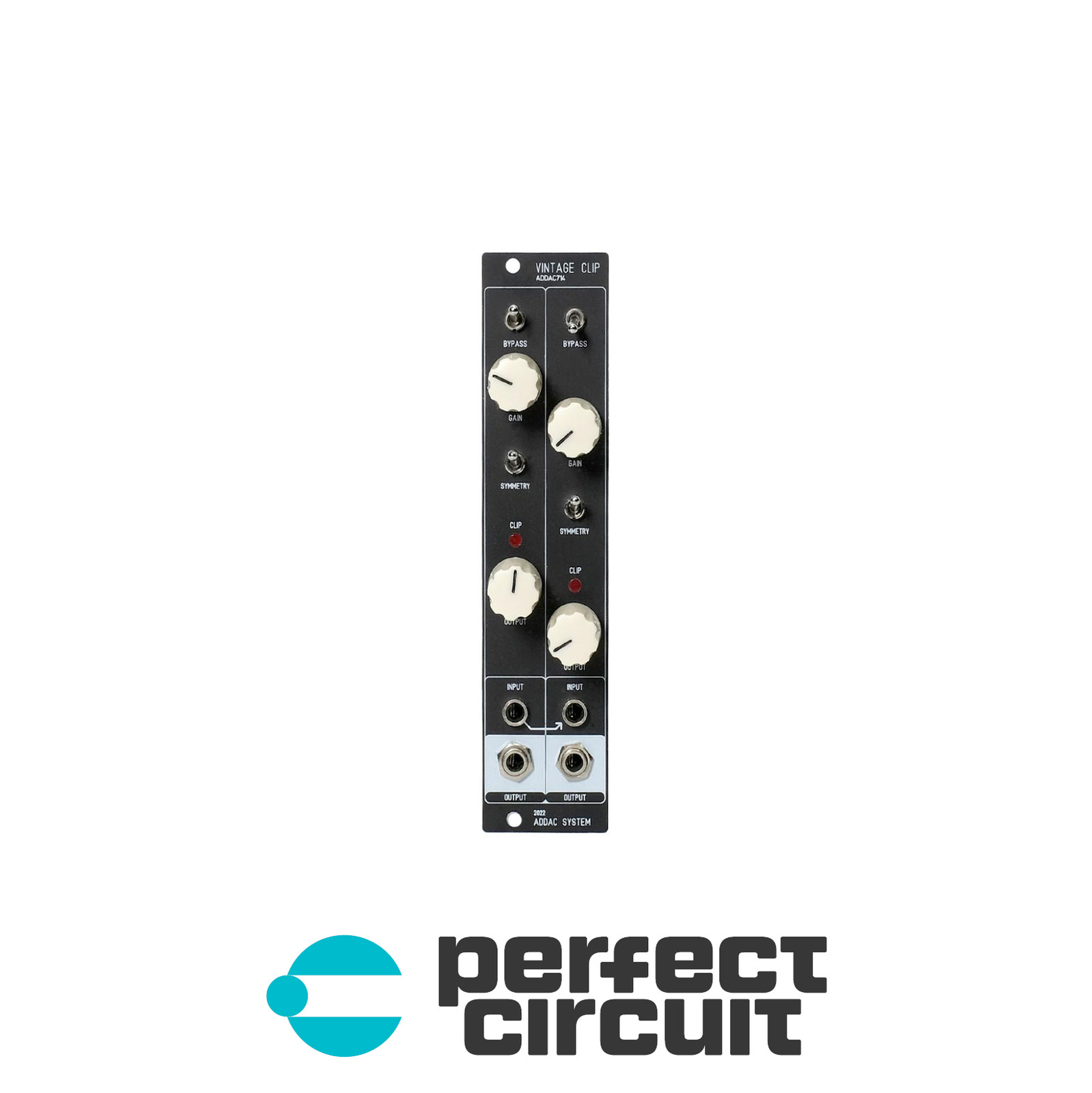
Despite its modest footprint—just 6HP and 40mm deep—the 714 packs dual channels of diode-based soft clipping, each with independent gain, output, bypass, and a symmetry switch that toggles between bipolar and unipolar clipping. That last bit is where the magic hides: flip it to bipolar and you get both odd and even harmonics, a fuller, more organic saturation that recalls vintage console summing. Flip it to unipolar and the character tightens, leaning into odd-order harmonics for a grittier, more nasal edge—think tape saturation pushed into the red. The module’s passive RC low-pass filter, fixed at -3dB at 3.3kHz, isn’t advertised as a feature, but it’s essential to the tone. It rolls off the fizz, ensuring the distortion never turns into digital hash, even when you’re slamming the gain. That’s the secret: it’s not just clipping, it’s clipping with manners.
And yes, it’s a limiter in disguise. The diode network acts as a “brick wall,” catching signals that try to spike too high and gently (or not-so-gently) rounding them off. But unlike aggressive digital limiters that suck the life out of transients, the 714 lets the punch through while just softening the leading edge. It’s the difference between a slammed gate and a firm handshake. Musicians report using it on drum buses, synth leads, even full mixes—especially when they want to emulate the compressed, slightly woolly character of old E-mu or Akai samplers. One user on Mod Wiggler noted it made their MPC Live sound like a battered SP-1200, which, if you think about it, is high praise indeed.
Specifications
| Manufacturer | ADDAC System |
| Production Years | 2022– |
| Original Price | €130 (assembled), €77 (DIY kit, excl. VAT) |
| Format | Eurorack |
| Width | 6 HP |
| Depth | 40 mm |
| Power Consumption | 40 mA (+12 V), 40 mA (-12 V) |
| Number of Channels | 2 |
| Clipping Type | Diode-based passive soft clipping |
| Clipping Modes | Bipolar (odd and even harmonics), Unipolar (odd harmonics only) |
| Filter | Passive RC low-pass, -3 dB at 3.3 kHz |
| Controls | Gain (per channel), Output (per channel), Bypass switch (per channel), Symmetry switch (per channel) |
| Indicators | Clipping LED (per channel) |
| Inputs | Left and Right audio inputs (Left normalled to Right) |
| Outputs | Left and Right audio outputs |
| Output Gain Stage | Op-amp based, x2 gain |
| Bypass Function | True bypass via switch |
| Build Options | Assembled module, Full DIY kit (SMD pre-soldered) |
Key Features
The Diode Wall That Warms Instead of Wounds
At the heart of the 714 is its diode-based clipping circuit—passive, no feedback loops, just silicon and physics doing their thing. This isn’t DSP modeling or op-amp overdrive; it’s the kind of clipping you’d find in vintage console inserts or tape machine limiters, where the knee is fixed by the diode’s inherent characteristics. That means no tweaking the curve, no soft/hard switch—just a predictable, repeatable saturation that feels analog in the best sense. Because it’s passive, the signal loses amplitude as it clips, so ADDAC added a gain compensation stage to keep output levels consistent across the gain range. That’s a subtle but crucial touch: you can crank the distortion without suddenly blowing out your downstream modules. The result is a module that behaves more like a classic outboard unit than a typical Eurorack effect—stable, musical, and forgiving.
Two Flavors of Grit, One Switch Apart
The symmetry switch is where the 714 transcends being just another clipper. In bipolar mode (switch up), the signal clips on both positive and negative peaks, generating a mix of odd and even harmonics—warm, full, and slightly rounded, like a tube preamp hitting its limits. Flip it to unipolar (switch down), and only the positive peaks are clipped, creating a more aggressive, asymmetric waveform rich in odd harmonics. This mode has a nasal, almost ring-modulated character at high gain, perfect for adding bite to leads or making drums cut through a dense mix. The difference isn’t night and day, but it’s immediately audible—like switching between a Neve and an API on a vocal track. Having both channels independently switchable means you can run stereo sources with different clipping profiles, or parallel process a single signal with two distinct flavors and blend them via external mixers.
The Hidden Filter That Makes It Sing
That 3.3kHz low-pass filter isn’t listed as a control, but it’s arguably the secret sauce. Unlike many distortion modules that leave high-end fizz to be tamed externally, the 714 rolls it off gently with a passive RC network. This isn’t a steep filter—it’s more like a tone knob frozen at “vintage.” It ensures that even when you’re pushing the gain hard, the output never turns into a sibilant mess. It’s particularly effective on digital sources: MIDI-to-CV converters, sample players, or DAW outputs that lack analog warmth. One user reported using it on hi-hats and finding them “too dull” in complex hip-hop arrangements, which suggests the filter isn’t for everyone—but that’s the point. It’s not trying to be neutral. It’s trying to be characterful. If you want clinical clipping, look elsewhere. If you want something that sounds like it was designed in 1975, you’re in the right place.
Historical Context
The ADDAC 714 didn’t arrive into a vacuum. Eurorack, for all its creativity, has long struggled with the “digital curse”—clean, precise signals that lack the harmonic complexity of analog gear. As more musicians blend digital sequencers, MIDI controllers, and software synths into their racks, the demand for analog-style saturation has surged. The 714 is part of a quiet renaissance of “analog heritage” modules—units that don’t generate sound but color it, inspired by the circuitry of classic consoles, tape machines, and preamps. ADDAC positioned it alongside the 712 Vintage Pre, another module drawing from 1970s discrete amplifier designs, suggesting a deliberate effort to recapture the warmth of analog signal chains without resorting to modeling.
What sets the 714 apart from contemporaries like the WMD SSC or the Intellijel Triatt is its simplicity and focus. It doesn’t offer voltage control, envelope following, or multi-mode filtering. It’s a dedicated soft clipper, nothing more. That purity appeals to players who want a “set and forget” saturation stage—something to insert at the end of a chain or on a mix bus to add glue and grit. In an era where many Eurorack modules are bloated with features, the 714’s minimalism feels radical. It’s also a product of the DIY ethos: available as a full kit with SMD components pre-soldered, it’s accessible to builders who want hands-on experience without the frustration of tiny parts. That dual identity—as both a boutique assembled module and a builder’s kit—reflects ADDAC’s roots in the maker community.
Collectibility & Value
As of 2026, the ADDAC 714 isn’t a vintage item by calendar—it’s barely four years old—but it’s already developed a cult following among Eurorack users who prize analog character over digital precision. The assembled version sells for around €155 at European dealers like SchneidersLaden, while US prices hover near $170. The DIY kit, priced at €77 (excluding VAT), remains popular among builders and is occasionally available from retailers like Thonk and Exploding Shed. Used units appear on Reverb and eBay, typically in the $100–$130 range, depending on condition and whether they’re kit-built or factory assembled.
There are no known failure points in the design—the circuit is passive and robust, with no delicate ICs or power-hungry components. The clipping LEDs are standard indicators, and the switches and pots are standard Alps or equivalent, all rated for long life. However, buyers should be cautious with DIY units: poor soldering, especially on the power header or input/output jacks, can lead to intermittent signals or ground loops. Always check for cold joints and verify power draw with a multimeter before installing in a shared bus board. The module draws a modest 40mA on both rails, so it won’t stress even the smallest power supplies.
For collectors, the 714’s appeal lies in its focused design and authenticity. It’s not trying to be everything; it’s trying to do one thing exceptionally well. Custom front panels (offered directly by ADDAC in colors like bronze, red, or silver gray) add a touch of exclusivity, though they’re more aesthetic than functional. Given its role as a “finishing” module—often used sparingly but valued highly—it’s unlikely to depreciate quickly. If anything, as the Eurorack market matures and users seek out characterful, non-CV-dependent effects, the 714 may become a quiet staple, the kind of module you don’t notice until it’s gone.
eBay Listings
As an eBay Partner, we earn from qualifying purchases. This helps support our independent vintage technology research.