ADDAC System 101 .WAV Player (2016–?)
A monophonic Eurorack gateway to gritty, lo-fi sample playback—simple, hands-on, and full of character, if you can tame its quirks.
Overview
Slap a .WAV file onto an SD card, plug it into the ADDAC System 101, and you’re not just triggering a sample—you’re summoning something with texture, weight, and a little bit of attitude. This isn’t a pristine digital player; it’s a tactile, voltage-responsive module that treats audio like a physical object you can stretch, loop, and degrade. From the moment you hear that first crunchy playback—slightly aliased, with a warm edge that feels more analog than digital—you realize the 101 wasn’t built to be transparent. It was built to be *felt*. It’s the sound of a tape head wearing thin, of a sample rate cranked down until the harmonics start to wobble, of a system that doesn’t hide its limitations but instead turns them into features.
Released around 2016, the 101 arrived at a time when Eurorack was exploding with digital experimentation, but many sample players were still overly complex, menu-diving machines. The 101 cut through that with a refreshingly minimal approach: no screens, no endless folders, no deep parameter diving. Just a few knobs, a reset switch, and a blinking error LED that becomes your guide through the setup process. It supports monophonic 22.05kHz .WAV files, stored on SD cards formatted in FAT16, and plays them back with a rawness that some might call flawed—but in the world of modular synthesis, flaws are often the soul of the sound. The loop controls let you define start and end points manually or via CV, and the sample rate can be modulated, giving you pitch bends, gritty downshifts, and lo-fi artifacts that evolve with your patch.
It slots into the ADDAC ecosystem as the original, no-frills version of their sample playback concept—before the more advanced 111 Ultra .WAV Player added microSD support, expanded file handling, and deeper CV control. The 101 is the stripped-down ancestor: charming, limited, and oddly endearing in its constraints. It doesn’t do everything, but what it does, it does with a certain honesty. And if you’re the type who likes to hear the mechanism—the grit in the gears, the stutter of a file loading—then the 101 delivers that in spades. It’s not trying to be a workstation or a sampler; it’s a single-voice playback engine with character, built for looping field recordings, triggering drum hits, or warping spoken word into something surreal.
Specifications
| Manufacturer | ADDAC System |
| Production Years | 2016–? |
| Original Price | $414 |
| Format | Eurorack |
| Width | 11 HP |
| Depth | 55 mm |
| Power Consumption | 150 mA (+12V), 150 mA (-12V) |
| Audio Output | 1 x Monophonic |
| Sample Format | Monophonic .WAV |
| Sample Rate | 22.05 kHz (fixed, but CV-controllable playback speed) |
| Storage | SD Card (FAT16 formatted) |
| Max Files per Card | 36 (minimum 2 required) |
| File Naming Convention | a.wav, b.wav, ..., z.wav, 0.wav, ..., 9.wav |
| Loop Controls | Loop size, start point, one-shot/loop mode (manual and CV controllable) |
| Sample Rate Control | CV input with attenuverter |
| Envelope Follower | 1 x CV output (pre-VCA amplitude) |
| VCA | Manual level control |
| Bus Board Connector | 8-pin IDC (Doepfer style) |
Key Features
Hands-On Sample Manipulation
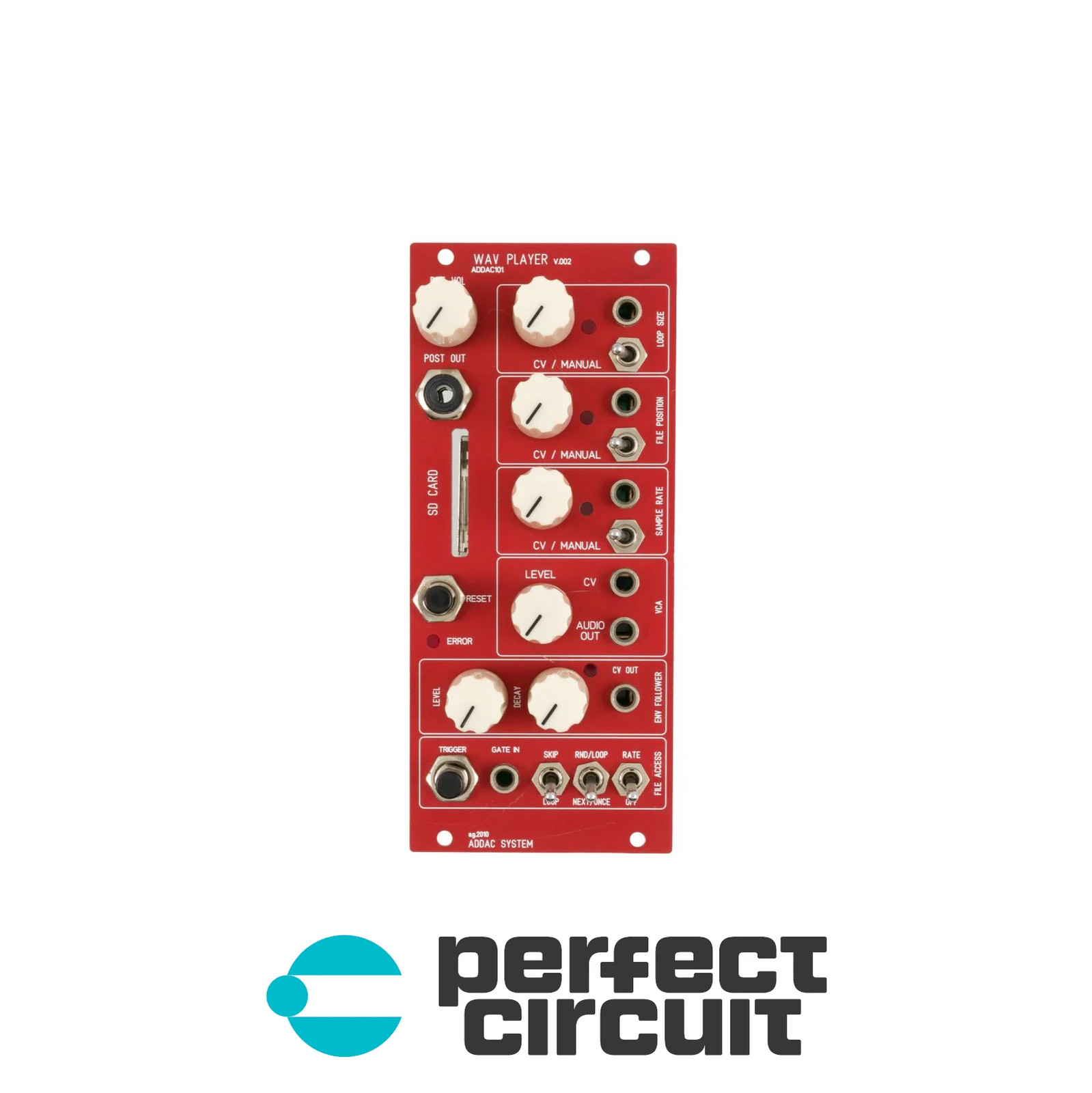
The 101’s front panel is sparse but purposeful: a VCA level knob, loop size and start point controls, a sample rate knob, and a file advance button. There’s no screen, no menu navigation—just direct, tactile interaction. Want to shift the loop point? Turn the knob. Want to jump to the next sample? Press the button. This immediacy makes it feel more like a synth module than a digital file player. The loop controls are especially powerful in a live patch, letting you create evolving textures by slowly shifting the playback window across a sample. Pair that with CV control over loop start or sample rate, and you can generate rhythmic glitches, stuttering delays, or pitch-drifting drones that feel organic rather than programmed.
CV Integration with Character
While the 101 lacks the full 1V/oct sample rate tracking of its successor, it still offers meaningful CV control. The sample rate input accepts bipolar CV with an attenuverter, allowing you to modulate playback speed up and down—slowing a vocal snippet into a ghostly crawl or speeding a drum hit into a metallic ping. The loop start and size parameters can also be voltage-controlled, opening up generative possibilities. An envelope follower outputs a CV signal based on the pre-VCA audio amplitude, which can be used to trigger other modules, modulate filters, or feed back into the patch for dynamic response. It’s not a full-fledged sampler, but it plays well with others, acting as a sonic catalyst in a larger system.
Lo-Fi Aesthetic as a Feature
The 101 doesn’t pretend to be high fidelity. Its 22.05kHz sample rate introduces aliasing and a slightly grainy texture, especially on high-frequency content. But that’s part of its charm. Played back through a clean signal chain, it sounds raw and immediate; run through a vintage preamp or distortion, it melts into the mix like a found sound from a 1980s cassette. The lack of stereo output and limited file handling (no folders, strict naming) might frustrate users looking for flexibility, but for those who value immediacy and sonic character over convenience, the 101 turns its limitations into strengths. It forces you to work within its world, and in doing so, encourages creativity.
Historical Context
The ADDAC 101 emerged during a golden era of Eurorack expansion, when modular synthesis was no longer just for analog purists but a playground for hybrid experimentation. While many manufacturers were diving into complex digital architectures—granular synthesis, FM engines, full sampling workstations—the 101 stood out by doing one thing simply and well. It arrived alongside a wave of Portuguese and European boutique module makers who prioritized musicality and tactile design over technical excess. At a time when sample playback in modular often meant navigating LCD menus or relying on computer integration, the 101 offered a refreshingly hands-on alternative.
It competed indirectly with modules like the Critter & Guitari Organelle (as a standalone) or the Qu-Bit Nebulae (as a more advanced digital processor), but the 101 carved its niche by being affordable, focused, and deeply integrated into the Eurorack workflow. It wasn’t trying to replace a laptop or a sampler; it was meant to be a sonic texture generator, a lo-fi playback engine that could be patched, modulated, and degraded like any other analog voice. Its design philosophy—minimal interface, maximum character—echoed the ethos of classic analog gear, even though it was fundamentally digital at its core.
Collectibility & Value
The ADDAC 101 is not a rare module, but it’s no longer in active production, having been effectively superseded by the ADDAC 111 Ultra .WAV Player. As such, it trades mostly on the used market, with prices hovering between $350 and $450 depending on condition and included accessories. Units that come with the original firmware updater kit or documentation tend to fetch slightly more, as firmware updates (last updated in 2018) can affect stability and file compatibility. The most common failure point is the SD card reader, which can become finicky over time—especially if users frequently swap cards without resetting. Cards formatted incorrectly (not FAT16) or containing hidden system files (common on macOS) will trigger the ERROR LED, which blinks four times and stays lit. This isn’t a hardware fault, but it can confuse new users.
Owners report that the module is generally reliable if treated with care, but the lack of microSD support (the 111 moved to microSD for space savings) means you’re stuck with full-size SD cards, which are bulkier and more prone to dislodging in tight cases. The 55mm depth is manageable in most racks, but not skiff-friendly. For buyers, the key checks are: does the SD card reader consistently recognize properly formatted cards? Does the error LED turn off after reset when a valid card is inserted? And does the CV control respond smoothly without jitter? If so, the 101 remains a solid, characterful addition to any modular setup—especially for those who appreciate lo-fi textures and hands-on workflow.
eBay Listings
As an eBay Partner, we earn from qualifying purchases. This helps support our independent vintage technology research.