ADDAC 101 .WAV Player (2010s)
A gritty little slot machine for digital audio in a world of analog circuits—where scratched-up waveforms and glitched-out playback become instruments themselves.
Overview
You plug in an SD card, press reset, and suddenly your modular rig isn’t just making sound—it’s telling stories. Field recordings crackle to life. Drum hits stutter like a skipping CD. A single piano note gets stretched, warped, and mangled until it sounds like a dying robot singing a lullaby. That’s the ADDAC 101: a Eurorack module that smuggles digital sampling into analog systems with zero apologies. It doesn’t try to be pristine or transparent. It wants to be unstable, unpredictable, and alive—like a VHS tape left in the sun, but somehow more musical because of it.
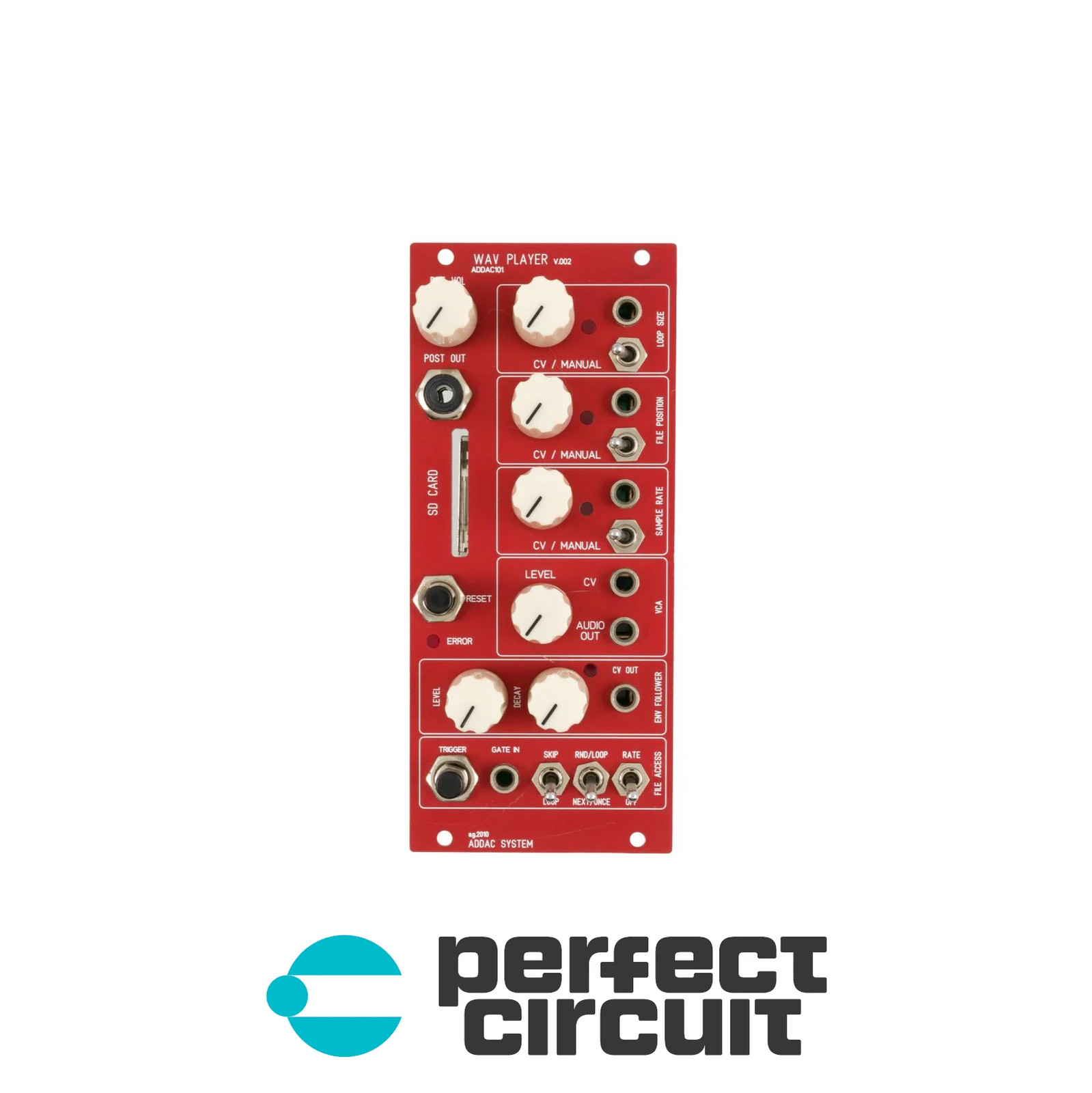
Launched in the early 2010s, when Eurorack was still figuring out how to blend digital quirks with analog warmth, the 101 landed at just the right time. It wasn’t the first sampler in a rack, but it was one of the first that felt like it belonged there—physically compact at 11 HP, electrically compatible with ±12V and ±15V systems, and sonically willing to get dirty. The core idea is simple: load 22.05kHz 16-bit mono WAV files onto a FAT16-formatted SD card, drop it into the slot, and let the module chew through them. But the magic isn’t in the playback—it’s in the mangling. You can sweep the playback position manually or with CV, shorten the loop size to create stuttering granular effects, shift the sample rate to pitch things down into sub-bass oblivion or up into chipmunk squeals, and even patch in gates to skip randomly between files. It’s less a sampler, more a sound mangler with a slot for memory cards.
Compared to ADDAC’s later 111 model—the “Ultra” version with microSD, more CV control, and loop-in-loop features—the 101 is the stripped-down, slightly temperamental older sibling. It doesn’t do everything, but what it does, it does with character. It’s the kind of module that makes you dig through old hard drives just to find weird audio snippets to abuse. And yes, it’ll glitch—especially if you use the wrong SD card or forget to clean out hidden system files from macOS—but that’s part of the charm. When it stutters, it often stutters musically.
Specifications
| Manufacturer | ADDAC System |
| Production Years | 2010s |
| Original Price | $420–$529 |
| Format | Eurorack |
| Width | 11 HP |
| Depth | 5.5 cm |
| Power Supply | ±12V or ±15V |
| Max Current Draw | 150mA |
| Bus Board Cable | 8 × 2 IDC (Doepfer style) |
| Sample Rate | 22.05 kHz |
| Bit Depth | 16-bit |
| Audio Format | Mono WAV |
| Storage | SD Card (FAT16 formatted) |
| Max Files per Card | 72 |
| Min Files per Card | 2 |
| Max File Size | 500 KB (for file "b.wav") |
| CV Inputs | 0–10V (Loop Size, Initial Position, Sample Rate, VCA) |
| Gate Input Threshold | 2.5V |
| Outputs | Pre-VCA audio, Post-VCA audio, Envelope Follower CV |
| Additional Features | File skip (next/previous/random), Loop/One Shot mode, Envelope follower with level/decay controls, Error LED indicator |
Key Features
The SD Card Slot That Demands Ritual
The SD card slot isn’t just a convenience—it’s a covenant. You can’t just drag and drop files and expect it to work. The card must be FAT16 formatted (not FAT32, not exFAT), and the files must follow a strict naming convention: a.wav, b.wav, c.wav, up to z.wav, then aa.wav, bb.wav, and so on. No underscores, no spaces, no capital letters. And if you’re on macOS, you’d better run a cleanup utility before ejecting, or the hidden .DS_Store files will trigger the ERROR LED and refuse to boot. There’s a whole subculture of forum posts and YouTube tutorials dedicated to getting the 101 to stop blinking red. It’s fussy, yes—but it also makes you slow down, pay attention, and treat the process like a ceremony. When it finally works, it feels earned.
Glitch as a Feature, Not a Bug
Buried on the back of the module is a jumper that, when toggled, introduces deliberate digital glitches during sample rate modulation. By default, it’s enabled—because of course it is. When you crank the sample rate CV while this jumper is active, the audio doesn’t just change pitch; it stutters, skips, and fractures in ways that resemble granular synthesis but are actually just the microprocessor struggling to keep up. It’s not clean. It’s not precise. But it’s expressive. Patch in an LFO, modulate the sample rate, and you’ll get rhythmic splutters that feel alive. It’s the sonic equivalent of a tube amp breaking up—only here, the breakup is in the code, not the circuit.
Envelope Follower That Feels Alive
The envelope follower isn’t just a utility—it’s a performance tool. It outputs a CV signal based on the amplitude of the audio post-VCA, with controls for level and decay. Patch that into a filter cutoff, a delay time, or even the loop size, and suddenly your sampled sound is modulating other parts of your patch in real time. A drum hit can open a filter. A spoken word can trigger a sequence. The decay control lets you smooth it out for subtle swells or leave it sharp for percussive spikes. It’s simple, but it turns the 101 from a sound source into a control center.
Historical Context
The ADDAC 101 arrived when Eurorack was still largely an analog playground. Digital modules existed, but many felt clinical—precise, sterile, and disconnected from the warmth of the rest of the system. The 101 flipped that script. Instead of hiding its digital nature, it leaned into it, embracing the limitations of low sample rates and basic file systems as creative tools. It wasn’t trying to compete with high-fidelity samplers like the Elektron Machinedrum or the Akai MPC. It was trying to be something else: a lo-fi audio mangler that felt at home next to analog oscillators and noise sources.
At the time, other companies were experimenting with digital-in-analog hybrids—Make Noise with the Morphagene, Critter & Guitari with the Organelle—but the 101 stood out for its simplicity and immediacy. No screens, no menus, no deep editing. Just knobs, CV inputs, and an SD card. It was also part of a broader trend of Portuguese and European boutique manufacturers (like Qu-bit, 4ms, and ALM) pushing the boundaries of what modular could do without relying on DSP-heavy designs. The 101 wasn’t just a product; it was a statement that digital doesn’t have to mean clean.
Collectibility & Value
Today, the ADDAC 101 trades hands for $300–$450 depending on condition, often bundled with an SD card already loaded with samples and a power cable. Units in mint condition with custom-colored panels (available direct from ADDAC for €65) can fetch closer to $500. It’s not rare, but it’s sought after—especially by performers who want unpredictable, tactile control over sampled material in live sets.
The most common failure point isn’t the circuitry—it’s the SD card slot. Repeated insertions can loosen the connection, and cheap or incompatible SD cards can corrupt or fail to read. The ERROR LED is both a blessing and a curse: it tells you when something’s wrong, but troubleshooting can be tedious. Always test a used unit with a known-good card before buying. Also check the jumper on the back—if it’s missing or bent, the glitch feature won’t work. Firmware updates are available (version D7 as of 2018), but most units in circulation are already up to date.
Maintenance is minimal. The module draws a modest 150mA and doesn’t run hot. The real cost isn’t in repairs—it’s in time. Learning how to prepare SD cards, name files correctly, and avoid system cruft takes patience. But once you’ve got it down, the 101 becomes less of a hassle and more of a collaborator. It’s the kind of module that rewards obsession.
eBay Listings
As an eBay Partner, we earn from qualifying purchases. This helps support our independent vintage technology research.