ADDAC System 107 (2023)
A happy accident that became a full-blooded acid voice in just 9 HP—squelch on tap, distortion built in, and a smiley face etched like a secret handshake.
Overview
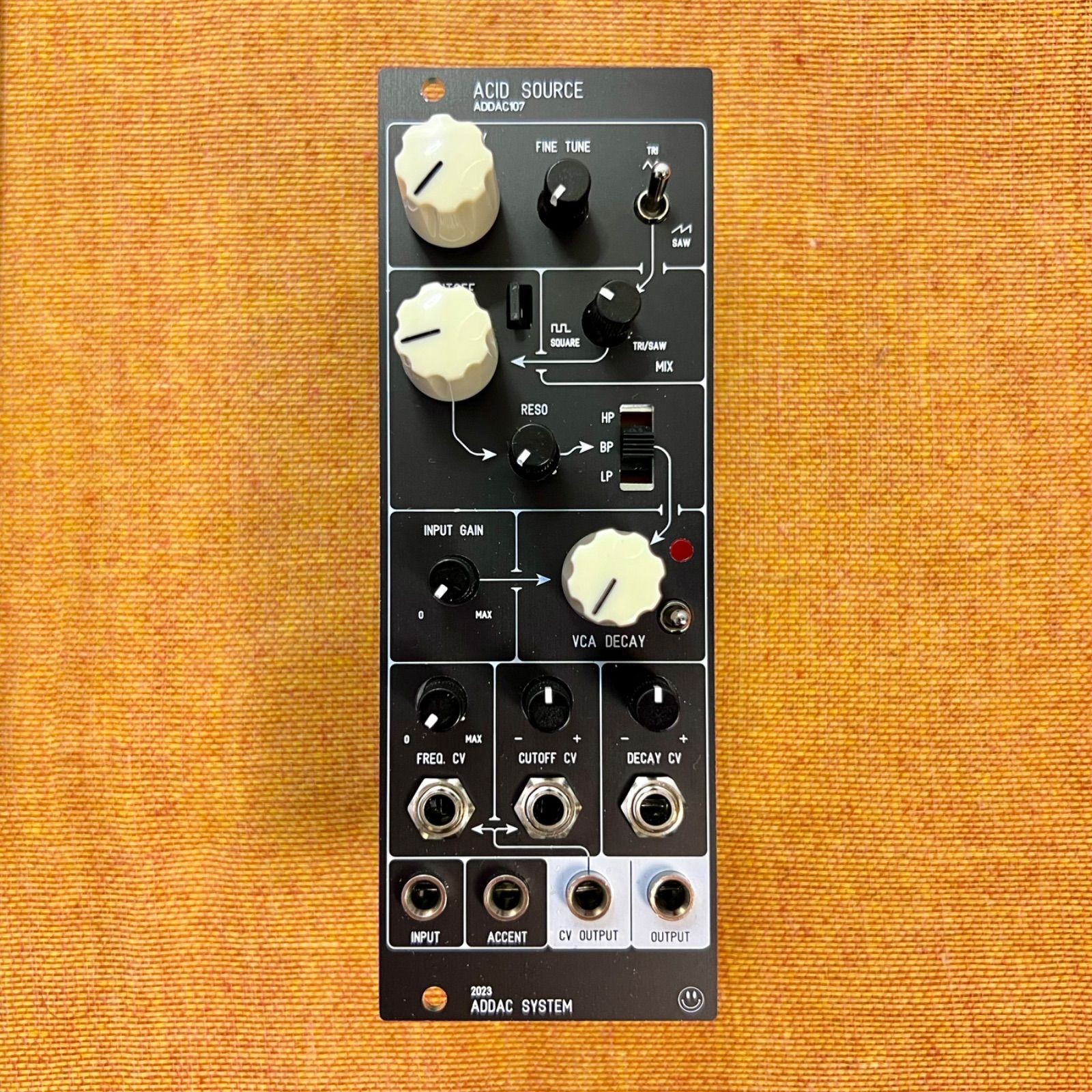
Plug in the ADDAC 107 and twist the resonance up past 12 o’clock—you know what’s coming. That gurgle, that wet, unstable snarl, the kind of sound that feels like it’s melting through your patch cable. It’s not trying to be subtle. This is a module that wants to be loud, a little rude, and unapologetically fun. And the wildest part? It wasn’t even supposed to be this. Originally pitched as a complex percussion source, the 107 veered off course during development when the Lisbon-based team at ADDAC realized the circuit had a different personality entirely: it was an acid machine, pure and simple. So they leaned in. Hard. What emerged is a complete, self-contained analog voice—VCO, filter, VCA, envelope—all packed into a svelte 9 HP Eurorack module that doesn’t just imitate the TB-303’s legacy, it reimagines it with modern flexibility and a dash of cheeky charm.
It starts with a voltage-controlled oscillator offering either sawtooth or triangle waveforms, switchable via a small toggle. That signal gets blended with a square wave before hitting the filter, a multimode design with lowpass, bandpass, and highpass modes—each with its own character, but let’s be honest, you’re going to live in bandpass. The filter’s resonance is where the magic happens: crank it and the cutoff starts to scream, wobble, and self-oscillate in that classic resonant peak that defines acid. CV control is standard, but the 107 adds an attenuverter for the cutoff modulation, giving you precise control over how much external movement you inject. The VCA stage is where things get clever. Instead of a traditional envelope generator, it uses an AD (attack-decay) contour with a fixed short attack and a decay time you can adjust manually or via CV. But here’s the twist: the VCA’s input doubles as a gain stage that can push signals past unity gain—up to double amplification—introducing harmonic saturation and soft clipping that turns clean acid lines into gnarled, overdriven growls. Patch in a gate, trigger, or CV above +5V and the 107 doesn’t just respond—it distorts, making the VCA as much a tone-shaping tool as an amplitude controller.
And then there’s the accent input. A feature more common on drum modules than synth voices, it lets you dynamically boost the amplitude of individual notes, adding punch and variation to sequences. It’s a small thing, but it makes the 107 feel more alive, more musical, especially when paired with a sequencer. The module also includes a CV output that mirrors the internal slewed envelope signal, letting you route modulation to other parts of your system—say, to modulate a second filter or pan position. It’s a thoughtful touch, turning the 107 into not just a sound source, but a modulation hub. Even the faceplate has personality: a tiny smiley face etched near the bottom, a wink to the genre’s rave roots. This isn’t sterile engineering—it’s gear with a sense of humor, built by people who’ve clearly spent time in dark rooms with loud music.
Specifications
| Manufacturer | ADDAC System |
| Production Years | 2023–present |
| Original Price | $249 (assembled), €202 (DIY kit) |
| Format | Eurorack |
| Width | 9 HP |
| Depth | 40 mm |
| Power Consumption (+12V) | 80 mA |
| Power Consumption (-12V) | 80 mA |
| Power Connector | Standard Eurorack 16-pin ribbon cable |
| VCO Waveforms | Sawtooth, Triangle (switchable), Square (mixed) |
| VCO Range | 4 octaves |
| Filter Types | Lowpass, Bandpass, Highpass (3-position switch) |
| Filter Resonance | Voltage-controlled with manual knob |
| VCA Type | AD envelope (fixed attack, variable decay) |
| VCA Gain | Adjustable up to 2x amplification (unity gain + boost) |
| Inputs | VCO CV, Filter Cutoff CV, VCA Input (Gate/Trigger/CV), Accent CV |
| Outputs | Audio Out, CV Out (slewed envelope) |
| Normalizations | CV Out normalled to VCO and Filter CV inputs; jumpers allow de-normalization |
| DIY Option | Available as SMD/through-hole hybrid kit (SMD-Kit-2, medium difficulty) |
| Weight | Approx. 150 g (assembled) |
Key Features
A Filter That Knows How to Misbehave
The 107’s multimode filter isn’t just a tone shaper—it’s the soul of the module. In bandpass mode, it delivers that quintessential squelch with a liquid, almost vocal quality. Turn up the resonance and it doesn’t just peak—it oscillates, warbles, and breathes like a living thing. The cutoff CV input with attenuverter means you can dial in exactly how much external modulation affects the filter’s movement, whether it’s a subtle wobble from an LFO or a full-on dive from a sequencer. And because the filter sits after a mixed VCO stage (triangle or saw blended with square), you’ve got a rich harmonic foundation to work with before the sound even hits the resonance knob. It’s not a 303 clone, but it shares that same DNA: unstable, expressive, and capable of going from polite to unhinged with a single turn.
VCA as a Sonic Weapon
Most synth voices treat the VCA as a simple gatekeeper for volume. The 107 turns it into a distortion stage. The input gain knob can push signals past unity, introducing soft clipping and harmonic saturation that thickens the sound dramatically. This isn’t just about loudness—it’s about texture. Feed in a clean gate and you get a punchy note. Feed in a hot CV or overdrive the input, and the VCA starts to saturate, adding grit and growl that feels more like a stomp box than a modular component. The AD envelope is simple by design—short fixed attack, variable decay—but that simplicity is part of the charm. It encourages you to patch creatively, using external envelopes or mod sources if you want more control. And the accent input? It’s a game-changer. Patch in a CV to dynamically boost note velocity, and suddenly your sequences have human-like variation, like a drummer hitting harder on the offbeats.
Hidden Modulation & DIY Flexibility
Flip the module over and you’ll find jumpers on the side that let you de-normalize the CV output from the internal VCO and filter CV inputs. It’s not the most accessible design—those jumpers aren’t on the front panel, so you’ll need to power down and remove the module to tweak them—but it’s a smart compromise between clean front-panel layout and deep customization. The CV output itself is a goldmine: it sends out the slewed envelope signal from the VCA stage, which means you can use it to modulate other modules in your system. Want to sync a filter sweep or panning effect to your acid line? Patch it in. It turns the 107 into a mini modulation hub. And for tinkerers, the DIY kit option is a major draw. It’s rated as medium difficulty, combining SMD and through-hole parts, making it accessible to intermediate builders. For the price, it’s a rare chance to get hands-on with a module that sounds this good.
Historical Context
The 107 landed in 2023, a time when Eurorack feels both saturated and endlessly inventive. On one hand, the market is flooded with oscillators, filters, and voices—why add another? But ADDAC didn’t just drop another utility module. They tapped into a very specific craving: the desire for self-contained, characterful voices that don’t eat up rack space. The 107 sits in a lineage of compact acid modules—like the Intellijel Polaris or the XAOC Batumi—but with a distinct personality. It’s not trying to be a full synth; it’s trying to be the best damn acid voice in 9 HP. And it arrives at a moment when analog warmth is being revalued. After years of digital precision and clean FM tones, there’s a renewed appetite for circuits that misbehave, that saturate, that feel alive. The 107 delivers that in spades. It’s also a product of ADDAC’s broader philosophy: hybrid instruments that blend analog sound with digital control, though in this case, they went fully analog and leaned into the chaos. Competitors like Doepfer and Erica Synths offer acid-style modules, but few package it all—VCO, filter, VCA, envelope, distortion—into such a tight footprint with this level of musicality.
Collectibility & Value
As of 2026, the ADDAC 107 is still in production and readily available from retailers like Perfect Circuit, Reverb, and Exploding Shed. The assembled version lists for $249, while the DIY kit goes for €202. On the used market, prices hover between $200 and $230 depending on condition, with mint units from careful owners sometimes fetching closer to retail. It’s not a rare module—yet—but it’s gaining a reputation as a “must-have” for acid enthusiasts and minimal techno builders. The DIY kit adds a layer of collectibility for builders, though completed kits are more common in the wild. Failures are rare, but owners should be aware of the SMD components if repairing—reflowing solder joints on the filter or VCA stage may be needed after years of use, though no widespread reliability issues have been reported. The biggest risk isn’t mechanical—it’s temptation. Once you have one 107, you’ll want another. They stack beautifully, and many users run multiple units for layered acid lines. When buying used, check that the toggle switches (waveform and filter mode) are clean and crackle-free, and verify that the accent input responds dynamically. Power up slowly with a current-limited supply if the module has been stored for years. No known firmware or revision changes affect performance—what you get is what was shipped.
eBay Listings


As an eBay Partner, we earn from qualifying purchases. This helps support our independent vintage technology research.