ADDAC System ADDAC713 (2022–)
A deceptively simple mixer that can gently warm your mix or tear it apart with snarling analog grit—just don’t call it “just a mixer.”
Overview
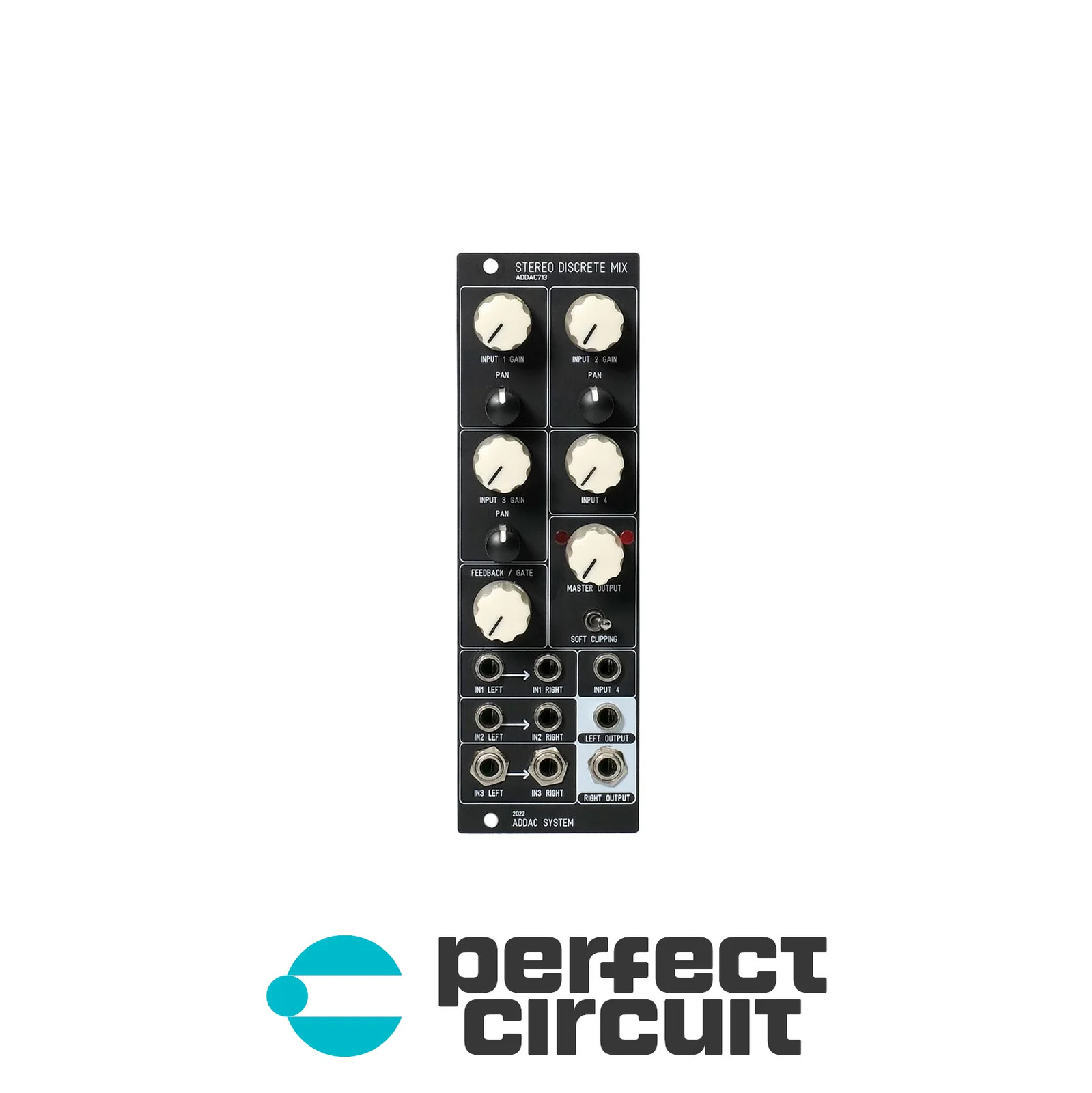
You reach for a mixer to sum signals, sure—but the ADDAC713 doesn’t just add, it transforms. At first glance, it’s unassuming: 8HP of black panel, clean labeling, a few knobs, and no flashy extras. But plug it in, crank the feedback, and suddenly your pristine modular rig sounds like it’s been dragged through a ’70s studio basement and back. This isn’t a passive summing box; it’s a character module wearing a utility disguise. Inspired by the Moog CP3, the 713 is fully discrete, built from analog components without op-amps, giving it that raw, uncolored-yet-colorful transparency that only discrete circuitry delivers. It’s the kind of module that makes you rethink what a mixer can do—not just balancing levels, but shaping tone, adding saturation, and even generating rhythmic gate effects through its feedback loop.
The layout is clever: three stereo channels, each with gain and pan controls, plus a fourth mono channel tucked at the end—perfect for keeping your kick or bass dead center while placing hats, synths, or percussion in the stereo field. The pan pots are actual analog panning circuits, not just VCAs faking stereo placement, so the movement feels smooth and organic. Channel 4’s mono input is a small but thoughtful touch, acknowledging that not everything needs to wander. But the real magic lives in the feedback path. Right below channel 3, there’s a dedicated feedback control that routes the master output back into the mix, letting you push the entire signal chain into soft clipping, hard clipping, or even self-oscillation that generates rhythmic pulses. It’s not just distortion—it’s a performance tool. Turn it up slowly, and you’ll hear the mix start to bloom with harmonic warmth; go further, and it starts to break up into fuzzy, gated chaos, perfect for live manipulation or adding unpredictable texture to drones and loops.
And then there’s the soft clipping switch. It’s not just a limiter—it engages an anti-click circuit with a low-pass filter that rolls off highs before the output. Three positions: soft low-pass, off, hard low-pass. You don’t get to tweak the frequency, but that’s the point—it’s a fixed character choice. The soft setting tames transients and smoothes out digital harshness, making it ideal for warming up FM synths or crisp digital oscillators. The hard setting is more aggressive, cutting highs more sharply and pushing the signal into a woolier, more compressed domain. It’s a subtle but powerful tonal switch, like choosing between a vintage tube console and a battered cassette deck. The LEDs above the master output give you visual feedback (pun intended) on clipping behavior, so you can see when things are getting out of hand—though honestly, sometimes you want them to.
Specifications
| Manufacturer | ADDAC System |
| Production Years | 2022– |
| Original Price | 220€ (assembled) |
| HP | 8 |
| Depth | 40mm |
| Channels | 3 stereo, 1 mono |
| Circuit Type | Fully discrete analog |
| Feedback Path | Yes, with clipping and gate generation |
| Soft Clipping | Switchable with low-pass filter (soft/hard/off) |
| Anti-Click Circuit | Yes, engaged with soft clipping |
| LED Indicators | 2 x output clipping LEDs |
| Inputs | 3 x stereo, 1 x mono, normalled |
| Outputs | 1 x stereo master |
| Power Connection | Eurorack power bus cable (±12V) |
| Weight | Approx. 200g |
| Mounting Options | Standard Eurorack 3U panel |
| Available Formats | Assembled, DIY kit |
| Inspiration | Moog CP3 mixer |
Key Features
A Discrete Heart with Teeth
Most modern Eurorack mixers use op-amps for consistency and headroom, but the ADDAC713 goes the harder, more authentic route: fully discrete circuitry. That means no integrated circuits in the signal path—just transistors, resistors, and capacitors doing the work. The result? A warmer, more dynamic response that reacts to input levels in a musical way. It doesn’t just sum signals—it interacts with them. Feed it hot signals, and it naturally compresses and saturates, adding even-order harmonics that thicken the sound without turning fizzy. It’s the kind of saturation that makes you reach for it even when you don’t technically need a mixer. And because it’s discrete, it avoids the slight sterility that some op-amp-based mixers can have, especially when pushed. This isn’t just about nostalgia—it’s about how the circuit behaves when stressed, and the 713 behaves like a classic piece of gear that was built to last and color.
Feedback as a Creative Tool
The feedback control isn’t an afterthought—it’s a core part of the design. By routing the master output back into the mix, you can push the entire signal into self-oscillation, creating rhythmic pulses, gated effects, or sustained drones that evolve over time. It’s not just for noise musicians, either. In a more controlled setting, it can add subtle movement to pads or make a static sequence feel alive. Turn it up slowly, and you’ll hear the mix start to “breathe,” with soft clipping adding a gentle pump. Go further, and it starts to break into hard clipping, where the signal folds over itself in a way that’s more musical than destructive. Some users report using it to generate clocked pulses or even pseudo-LFOs by feeding back a steady tone. It’s a rare feature in a mixer, and one that turns the 713 from a utility module into a performance centerpiece.
Fixed Filtering with Purpose
The soft clipping switch engages a low-pass filter with two settings—soft and hard—plus an off position. There’s no frequency knob, no resonance, no modulation. It’s fixed, and that’s the point. The soft setting applies a gentle roll-off, ideal for taming harsh digital sources or adding a touch of vintage warmth. The hard setting cuts more aggressively, giving you a muffled, lo-fi character that works beautifully on drums or vocals. It’s not meant to be surgical; it’s meant to be characterful. Think of it like choosing between two different tape machines—one with a smooth high-end, the other with a grittier, more compressed top. The anti-click circuit also helps prevent pops when patching, which is a small but appreciated detail in a live setup.
Historical Context
The ADDAC713 arrived in 2022, a time when Eurorack was already overflowing with mixers—but most were clean, transparent, and digitally inspired. As modular systems grew more complex, with digital oscillators, FM engines, and sample playback, the sound became increasingly pristine, sometimes at the cost of warmth and unpredictability. ADDAC saw a gap: a mixer that didn’t just sum, but colored. By drawing inspiration from the Moog CP3—a rare, sought-after mixer known for its discrete, no-compromise design—they tapped into a legacy of analog character. The CP3 was never mass-produced, so the 713 isn’t a clone, but a spiritual successor: affordable, skiff-friendly, and built for modern systems. It also reflects a broader trend in the 2020s modular scene: a return to analog authenticity, with builders favoring discrete circuits, vintage-inspired topologies, and hands-on performance features over digital precision. The 713 fits perfectly in that wave—not as a novelty, but as a practical tool with soul.
Collectibility & Value
The ADDAC713 is still in production, so it’s not a vintage item yet—but it’s already gained a cult following among modular users who value character over cleanliness. New units sell for around €220, with DIY kits available at a lower price point for builders. On the used market, prices hover between €180 and €220 depending on condition, with little fluctuation—this isn’t a module that trades like a rare synth, but it also doesn’t depreciate quickly. It’s solidly built, with no known chronic failures, though service technicians note that the feedback path can be sensitive to overvoltage if patched aggressively. Owners report that the discrete circuitry is robust, but like any analog gear, it benefits from clean power and moderate signal levels. The most common issue? Misunderstanding what it is. Some buyers expect a clean summing mixer and are surprised by the saturation—so the real “failure” is mismatched expectations. When buying used, check for clean potentiometer operation and ensure the LEDs respond correctly to clipping. The module ships with a bus cable, but verify it’s included if buying secondhand. For a module this compact and functional, maintenance costs are negligible—no tubes to replace, no complex calibration. It’s a keeper, not a fixer-upper.
eBay Listings
As an eBay Partner, we earn from qualifying purchases. This helps support our independent vintage technology research.