ADDAC System ADDAC714 Vintage Clip (2023–)
A deceptively simple dual-channel soft clipper that imparts vintage warmth with surgical precision—just don’t expect to keep your highs pristine.
Overview
Plug in a clean sine wave, crank the gain, and what you get isn’t the fizzy, overcooked distortion some digital models serve up—it’s something smoother, rounder, almost syrupy, like tape pushed past its limit but still holding together. The ADDAC714 Vintage Clip doesn’t scream; it smolders. It’s the kind of module that makes you reroute your entire patch just to run everything through it, chasing that sweet spot where the signal starts to bloom but hasn’t yet collapsed into mush. And yet, for all its character, it’s not a one-trick saturator. It’s a surgical tool disguised as a brute, with just enough control to shape how dirty you want to get—but not so much that you’re buried in menus or micro-adjustments.
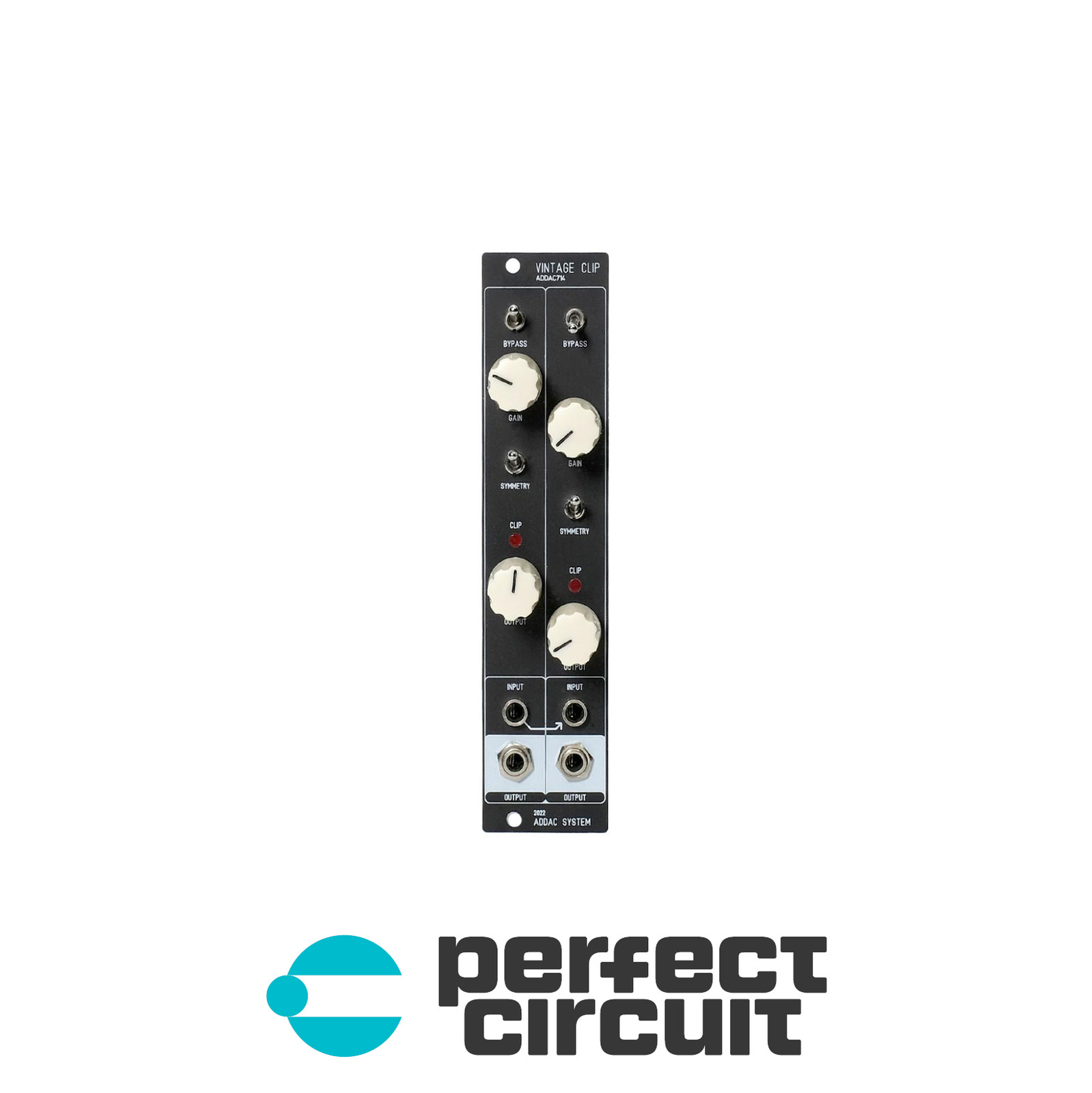
Each of the two channels operates independently or can be normaled, letting you process stereo sources or cascade a single signal through both stages for cumulative saturation. The topology is elegantly minimal: diode-based passive clipping creates a hard “brick wall” limit, but the term “soft clipping” here isn’t marketing fluff—it genuinely rounds off the waveform in a way that feels organic, not jagged. There’s no DSP trickery, no attempt to model vintage gear through algorithms. Instead, ADDAC leans on analog circuitry inspired by 1970s signal paths, using real diodes and a fixed passive RC low-pass filter at 3.3kHz to shape the tone. That filter is always active, and it’s the secret sauce: it takes the edge off the highs, giving everything a slightly veiled, aged quality—like listening to a well-worn cassette tape where the top end has gently faded. It’s not a flaw, but it’s a commitment. If you’re after transparent overdrive with sparkling highs, this isn’t your module. But if you want to make a modern, clinical Eurorack rig sound like it was recorded in a dimly lit studio circa 1975, the 714 gets you there in two knobs and a switch.
The signal path is split into two gain stages: the first handles the clipping threshold via the Gain knob, while the second—after the diodes—gives you an Output control to rein things in. This dual-stage approach means you can drive the input hard and still manage the final level without losing headroom or introducing noise. A red LED near the output glows when clipping is active, offering a quick visual cue, though it doesn’t distinguish between mild saturation and full-on squashing. The bypass switch is fully mechanical, so you’re not introducing any extra circuitry into the signal path when disengaged—just pure, uncolored pass-through. At 6HP and 40mm deep, it’s skiff-friendly and won’t hog space, making it an easy fit even in tightly packed systems. Power draw is modest: 40mA on both +12V and -12V rails, nothing that’ll stress a standard Eurorack supply.
Specifications
| Manufacturer | ADDAC System |
| Production Years | 2023– |
| Original Price | €130 (assembled), €77 (DIY kit, excl. VAT) |
| Format | Eurorack |
| Width | 6HP |
| Depth | 40mm |
| Power Consumption (+12V) | 40mA |
| Power Consumption (-12V) | 40mA |
| Channels | Dual |
| Clipping Type | Diode-based passive soft clipping |
| Clipping Modes | Bipolar (odd and even harmonics), Unipolar (odd harmonics only) |
| Filter | Passive RC low-pass, -3dB at 3.3kHz |
| Controls | Gain (per channel), Output (per channel), Bypass switch (per channel), Symmetry switch (per channel) |
| Indicators | Clipping LED (per channel) |
| Inputs | Left and Right (Left normalled to Right) |
| Outputs | Left and Right |
| Construction | PCB with pre-soldered SMD components (DIY kit), fully assembled option available |
| DIY Availability | Yes, full kit with through-hole components to solder |
Key Features
The Diode Wall: Analog Limiting Without the Fizz
The heart of the 714 is its diode clipping stage, which acts as a passive “brick wall” limiter. Unlike op-amp-based clippers that can introduce their own coloration or distortion artifacts, this design relies on the inherent voltage drop of the diodes themselves—typically around 0.7V for silicon—to cap the signal peak. The result is a predictable, consistent clipping threshold that doesn’t vary with input level or temperature. Because it’s passive, there’s no active gain before the diodes, which keeps noise low and preserves transient detail. What you lose in dynamic range, you gain in warmth. The clipping isn’t symmetrical by default; instead, the Symmetry switch lets you choose between bipolar (clipping both positive and negative waveform peaks) and unipolar (clipping only the positive half). This isn’t just a tonal tweak—it fundamentally changes the harmonic content. Bipolar mode generates both odd and even harmonics, giving a fuller, more complex saturation reminiscent of tube overdrive. Unipolar mode produces only odd harmonics, resulting in a leaner, more nasal crunch that cuts through a mix but can get aggressive fast. It’s a subtle but powerful choice, and having it on a toggle per channel means you can process stereo signals with asymmetrical character—one side warm and round, the other sharp and biting.
That 3.3kHz Filter: Love It or Leave It
The fixed low-pass filter at 3.3kHz is the 714’s defining compromise. It’s not user-adjustable, not switchable, not skippable—it’s always there, gently rolling off everything above that point. At -3dB, it’s not a steep cutoff; more like a gentle slope that takes the clinical edge off digital oscillators or bright FM tones. In practice, it’s what makes the 714 sound “vintage” rather than just “dirty.” It mimics the bandwidth limitations of older recording gear, where high-frequency content was naturally attenuated by tape heads, transformers, or early solid-state circuits. But it also means you can’t use this module if you’re trying to preserve crisp hi-hats, cymbals, or FM percussion. One user reported running their MPC through it to emulate an E-Mu SP-1200’s gritty character—perfect for lo-fi hip-hop—but found the mix got too muddy when complex high-frequency counterpoint was involved. That’s not a flaw in execution; it’s a design philosophy. The 714 isn’t trying to be a transparent saturator. It’s trying to be a time machine.
Dual Channels with Real Flexibility
Having two identical channels isn’t just about stereo processing. The normalling—from left input to right—means you can patch a mono source into the left jack and have it automatically feed both channels. That opens up creative possibilities: run a drum bus into the first channel, then patch its output into the second for a double-dose of saturation. Or use the two channels to process different elements—say, bass in one, leads in the other—then mix them downstream. Each channel has its own bypass, gain, symmetry switch, and output control, so you’re not locked into parallel processing. The output stage uses an op-amp with x2 gain, which helps compensate for signal loss after clipping (since diode clipping tends to reduce overall amplitude). This means you can drive the input hard without having to boost gain downstream, keeping noise in check. It’s a thoughtful bit of engineering that makes the module feel more pro than its price suggests.
Historical Context
The ADDAC714 arrived in 2023, a time when Eurorack was already saturated with distortion modules—everything from clean digital waveshapers to chaotic analog manglers. What set the 714 apart was its restraint. While many manufacturers were chasing extreme, in-your-face effects, ADDAC went the opposite direction: a module that colors the sound without dominating it. It fits into a broader trend of “vintage-inspired” analog processing in modular, where builders look to 1970s studio gear—not just for tone, but for circuit topology. Unlike modules that use DSP to model old tape machines or tube amps, the 714 achieves its character through actual analog components, echoing designs found in classic preamps and limiters from that era. It’s part of ADDAC’s 700 series, dubbed “Analog Heritage,” which suggests a deliberate effort to ground their designs in historical precedent rather than digital simulation. Competitors like the 4ms Rotating Inputs or the WMD SX-1 offer more complex distortion algorithms, but they lack the 714’s simplicity and immediacy. This isn’t a module for sound design experimentation—it’s for tone shaping, the kind of thing you’d find on a channel strip in a vintage console.
Collectibility & Value
As of 2026, the ADDAC714 isn’t a vintage item by strict definition, but it’s already developed a cult following among modular users who value analog authenticity over feature bloat. The assembled version retails for €130, while the DIY kit comes in at €77 before VAT—making it one of the more affordable entry points into high-quality analog clipping. On the used market, prices hover around $100–$130 depending on condition, with little premium for NOS (new old stock) units since production has been steady. The DIY kit is popular among builders, especially since the SMD components come pre-soldered, reducing the skill barrier. Failures are rare, but the most common issue reported is cold solder joints on the through-hole components if the kit wasn’t assembled carefully. The diodes themselves are robust, but overvoltage (from incorrect power supply polarity) can kill the module instantly—always double-check your cable before powering up. There’s no firmware, no calibration, no trim pots to tweak, so once it’s built, it’s essentially maintenance-free. If you’re buying used, check that the bypass switches click cleanly and that the LEDs respond to signal. No LED activity could mean a dead op-amp or a broken trace, but given the simple design, most issues are repairable with basic tools. It’s not a “grail” module, but it’s a keeper for anyone who values tone over tricks.
eBay Listings
As an eBay Partner, we earn from qualifying purchases. This helps support our independent vintage technology research.