ADDAC System ADDAC712 Vintage Pre (Years Not Confirmed)
Two channels of 1970s-inspired discrete grit, ready to soften edges or rip them clean off
Overview
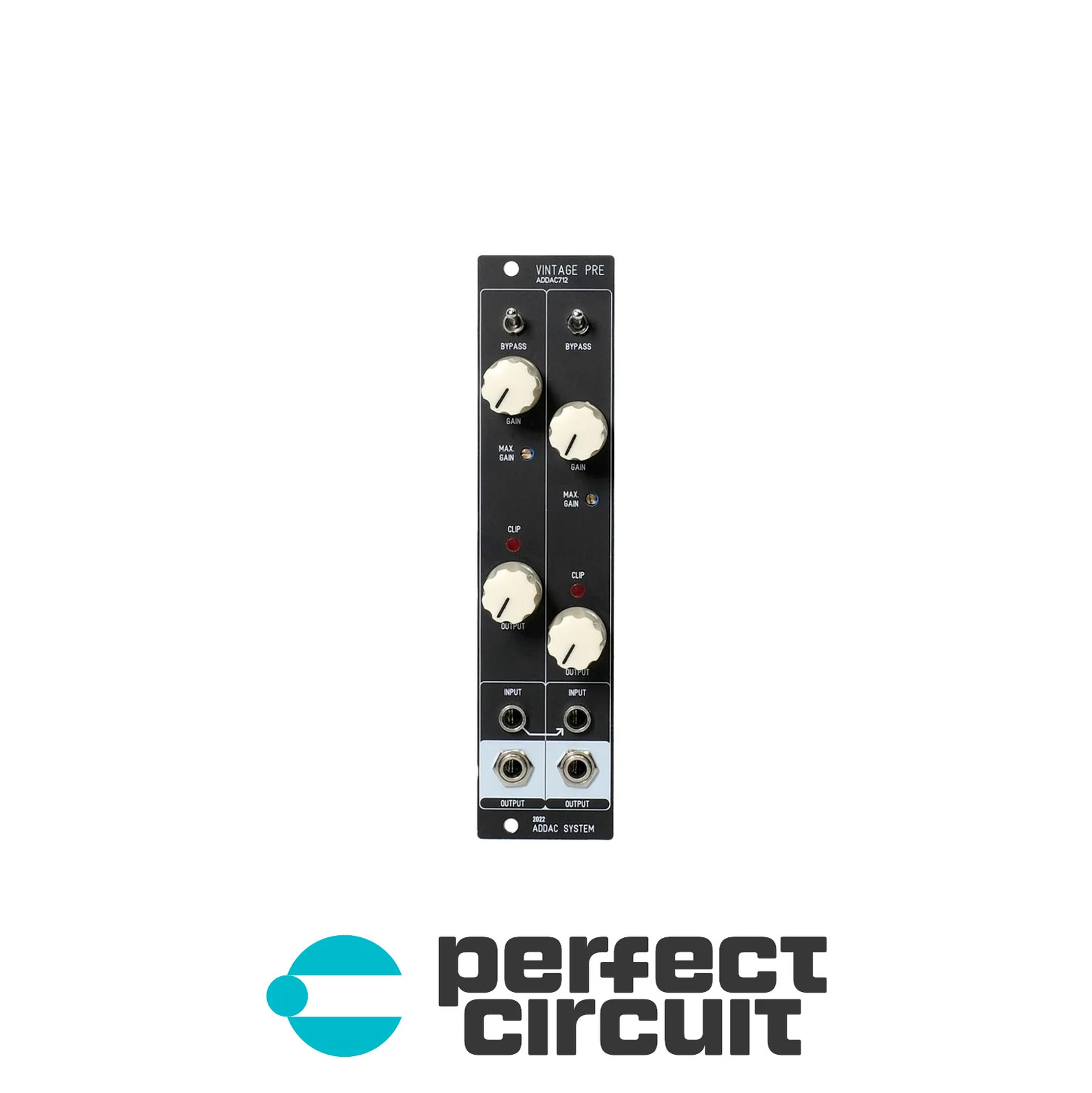
If you’ve ever wished your clean digital oscillators could sound like they were recorded through a dusty console in a 1975 psych rock session, the ADDAC712 Vintage Pre is whispering your name. It’s not a subtle flavoring—it’s a full-course meal of vintage saturation, built as a dual-channel discrete preamplifier for Eurorack systems. Made by ADDAC System, a name that’s carved out a niche in thoughtful, character-driven modules, this 6 HP slab brings the warmth, fuzz, and harmonic complexity of a classic 1970s discrete preamp design into the modular world. It doesn’t just amplify—it transforms.
The module is based on a famous discrete preamp board from the 1970s, the kind once tucked inside gear that now sells for thousands. While the specific legendary equipment isn’t named (and likely won’t be), the lineage is clear in its behavior: it’s designed to clip, saturate, and distort with musicality. It’s not about clean gain staging—it’s about coloring the signal from the moment it hits the input. Whether you’re feeding it a crisp digital square wave or a brittle sample, the ADDAC712 wraps it in a soft, organic haze before pushing it into full-on hard clipping territory.
Each of the two identical channels gives you separate Gain and Output controls, letting you stage the signal path precisely—crank the input for saturation, then rein in the output to avoid frying downstream modules. And because no two systems are identical, each channel includes a trimmer to adjust the maximum gain, a small but meaningful touch for system integration. It’s not just a pedal in a Eurorack shell; it’s a proper preamp stage with surgical tweakability beneath its aggressive character.
Specifications
| Manufacturer | ADDAC System |
| Model | ADDAC712 Vintage Pre |
| Product Type | Eurorack module; dual-channel discrete gain staging amplifier/preamp |
| Width | 6 HP |
| Depth | 40 mm |
| Power Consumption | 40 mA +12V, 40 mA -12V |
| Item Number | 25666 |
| Finish | Black |
| Made in | Portugal |
| MPN | ADDAC712 |
| Gain Control | Gain knob per channel |
| Max Gain Adjustment | Trimmer per channel |
| Signal Integrity | Up to 5.5v of bipolar signal maintains integrity |
| Saturation Threshold | Signal saturates beyond 5.5v |
| Hard Clipping | Occurs around 6v |
| Output Circuit | Opamp x2 gain circuit |
| Output Monitoring | LED monitoring per output |
| Frequency Response (User Estimate) | Slope guessed as 6dB per octave (Mod Wiggler) |
Key Features
Discrete 1970s Circuitry, Reborn
The heart of the ADDAC712 is its discrete design—no integrated circuits here, just transistors and passive components wired to replicate the behavior of a vintage preamp board from the 1970s. This isn’t just marketing speak; discrete circuits behave differently than opamp-based ones, often with softer transitions and more complex harmonic generation when pushed. The result is a preamp that doesn’t just boost—it breathes. When you drive a signal into it, you’re not just adding gain, you’re engaging a circuit that reacts, compresses, and colors in ways that feel alive. It’s the kind of module that makes you route things through it just to hear how they change, even if you didn’t “need” to.
From Soft Saturation to Hard Clipping
The ADDAC712 doesn’t tiptoe into distortion—it invites you to explore the full range. Up to 5.5v, bipolar signals maintain their integrity, but as they cross that threshold, saturation begins to bloom. This isn’t digital clipping; it’s analog, gradual, and musical. Push further, and hard clipping kicks in around 6v, delivering a fuzz that’s aggressive but not harsh. The transition from clean to dirty is smooth and predictable, making it useful for everything from warming up sterile digital oscillators to mangling drum samples into oblivion. It’s particularly effective on guitar signals—owners report it adds subtle overdrive when fed into a proper preamp chain—though it’s not ideal for preserving crisp hi-hats or high-frequency detail, where its character might dull the sparkle.
Per-Channel Control and Monitoring
Each of the two channels is fully independent, with its own Gain and Output controls. This lets you treat two different signals—say, a bass oscillator and a noise source—with entirely different levels of saturation. The Output stage includes an opamp x2 gain circuit, which can be used to boost the signal back after heavy saturation or to fine-tune levels for downstream modules. LED monitoring on each output gives immediate visual feedback on signal presence and clipping behavior, a small but crucial aid when dialing in levels blind. And the trimmer for maximum gain per channel? That’s the kind of detail that suggests ADDAC didn’t just clone a circuit—they thought about how it would live in a real system.
Designed to Feed the Fuzz
There’s a suggestion in the community that the ADDAC712 was practically made to feed the ADDAC714 Vintage Clip—a module designed for even more extreme clipping. The idea makes sense: use the 712 as a warm, musical preamp stage, then slam that into the 714 for full-on destruction. But even on its own, the 712 stands as a complete character module. It’s not just for distortion junkies; it’s for anyone who wants to add analog warmth, subtle compression, or harmonic richness to otherwise clinical sources. Digital modules, in particular, benefit from its touch—suddenly, that cold, perfect sine wave sounds like it’s coming through a console that’s been warmed up for three hours.
eBay Listings
As an eBay Partner, we earn from qualifying purchases. This helps support our independent vintage technology research.