ADDAC System ADDAC203 (2010–2023)
A humble Eurorack utility that quietly became a cult favorite for voltage taming and CV sculpting
Overview
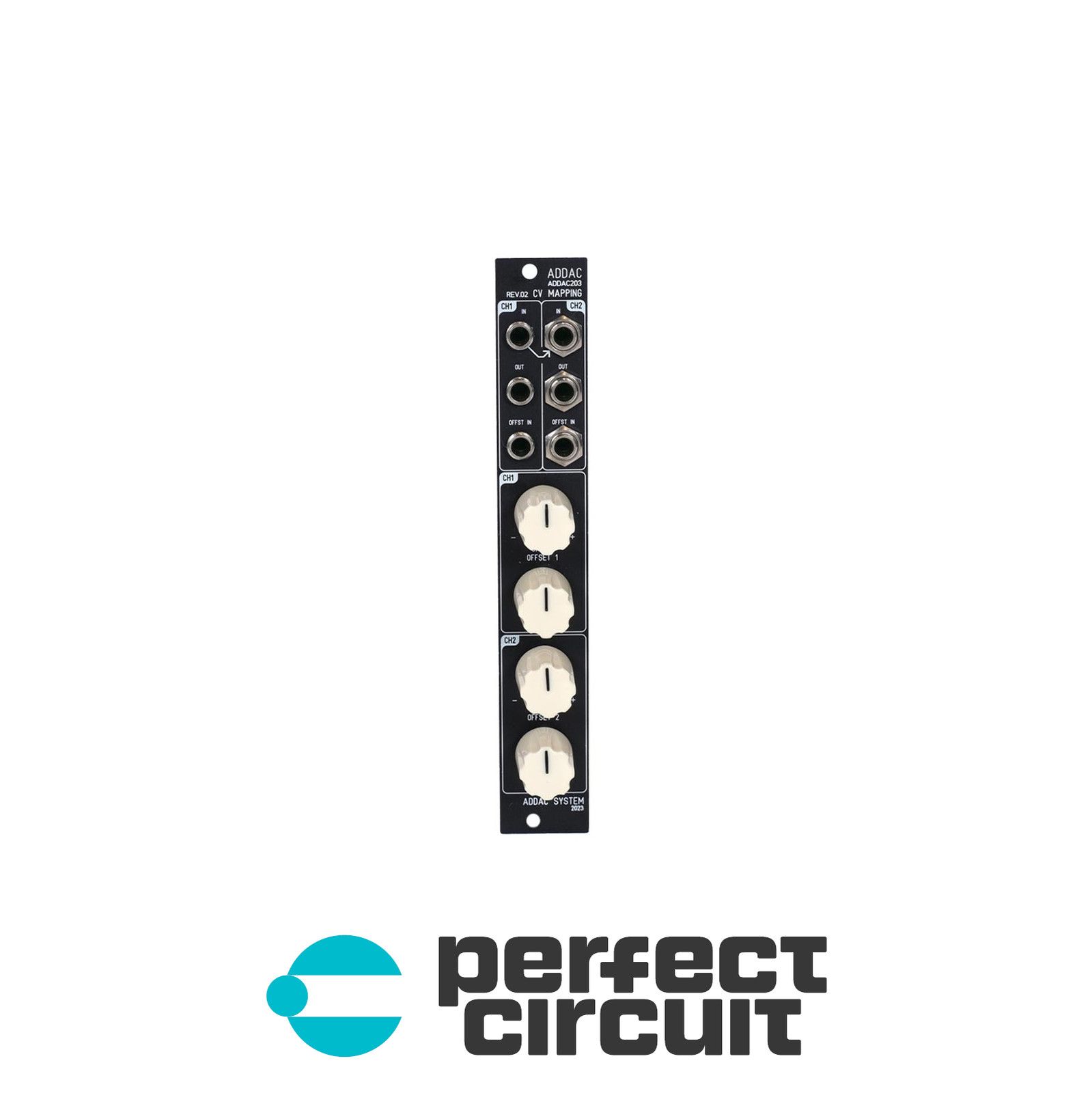
It doesn’t scream for attention, doesn’t glow with blinking lights or promise sonic fireworks—this is the ADDAC203 CV Mapping module, a workhorse of voltage control that does exactly what it says, and does it well. You won’t find waveforms blooming from its faceplate or presets stored in memory; instead, it’s all knobs, jacks, and analog precision, quietly shaping control voltages in ways that make the rest of your modular rig sing in tune. Originally released in 2010, the ADDAC203 carved out a niche as a dual-channel offset and attenuverter, letting users compress, invert, and shift CV signals with surgical control. It wasn’t flashy, but in a system where a single out-of-range envelope can derail an entire patch, having a reliable voltage wrangler is like owning a good pair of pliers—unseen, underrated, but utterly essential.
The module evolved over time, with the REV.02 update slimming it down from 4HP to a more compact 6HP footprint—a counterintuitive move that actually improved usability by repositioning jacks and adding a CV input for offset control. That revision also introduced a jumper on the back to cap gain at either unity (x1) or x10, giving builders and tech-savvy users a way to tailor the module’s response to their system’s needs. This isn’t a module that tries to be everything; it’s a specialist. Each channel handles input, attenuation (with phase inversion), and offset, letting you map erratic LFOs into usable pitch ranges, scale down gate voltages, or offset random voltages to sit perfectly in a desired octave. It’s the kind of module you don’t realize you need until your sequencer’s output is clipping a VCO’s CV input—and then suddenly, it’s indispensable.
Specifications
| Manufacturer | ADDAC System |
| Production Years | 2010–2023 |
| Original Price | 100€ (assembled), 74€ (DIY kit) |
| Format | Eurorack |
| Width | 6 HP (REV.02) |
| Depth | 2.5 cm (REV.02), 3 cm (original) |
| Power Supply | ±12V or ±15V compatible |
| Current Draw | 40mA +12V, 40mA -12V (REV.02) |
| Bus Board Connector | 8×2 IDC (Doepfer style) |
| Channels | 2 |
| Input Voltage | ±10V |
| Output Voltage | ±10V |
| Gain Control | Attenuverter with selectable max gain (x1 or x10 via back jumper) |
| Offset Range | -5V to +5V |
| Offset CV Input | Yes (REV.02) |
| Normalled Inputs | No |
| DIY Availability | Yes (full kit available) |
| Custom Panel Options | Yes (Red, Green, Blue, White, Silver Gray, Yellow, Gold) |
Key Features
Dual-Channel Voltage Sculpting
Each of the two channels on the ADDAC203 operates independently, giving you full control over two separate CV paths. The signal flow is straightforward: input, gain (via attenuverter), then offset. The attenuverter is key—it doesn’t just reduce signal amplitude, but can flip its polarity, which is crucial when you’re trying to invert an envelope or reverse an LFO’s sweep. This kind of phase manipulation isn’t just a convenience; it opens up expressive patching possibilities, like making a rising envelope close a filter instead of opening it. The offset knob then shifts the entire signal up or down between -5V and +5V, which is perfect for tuning a pitch CV to the right octave or biasing a modulation source into a desired range. When no input is patched, the offset control alone can generate a steady DC voltage, turning each channel into a simple offset generator.
CV-Controlled Offset (REV.02)
The REV.02 update added a CV input for the offset stage, a small but powerful upgrade. Now, instead of a static offset, you can modulate the DC bias with another CV source—say, an LFO to slowly drift a pitch over time, or a sequencer to shift modulation depth step by step. This turns the module from a static utility into a dynamic part of your patch. Want to sweep a filter’s cutoff across octaves using a slow sine wave? Patch the LFO into the offset CV input and dial in the range with the offset knob. It’s subtle, but it’s the kind of flexibility that separates a basic attenuator from a true voltage mapper. The addition of the CV input also reflects ADDAC’s responsiveness to user feedback—this wasn’t just a spec bump, but a thoughtful refinement based on how people actually use these modules in practice.
Gain Jumper and DIY Flexibility
On the back of the PCB, a small jumper lets you set the maximum gain to either x1 (unity) or x10. This is a boon for system builders who want to fine-tune the module’s behavior—x1 keeps things predictable for precise scaling, while x10 lets you boost weak signals or exaggerate modulation depth. More adventurous users can modify the gain by swapping resistors, opening the door to custom calibration. The fact that ADDAC offers a full DIY kit speaks to the module’s appeal among builders and tinkerers. It’s not just a black box; it’s a platform. The assembly guide is detailed and well-illustrated, making it accessible even to intermediate solderers. And for those who like their rack to have personality, custom front panels in colors like gold, red, or silver gray let you personalize the module—rare for utility gear, and a nice touch from a company that values both function and flair.
Historical Context
The ADDAC203 emerged during the early 2010s Eurorack renaissance, when modular synthesis was shifting from boutique curiosity to widespread adoption. At the time, many manufacturers focused on flashy sound generators or complex sequencers, but ADDAC System staked its claim in the utility space—modules that don’t make sound, but make everything else work better. The 203 was part of their 200 Series, dedicated to analog CV utilities, and it filled a quiet but critical gap: voltage scaling and offsetting. In a modular system, not all modules speak the same voltage language. A sequencer might output 0–8V, but a VCO expects 1V/octave; an LFO might swing ±8V, but a filter only wants ±5V. Without proper mapping, you get unstable tuning, clipped modulation, or unpredictable behavior. The ADDAC203 gave users a reliable, dual-channel solution. It wasn’t the only attenuverter on the market, but its combination of clean layout, dual functionality, and ADDAC’s growing reputation for solid build quality made it a go-to choice. As modular systems grew more complex, the need for precise CV management only increased—making the 203 not just useful, but essential.
Collectibility & Value
The ADDAC203 isn’t a rare unicorn, but it’s not generic either. Original 4HP versions from the early 2010s occasionally surface on the used market, but most collectors are focused on the REV.02, which is the definitive version. Prices for used REV.02 modules typically range from €80 to €120, depending on condition and whether it includes the original packaging or DIY kit materials. Assembled units in good working order hold their value well, especially with custom panels, which can add €20–€30 in resale value. The DIY kit, originally €74, is still sought after by builders and often sells secondhand for similar prices, sometimes more if rare panel colors are included.
Failures are rare, but not unheard of. The most common issue is misaligned potentiometers—early ADDAC modules, including the first 203s, had attenuverter knobs that felt “backwards” to some users (fully counter-clockwise = full signal). While REV.02 didn’t reverse the taper, the updated layout and labeling make it less confusing. More serious issues usually stem from incorrect power connection or DIY assembly errors—always check the jumper setting and ensure the module is receiving proper ±12V or ±15V. There’s no firmware, no digital components, so once it’s built right, it should last indefinitely. When buying used, test both channels for smooth pot response and verify that the offset CV input modulates cleanly. No LEDs or calibration routines here—just analog reliability. For a utility module, it’s surprisingly collectible, not because it’s rare, but because it’s trusted. In a world of overengineered modules, the ADDAC203 remains a quiet testament to doing one thing very well.
eBay Listings
As an eBay Partner, we earn from qualifying purchases. This helps support our independent vintage technology research.