ADDAC System 714 Vintage Clip (2022–)
A tiny diode-based brick wall that doesn’t just clip your signal—it seasons it, with a fixed low-pass filter that rolls off the top end like analog tape hitting saturation.
Overview
Plug a clean sine wave into the ADDAC 714 Vintage Clip and turn up the Gain—you’ll hear it first as a rounding of edges, then a soft bloom into warmth, then, as the diodes start conducting, a full-bodied crunch that feels less like digital clipping and more like something alive being gently overdriven. It’s not a surgical distortion; it’s a character module. The 714 doesn’t just add harmonics—it shapes them, filters them, and then hands them back with a knowing wink. This is soft clipping with attitude, built around passive diode circuits that behave like old-school analog limiters, the kind that used to live inside mixing consoles from the '70s, only here you can dial it in per channel and route it any way you like.
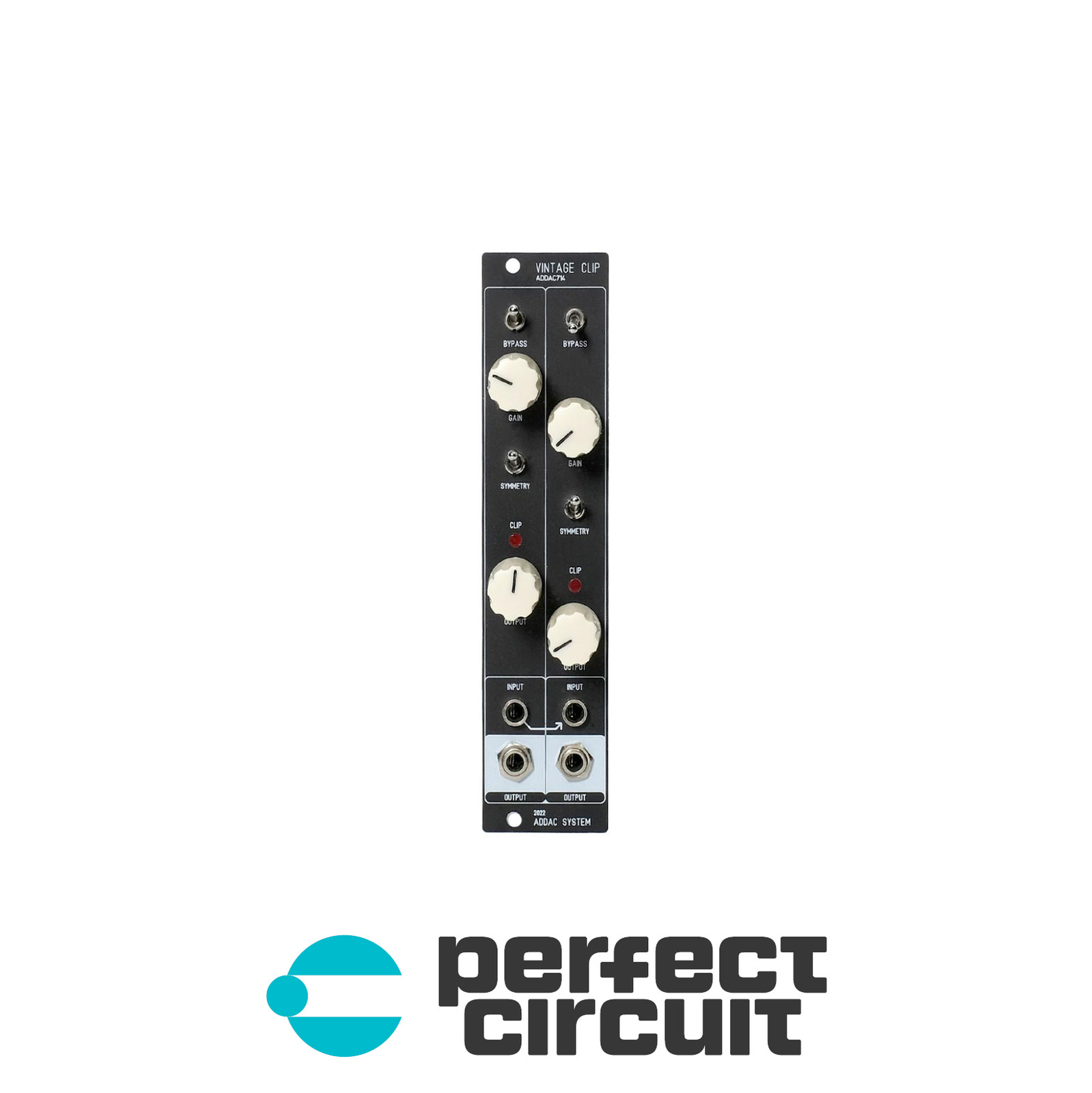
At just 6HP, it’s lean, but don’t let the size fool you—this module packs dual channels with independent gain, output, bypass, and a symmetry switch that changes the harmonic profile at the flip of a toggle. That last bit is where the 714 really sings: switch to bipolar (up), and you get both odd and even harmonics, a richer, more complex distortion that thickens leads or adds presence to drums. Flip it to unipolar (down), and it’s all odd-order—think classic tube-style overdrive, hollow and biting, perfect for carving space in a dense mix. The signal path is elegantly split into two gain stages: the first does the clipping, the second compensates and gives you control over the final output level, which means you can drive the front end into oblivion and still walk away with a usable, balanced signal. And yes, there’s an LED that lights up when the output stage clips—because sometimes you need to know when you’ve gone too far, even if it sounds good.
What really sets the 714 apart isn’t just the sound, though—it’s the fixed 3.3kHz low-pass filter baked into the design. This isn’t a module for preserving transient detail on cymbals or hi-hats; it’s for warming up digital sources, rounding off harsh edges, and making things feel older than they are. That filter rolls off at -3dB around 3.3kHz, giving everything a mellow, slightly veiled quality that some users compare to running a mix through an old E-Mu sampler or a cassette deck pushed into the red. It’s not subtle, and it’s not optional—but that’s the point. This isn’t a clean boost or a transparent limiter. It’s a flavor enhancer. Run your MPC through it, as one owner did, and suddenly your hip-hop beats sound like they were pulled from a '90s crate digger’s tape stash. Feed it a modular sequence with intricate high-end detail, and yes, it might get a little muddy—so use it where that coloration serves the music, not fights it.
Specifications
| Manufacturer | ADDAC System |
| Production Years | 2022– |
| Original Price | 130€ (assembled), 77€ (DIY kit, excl. VAT) |
| Format | Eurorack |
| Width | 6 HP |
| Depth | 40 mm |
| Power Consumption (+12V) | 40 mA |
| Power Consumption (-12V) | 40 mA |
| Channels | Dual (stereo or dual mono) |
| Clipping Type | Diode-based passive soft clipping |
| Symmetry Switch | Bipolar (odd + even harmonics) / Unipolar (odd harmonics only) |
| Filter | Passive RC low-pass, 3.3kHz -3dB point |
| Gain Control | Per channel, sets clipping threshold |
| Output Control | Per channel, post-gain stage |
| Bypass | Per channel, mechanical switch |
| Inputs | Left and Right (Left normalled to Right) |
| Outputs | Left and Right |
| Clipping Indicator | LED per channel (output stage) |
| DIY Availability | Yes, full kit with pre-soldered SMD components |
| Weight | 94 g (kit) |
Key Features
Diode-Based Soft Clipping with Character
The heart of the 714 is its passive diode clipping circuit, which behaves like a “brick wall” limiter with a soft knee determined by the physical properties of the diodes themselves. Unlike op-amp-driven clippers that can feel clinical, this approach introduces a natural compression and harmonic saturation that evolves smoothly as gain increases. There’s no digital modeling here—just analog components doing what they do best. Because the clipping is passive, it doesn’t add noise or coloration beyond what the diodes naturally produce, which means the distortion is consistent, predictable, and musically useful across a wide range of input levels. It’s not meant to be subtle, but it’s also not aggressive in a harsh way—more like a tube amp warming up on a cold morning.
Dual-Channel Flexibility and Signal Flow
Each channel operates independently, with its own gain, output, bypass, and symmetry switch, making the 714 ideal for stereo processing or dual-mono applications. The input jacks are normalled—Left to Right—so you can run a mono signal into the left input and have it automatically pass to the right channel, letting you process the same source with different clipping settings. This opens up creative possibilities: distort a kick and snare differently on the same bus, or run a stereo synth patch with asymmetric saturation for width and movement. The two-stage gain design—clipping first, then output leveling—means you can max out the drive without fear of overloading downstream modules, as long as you manage the final output knob. It’s a thoughtful workflow touch that reflects real-world use.
The 3.3kHz Low-Pass Filter: A Feature or a Limitation?
That fixed low-pass filter at 3.3kHz is the elephant in the room. It’s not advertised as a tone control, but it fundamentally shapes the module’s sonic identity. It rolls off high frequencies gently—around 6dB per octave—but the effect is unmistakable: transients soften, sibilance disappears, and everything gains a cozy, slightly distant quality. For sources that are already bright or digital, this can be a blessing. For material that relies on high-end clarity—FM synthesis, noise bursts, or crisp hats—it can feel like a loss. But that’s the trade-off: the 714 isn’t trying to be everything. It’s aiming for a specific vintage flavor, and that filter is part of the recipe. Think of it as the sonic equivalent of film grain—something added to evoke a bygone era, not to preserve clinical accuracy.
Historical Context
The ADDAC 714 Vintage Clip arrived in 2022 as part of a small wave of Eurorack modules that leaned into “analog heritage”—not by emulating vintage synths, but by capturing the behavior of old signal path components like preamps, transformers, and diode limiters. It shares DNA with the ADDAC 712 Vintage Pre, a discrete gain stage inspired by '70s console circuitry, though the 714 takes a different path: instead of amplifying cleanly, it leans into distortion as a creative tool. At a time when modular systems were filled with complex digital effects and morphing waveshapers, the 714 stood out for its simplicity and focus. It didn’t offer CV control, no wet/dry mix, no tone shaping—just gain, output, and a symmetry switch. That minimalism was a statement: sometimes, the best effects are the ones that force you to commit.
It also reflects a broader trend in modular synthesis: the desire to “warm up” digital sources. As more producers integrate MPCs, samplers, and DAW outputs into their racks, there’s been a growing appetite for modules that can add analog coloration in a single hop. The 714 fits that niche perfectly—small, affordable, and sonically distinct. It’s not competing with multi-effects units or plugin suites; it’s offering something those can’t replicate: the physical behavior of diodes and passive filters interacting in real time. In that sense, it’s less a modern recreation and more a distillation of a specific analog behavior—one that’s been hiding in plain sight in vintage gear for decades.
Collectibility & Value
The ADDAC 714 isn’t a rare module, but it’s not mass-produced either. Built in small batches by a boutique manufacturer based in Lisbon, availability depends on distributor stock and direct orders. As of 2026, the assembled module lists for 130€ (excluding VAT), while the DIY kit goes for 77€. On the secondhand market, assembled units typically sell for 100–140€, depending on condition and whether they include the original packaging or custom panel. The DIY version is more common and usually trades for 60–80€, reflecting the labor involved in assembly.
Because it’s a recent design (2022), there are no widespread reliability issues reported. The module uses standard through-hole and SMD components, with no known failure-prone parts. However, owners of DIY builds should ensure proper soldering, especially on the power header and jacks, as cold joints could cause intermittent signal or power issues. The front panel is aluminum, durable but prone to scratches if handled carelessly. The symmetry switches and potentiometers are standard Alps-style components, which are reliable but can wear over years of heavy use.
For buyers, the real question isn’t reliability—it’s suitability. The 714 is not a general-purpose distortion. If you need clean gain staging, CV control, or high-frequency preservation, look elsewhere. But if you want a compact, characterful soft clipper that adds warmth and mild saturation with a vintage tilt, it’s hard to beat. Watch out for knockoffs or mislabeled listings on eBay—some sellers confuse it with other “vintage”-named modules, but the 714 is distinct in both circuit and behavior. Always verify the model number and check for the symmetry switch and fixed low-pass response in demo videos before buying.
eBay Listings
As an eBay Partner, we earn from qualifying purchases. This helps support our independent vintage technology research.