ADDAC System 713 (2022–)
A wolf in sheep’s clothing: a stereo mixer that clips, howls, and gate-crushes your mix into oblivion.
Overview
Plug in a clean stereo patch, turn up the master, and you’ll think you’ve got a polite little summing box—until you push it. Then the ADDAC 713 reveals its teeth: a growling, snarling beast of discrete saturation that doesn’t just color your sound, it mutates it. This isn’t some soft-knee op-amp saturation unit; this is a fully discrete analog mixer inspired by the Moog CP3, built with the kind of rugged transistor architecture that doesn’t apologize for distortion—it invites it. Designed initially as a percussion mixer to place hits in the stereo field, ADDAC scrapped that idea and went full predator, turning the 713 into a feedback-wielding, gate-generating, overdrive-happy engine for sonic mayhem.
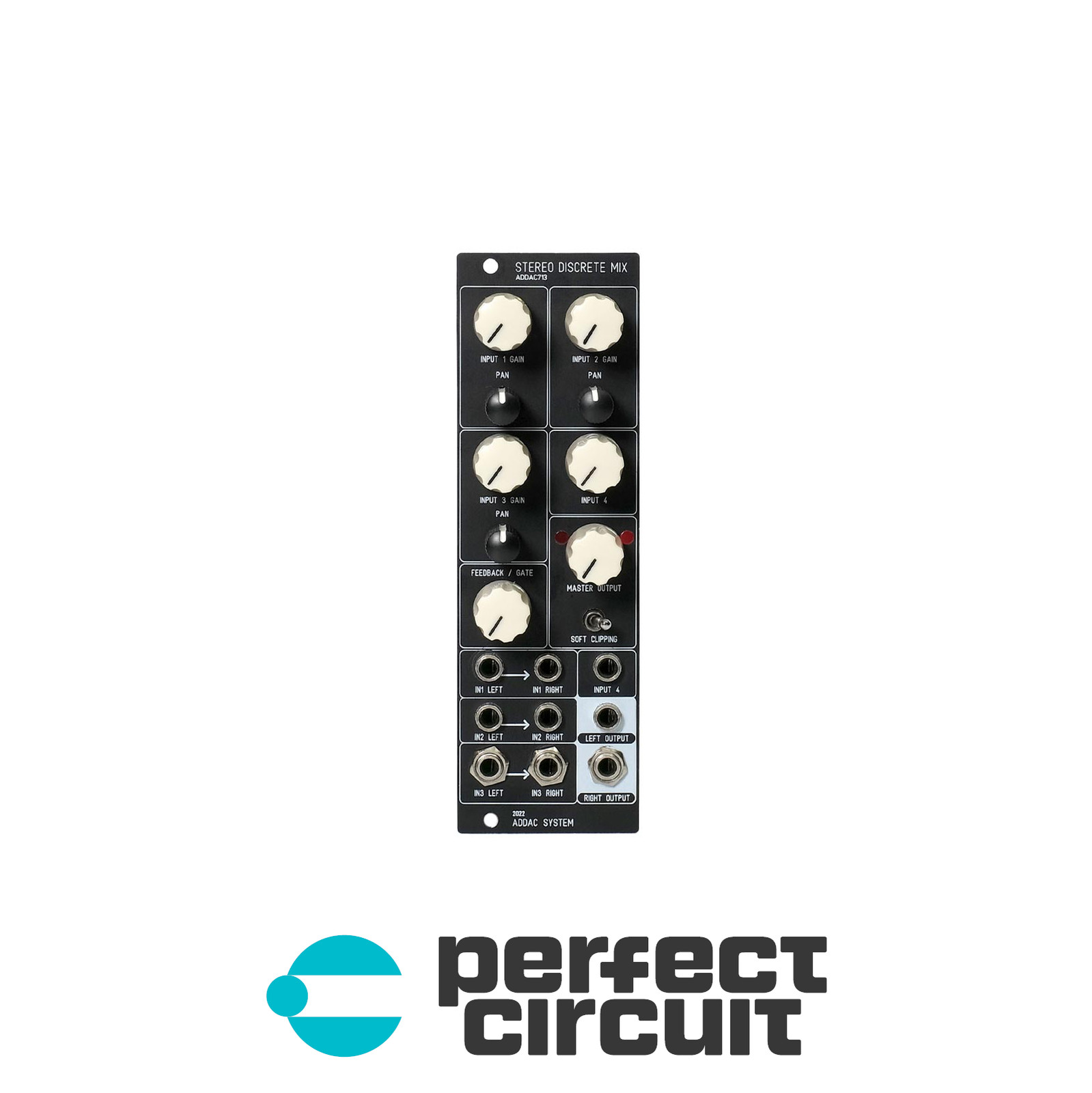
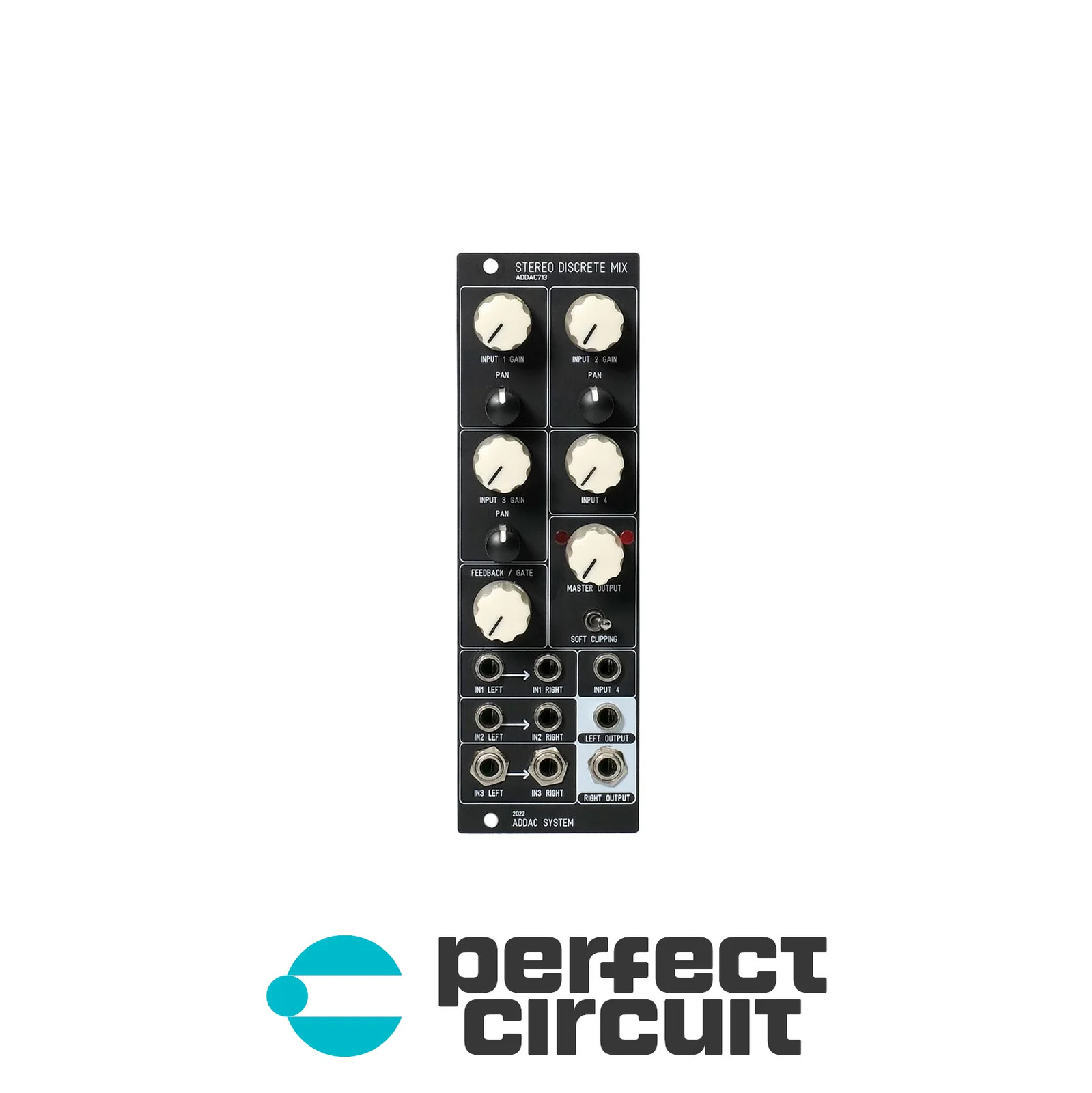
At its core, it’s a four-channel stereo mixer in 8HP—compact, yes, but deceptively deep. Three of those channels accept stereo inputs, each with individual gain and pan controls, letting you place sounds anywhere in the stereo image. The fourth channel is mono, a deliberate nod to tradition: keep your kick or bass dead center while everything else swirls around it. That alone makes it useful in any Eurorack system, but the 713 doesn’t stop at clean summing. It’s what happens after the mix that defines it. A feedback loop tucked under the third channel lets you route the master output back into the input, driving the entire mix into self-oscillation or cascading distortion. Turn the feedback knob clockwise and you don’t just get louder saturation—you get harmonic chaos, gate-like stuttering, and unpredictable textures that feel more like circuit bending than mixing.
And then there’s the clipping. Not an afterthought, not a switchable effect—clipping is baked into the DNA. The soft clipping switch engages an anti-click circuit with a built-in low-pass filter, offering three positions: soft low pass, off, and hard low pass. This isn’t just about taming transients; it’s about shaping the character of the distortion itself. In soft mode, the highs are smoothed, giving you warm, rounded saturation—perfect for vintage-style tube emulation. Flip it to hard, and the low-pass kicks in more aggressively, clamping down on high-frequency fizz that can emerge when you’re driving the feedback path into full-on meltdown. It’s a subtle but critical detail, one that keeps the 713 from turning into an unlistenable mess when pushed.
Two LEDs on the front panel monitor output level, not just for volume but for clipping behavior—because let’s be honest, you’re going to want to see when it’s breaking up. And break up it does, gloriously. Unlike many modern mixers that aim for transparency, the 713 wants to be heard. It adds weight, grit, and a certain analog “breath” to anything that passes through it. Even at moderate levels, there’s a slight thickening of the signal, a gentle saturation that feels like warming up cold digital oscillators. But when you really push it—say, feeding multiple overdriven oscillators or external drum machines into its inputs—the 713 stops being a mixer and starts being a performance instrument.
Specifications
| Manufacturer | ADDAC System |
| Production Years | 2022– |
| Original Price | €220 (assembled), DIY kit available |
| Format | Eurorack |
| Width | 8HP |
| Depth | 40mm |
| Power Consumption | +12V: 100mA, -12V: 100mA |
| Channels | 3 stereo, 1 mono |
| Inputs | 3x stereo input pairs (6 total), 1x mono input |
| Pan Controls | Per stereo channel |
| Feedback Path | Yes, with dedicated knob |
| Clipping Circuit | Soft/hard selectable via low-pass filter switch |
| Anti-Click Circuit | Engaged with soft clipping switch |
| Output | 1x stereo output |
| LED Indicators | 2x output level/clipping LEDs |
| Construction | Fully discrete analog design |
| Mounting | Standard Eurorack 3U panel |
| Color | Black anodized aluminum panel |
| Weight | Approx. 200g |
Key Features
Discrete Analog Circuitry with Character
The 713 isn’t built around op-amps or ICs—it’s fully discrete, meaning each gain stage is constructed from individual transistors and passive components, much like the Moog CP3 that inspired it. This design choice isn’t just nostalgic; it gives the module a dynamic, nonlinear response that feels alive. When you turn up the gain, the signal doesn’t just get louder—it blooms, with harmonics emerging in layers. The discrete topology also contributes to the module’s ability to handle feedback without fizzling out or locking up. Instead, it oscillates with a musicality that’s hard to replicate digitally. Even at unity gain, there’s a slight coloration—a “body” to the sound that makes quiet patches feel fuller and more present.
Feedback and Gate Generation
Few stereo mixers let you route the output back into the input, but the 713 not only allows it—it encourages it. The feedback knob isn’t just a trim; it’s a performance control. At low settings, it adds a subtle doubling effect or light resonance. Turn it up, and the mix begins to self-oscillate, creating drones, metallic rings, or rhythmic pulses depending on the input material. Push it further, and the feedback path starts to clip aggressively, producing gate-like chopping effects that can slice your audio into stuttering fragments. This isn’t clean amplitude modulation—it’s chaotic, unpredictable, and deeply analog. Some users report that at extreme settings, the feedback can generate its own rhythmic patterns, almost like a crude sequencer born from noise. It’s not for every patch, but when you need something unhinged, the 713 delivers.
Smart Clipping and Output Shaping
The three-position soft clipping switch is one of the most thoughtful design choices on the module. In “soft low pass” mode, a gentle filter rolls off the top end just before the output stage, reducing high-frequency harshness when driving the mixer hard. This is especially useful when mixing bright digital sources or FM oscillators that can get shrill under distortion. In “off” mode, the signal path is as direct as possible, letting you hear the raw clipping character. “Hard low pass” engages a steeper filter, useful for taming feedback squeal or creating lo-fi, telephone-style effects. The anti-click circuit, active in soft mode, prevents pops when patching or adjusting levels—small but essential in a live setting. Combined with the dual clipping LEDs, this gives the user real-time feedback on signal behavior, making it easier to ride the edge of breakup without going over.
Historical Context
The ADDAC 713 arrived in 2022, a time when Eurorack was deep into the “golden age” of utility modules—mixers, attenuators, and processors that were no longer afterthoughts but central to performance. While early modular systems relied on simple summing, the demand for stereo processing grew alongside the popularity of live modular performance. The 713 fits squarely into that shift, offering not just summing but transformation. It’s a descendant of the ADDAC 703, a mono discrete mixer that had already earned respect for its warmth and drive. By going stereo and adding feedback and gate functions, ADDAC didn’t just scale up—they reimagined what a mixer could do.
It also reflects a broader trend in Eurorack: the blurring of lines between signal path and effect. Modules like the 713, 712, and 714 from ADDAC aren’t just clean utilities—they’re tone-shapers, distorters, and sound manglers. Competitors like Intellijel, Mutable Instruments, and ALM had already explored saturated mixers, but few offered the 713’s combination of discrete design, feedback routing, and aggressive clipping in such a compact form. Its closest spiritual relative might be the Moog CP3, but the 713 pushes further into experimental territory, embracing instability as a feature rather than a flaw.
Collectibility & Value
As of 2026, the ADDAC 713 remains in production and readily available, so it’s not a “collector’s item” in the traditional sense—but it’s already earned a cult following among modular performers who value character over cleanliness. The original price of €220 for the assembled version holds steady, with DIY kits available at a lower cost for those comfortable with surface-mount soldering. On the secondhand market, used units sell for €180–€220 depending on condition, with little depreciation—rare for a utility module. That stability speaks to its perceived value: it’s not just a mixer, it’s a multi-tool for sound design.
Failures are rare, but service technicians note that the feedback path can be sensitive to improper patching, especially if high-level signals are fed into the return. There are no known design flaws, but owners report that the module draws a relatively high 100mA on both rails, so users with power-limited cases should plan accordingly. The discrete circuitry is robust, but like all analog gear, it can drift slightly over time—recalibration is rarely needed, but checking input/output levels every few years is advisable for critical applications.
When buying used, check that the pan pots don’t crackle and that the feedback knob responds smoothly across its range. The LEDs should illuminate with signal, and the soft clipping switch should click cleanly between positions. Because the 713 is often used in live sets, look for signs of overuse—worn knobs, loose jacks, or scratches on the panel that suggest heavy gigging. A well-maintained unit will last for years, but this isn’t a “set and forget” module—it’s meant to be pushed, so expect some wear if you’re hunting for a battle-tested performer.
eBay Listings

As an eBay Partner, we earn from qualifying purchases. This helps support our independent vintage technology research.