ADDAC 713 (2022–)
A sly little Eurorack mixer that starts clean and ends in snarling, gated chaos — like a polite conversation turning into a bar fight.
Overview
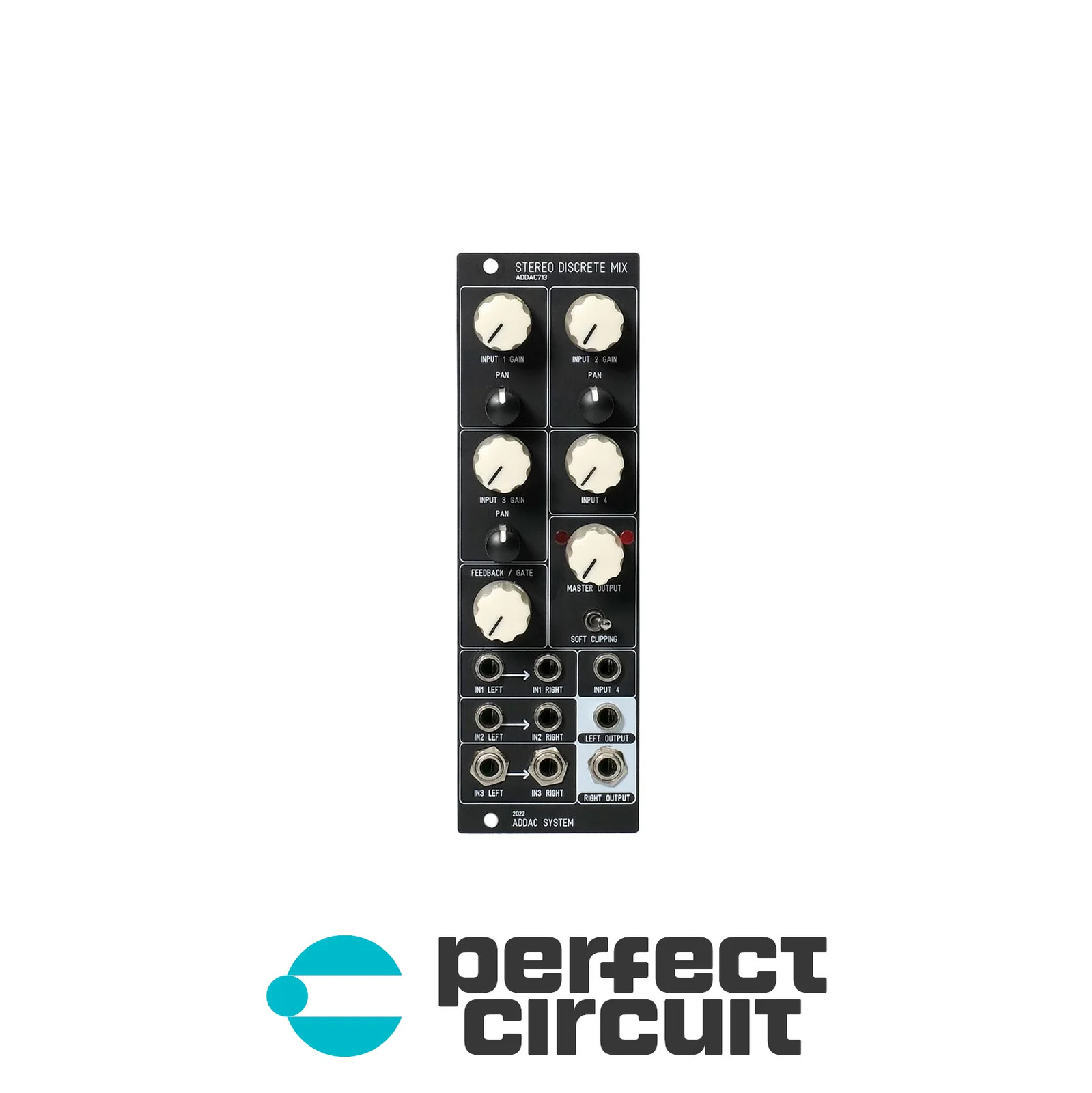
You flick the power on, patch in a few quiet oscillators, and the ADDAC 713 behaves itself — balanced stereo imaging, smooth panning, clean gain staging. Then you turn the Feedback knob just past noon, and suddenly your lush pads are being chewed up and spat out like overdriven trash. That’s the magic — and menace — of the 713. It doesn’t just mix; it mutates. Marketed as a stereo evolution of the beloved ADDAC703, this 8HP module wears a calm face but hides a circuit that’s ready to self-destruct in the most musical way possible. Inspired by Moog’s CP3, it’s fully discrete, meaning no op-amps muddying the signal path — just raw, unfiltered analog aggression when you ask for it. And you will ask for it.
At first glance, it’s a modest four-channel mixer: three stereo channels with gain and pan, one mono channel (perfect for kick or sub-bass), and a master output. But the real star is the Feedback/Gate knob — a deceptively labeled control that doesn’t just feed signal back into the mix; it warps the entire bias voltage of the circuit. Turn it clockwise, and you don’t just get overdrive — you get soft clipping, then hard clipping, then full-on gating as the signal gets shoved into the power rails. It’s not a distortion effect in the traditional sense; it’s a controlled meltdown. And because it’s all analog and discrete, the transitions feel organic, not digital or stepped. You’re not toggling modes — you’re riding a feedback wave that can go from warm saturation to rhythmic stutter to complete sonic obliteration.
Then there’s the Soft Clipping switch — a clever bit of engineering that doubles as an anti-click circuit. It inserts a low-pass filter before the output, with three positions: Soft Low Pass (gentle roll-off, smooths transients), Off (full bandwidth), and Hard Low Pass (steeper filtering, tames the fizz). It’s not just about tone; it’s about system safety. Crank the Feedback knob during a live set and you’ll appreciate not having loud DC pops hitting your speakers. The module’s compact depth (just 4cm) makes it skiff-friendly, and the dual LEDs for left and right output give you real-time visual feedback — essential when you’re pushing the mix into redline territory.
Specifications
| Manufacturer | ADDAC System |
| Production Years | 2022– |
| Original Price | €220 (assembled), €105 (DIY kit) |
| Format | Eurorack |
| HP | 8 |
| Depth | 40mm |
| Current Draw +12V | 80mA |
| Current Draw -12V | 80mA |
| Channels | 3 stereo, 1 mono |
| Inputs | 3x stereo (6 input jacks), 1x mono (1 input jack) |
| Outputs | 1x stereo master output |
| Controls | 4x gain knobs (per channel), 3x pan knobs, 1x feedback/gate knob, 1x master output knob, 1x soft clipping switch (3-position) |
| Indicators | 2x LEDs (left/right output level) |
| Circuit Type | Fully discrete analog |
| Special Features | Feedback-induced clipping and gating, anti-click soft clipping switch with low-pass filtering |
| Based On | ADDAC703 Discrete Mixer |
| Inspired By | Moog CP3 mixer |
| Assembly Options | Assembled or DIY kit available |
Key Features
The Feedback Knob That Breaks All Rules
Most mixers treat feedback as something to avoid — a technical flaw, a risk of oscillation. The 713 treats it as a feature. The Feedback/Gate knob doesn’t just route output back to input; it manipulates the DC bias of the entire circuit. As you turn it up, the signal isn’t just getting louder — it’s being pushed upward in voltage until it clips against the +12V rail. This creates a natural soft-clipping effect that evolves into hard clipping, and eventually, at extreme settings, cuts the signal entirely — not by muting, but by biasing it out of operational range. The result? A rhythmic gating effect that’s not tempo-synced, not quantized, but organic and slightly unpredictable. It’s perfect for live performance, where a simple twist can turn a steady drone into a pulsing, stuttering rhythm. And because it’s all analog, there’s no latency, no digital artifacts — just raw, immediate response.
Stereo Architecture With a Mono Anchor
The channel layout tells a story of thoughtful design. Three stereo channels let you place complex, wide sources across the soundstage — think stereo delays, granular textures, or dual-oscillator patches. The fourth channel, mono, is clearly intended for low-end foundation: kick drums, sub-bass, or any element you want centered and solid. This isn’t just practical; it’s psychoacoustic. Keeping the bass mono prevents phase cancellation and ensures punch, while the stereo channels provide movement and space. The pan controls are smooth and centered, with no dead zone — a small detail that matters when you’re automating or tweaking in real time. And because all gain knobs go to “extreme levels,” you’re not just mixing — you’re overdriving individual channels before they even hit the feedback stage, creating layered distortion that’s both chaotic and controllable.
Soft Clipping Switch: Tone Shaper and System Protector
The three-position Soft Clipping switch is more than a tone control — it’s a system safeguard. In Soft Low Pass mode, a gentle filter rolls off the highs, taming the fizz that can come from aggressive clipping. It’s ideal for vintage-style saturation, reminiscent of old tape or tube gear. In Off mode, you get the full, unfiltered bandwidth — crucial if you’re using the 713 as a clean mixer or want maximum clarity before distortion. Hard Low Pass engages a steeper roll-off, useful when you’re pushing the feedback into gate mode and want to avoid harsh transients. But the real genius is the anti-click function: by filtering before the output stage, it prevents sudden DC jumps when patching or adjusting the feedback knob. This isn’t just about sound — it’s about protecting your ears and your speakers. In a modular system where patch changes happen on the fly, that’s a feature worth its weight in gold.
Historical Context
The ADDAC 713 arrived in 2022, a time when Eurorack was deep into the “analog authenticity” movement — a backlash against the clean, digital-perfect sound of many modern modules. Designers were revisiting discrete circuits, tube emulations, and vintage topologies to reintroduce warmth, color, and unpredictability. The 713 fits squarely in that wave, but with a twist: it’s not just emulating vintage gear — it’s weaponizing it. While modules like the 4ms Rotating Inputs or Intellijel µVCA offered clean, precise mixing, the 713 leaned into chaos. It followed in the footsteps of the ADDAC703, a cult-favorite mono mixer known for its gritty character, and expanded it into stereo — not just for spatialization, but for greater sonic destruction.
Its inspiration, the Moog CP3, was a studio-grade mixer from the 1970s, prized for its punch and clarity. ADDAC didn’t just copy it — they amplified its most aggressive tendencies. In an era where many stereo mixers were becoming transparent signal routers, the 713 stood out by refusing to stay neutral. It competed with modules like the WMD Mix Minus and the TipTop Audio Z-Mix, but where those aimed for fidelity, the 713 aimed for character. It wasn’t the first mixer to offer overdrive — the Make Noise Optomix did it with light-dependent resistors — but it was among the first to make feedback a core part of the mixing process, not just an effect loop.
Collectibility & Value
The ADDAC 713 isn’t a rare bird — it’s in active production, and both assembled and DIY versions are available directly from ADDAC and dealers. That said, it’s developed a cult following among modular users who value character over cleanliness. In used markets, assembled units typically sell for €180–€220, depending on condition and whether they’ve been modified (custom panels are popular). The DIY kit, priced at €105, is a bargain for a fully discrete module, but requires intermediate soldering skills — the board is compact, and the discrete transistors need careful alignment.
Failure points are minimal — no moving faders, no complex ICs — but the feedback circuit’s reliance on precise biasing means power stability is critical. Running it in a poorly regulated power supply can lead to inconsistent clipping behavior or DC offset issues. The LEDs are simple indicators, but if one fails, it’s a sign to check the output buffer stage. No major design flaws have been reported, but owners note that the soft clipping switch’s mechanical feel can be a bit stiff — not a reliability issue, but something to be mindful of during frequent live use.
For buyers, the key is understanding what you’re getting: not a transparent mixer, but a coloration engine. If you want pristine summing, look elsewhere. But if you want a module that can go from subtle glue to full-on sonic demolition with one knob, the 713 delivers. It’s especially valuable in smaller systems where space is tight — 8HP that does mixing, distortion, and gating is hard to beat. And because it’s from ADDAC, a company known for thoughtful design and long-term support, it’s likely to hold its value among enthusiasts who appreciate analog character with a dark sense of humor.
eBay Listings
As an eBay Partner, we earn from qualifying purchases. This helps support our independent vintage technology research.