ADDAC 712 Vintage Pre (2022–)
A dual-channel time machine that smells like old console tape returns and sounds like your favorite records finally came to life in modular form.
Overview
Plug a clean sine wave into the ADDAC 712 and slowly crank the gain—you’ll hear it first as a soft bloom around the edges, then a low growl as the waveform starts to fray. Push harder and suddenly it’s not just distorting, it’s behaving: the zero-crossing point wobbles upward like a tape head losing bias, turning clean audio into something lopsided, almost gate-like, as if the signal’s been run through a half-dead Neve on a bad power day. This isn’t modeling. It’s not algorithmic. It’s discrete analog circuitry doing what old iron used to do when pushed too hard—and doing it with such character that you’ll find yourself patching through it just to hear your drums breathe.
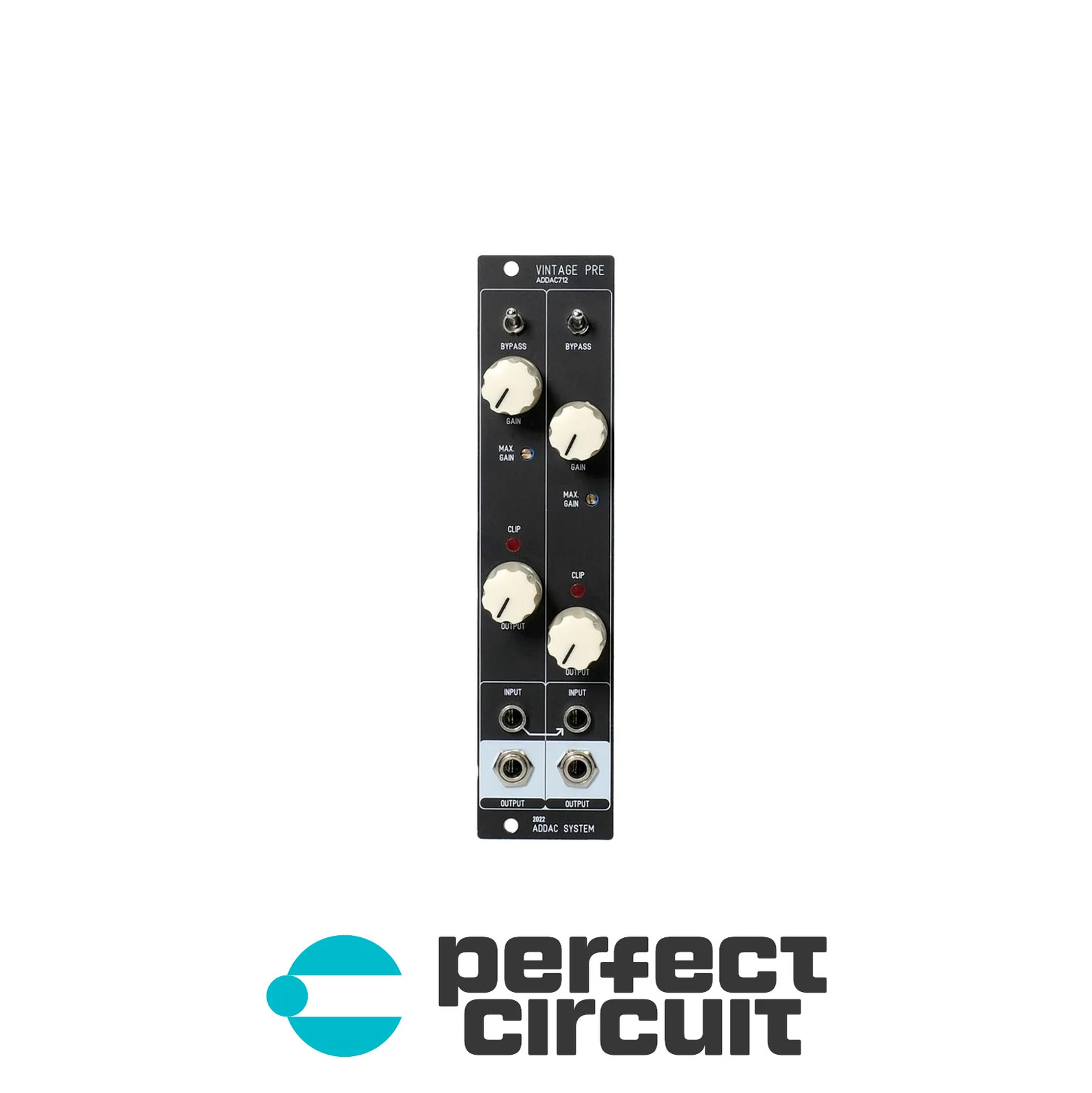
Built as a dual-channel Eurorack module, the 712 is deceptively simple: two identical preamp channels, each with input gain, output level, and a bypass switch. But the magic lives in the details. It’s based on a discrete preamp topology from the 1970s—ADDAC won’t say which one, but the sonic fingerprints point toward the kind of high-headroom, transformerless boards found in revered British consoles. The module doesn’t just clip; it saturates with a harmonic profile that’s rich in even-order warmth at lower drive settings, then flips into gritty, asymmetrical hard clipping when pushed past ±6V. That shift isn’t abrupt—it’s a slow corruption, like watching a tape machine melt into self-oscillation.
What makes the 712 more than just a distortion box is its dual gain stage per channel. You can slam the input to create wild fuzz textures, then use the output knob to pull it back into line level without losing the coloration. That kind of surgical control is rare in analog saturation modules, where most either go full chaos or stay too polite. Here, you can dial in just enough grit to make a sub-bass growl without turning your mix into mud. And because the inputs are normalled (left to right), you can run stereo sources easily, making it a favorite for coloring full mixes from samplers or DAW outputs. One user on a modular forum summed it up: “It makes my MPC Live sound like an E-mu SP-1200 that’s been stored in a basement since 1988.” That’s not hyperbole. It’s a specific kind of sonic aging, and the 712 nails it.
Specifications
| Manufacturer | ADDAC System |
| Production Years | 2022–present |
| Original Price | €140 (assembled), €81 (DIY kit, excl. VAT) |
| Format | Eurorack |
| Width | 6HP |
| Depth | 40mm |
| Power | 40mA @ +12V, 40mA @ -12V |
| Channels | 2 (independent, normalled) |
| Circuit Type | Discrete gain staging amplifier |
| Input Gain Control | Per channel |
| Output Gain Control | Per channel |
| Bypass Switch | Per channel (mechanical toggle) |
| Max Gain Trim | Internal trimmer per channel |
| Clipping Threshold | ±5.5V (saturation begins), ±6V (hard clipping) |
| Clipping Behavior | Asymmetrical, with DC bias shift at extreme levels |
| Output Clipping LED | Per channel |
| Input Impedance | Not specified |
| Output Impedance | Not specified |
| DIY Availability | Yes (SMD pre-soldered kit) |
| Custom Panel Options | Yes (Red, Green, Blue, White, Silver Gray, Yellowed Silver, Bronze) |
Key Features
Discrete 1970s-Inspired Circuitry
The 712 doesn’t use op-amps for its input stage—instead, it relies on a discrete transistor design that mimics the behavior of high-end console preamps from the 1970s. This isn’t just about nostalgia; discrete circuits respond differently to overdrive than IC-based designs. They compress more gradually, generate smoother harmonics, and exhibit non-linearities that feel organic rather than digital. When pushed, the 712 doesn’t just clip—it drifts, with the audio ground reference shifting upward under heavy load, creating a gating effect that modulates the waveform in unpredictable ways. This behavior is documented in user reports and matches the kind of instability seen in aging studio gear, where power supplies sag and bias points wander. It’s not a flaw—it’s the sound of history.
Dual Gain Stages with Surgical Control
Each channel features two gain stages: the first for input amplification and saturation, the second for output level control. This separation is critical. It means you can drive the input into full-on fuzz while using the output knob to bring the level back down to a manageable range—without filtering out the distortion. Most analog saturators combine gain and output into a single knob, forcing you to choose between color and level. The 712 gives you both. The output stage also includes a clipping LED, so you can see when the final op-amp stage is overloading, letting you fine-tune the balance between input grit and output headroom. It’s a rare level of control in a 6HP module.
Flexible Signal Routing and Normalled Inputs
The left input is normalled to the right, meaning a mono signal fed into the left will pass through both channels. This is ideal for stereo processing or for using the second channel as a wet/dry mix path. Some users patch a clean signal into the right input while driving the left, then blend them manually for parallel saturation. The bypass switches are hard toggles, not momentary, so you can leave one channel active while the other remains clean. This makes the 712 useful not just as a distortion module, but as a dual-channel line-level booster with character—perfect for bringing external synths, guitars, or drum machines up to Eurorack levels without sounding sterile.
Historical Context
The ADDAC 712 emerged in 2022 as part of a broader trend in Eurorack: the return to analog authenticity. While many manufacturers had been relying on DSP to emulate vintage coloration, ADDAC took the harder route—reverse-engineering the behavior of classic discrete preamps using actual analog components. This placed the 712 alongside modules like the WMD Analog Drive and the Intellijel Triatt, but with a crucial difference: it wasn’t trying to be a general-purpose saturator. It was chasing a specific sonic ghost—the kind of warmth and instability found in 1970s recording consoles that had been driven into the red for decades.
At the time, modular users were increasingly looking for ways to break the “digital sterility” of modern systems, especially as more digital oscillators and effects entered the format. The 712 answered that need with a focused, no-frills approach: two channels of pure analog gain, no CV control, no modulation inputs, no digital trickery. It was a statement piece—a reminder that sometimes the most musical distortion comes from circuits that weren’t designed to be musical at all. Competitors like Happy Nerding’s FX Aid and Noise Engineering’s Loquelic Iteritas offered more features, but the 712 stood out for its authenticity and simplicity. It wasn’t a Swiss Army knife. It was a well-worn tube tester from a BBC studio.
Collectibility & Value
The ADDAC 712 isn’t a rare module—ADDAC produces it consistently, and it’s available both assembled and as a DIY kit. As of 2026, used prices hover between €100 and €130 depending on condition, with mint units rarely exceeding €140. The DIY kit sells for €81 (excl. VAT), making it one of the more affordable entry points into high-quality analog saturation. Because it’s a recent design, there are no known batch defects or widespread failure points. The only serviceable component is the internal trimmer for max gain, which requires a small screwdriver and basic multimeter knowledge to adjust.
That said, buyers should be cautious when purchasing used units. While the circuit is robust, the module’s behavior depends on precise biasing. A poorly calibrated unit may not exhibit the characteristic DC shift at high gain, robbing it of its most distinctive feature. Always ask the seller if the trimmer has been adjusted or if the module has been tested for proper clipping behavior. Units with custom faceplates (available directly from ADDAC in colors like bronze or yellowed silver) often command a slight premium, especially among collectors who value aesthetic cohesion in their systems.
For DIY builders, the kit is rated “easy to medium” difficulty. All surface-mount components come pre-soldered; only through-hole parts like jacks, switches, and pots need to be installed. The build guide is thorough, and the module draws a modest 40mA on both rails, making it safe for most power supplies. No firmware, no updates, no hidden software—just solder, signal, and sound. That kind of simplicity is increasingly rare in modern Eurorack, and it’s part of what makes the 712 a quiet classic in the making.
eBay Listings
As an eBay Partner, we earn from qualifying purchases. This helps support our independent vintage technology research.