ADDAC System 215 (2019–)
A 6HP Eurorack magician that turns randomness into precision, and noise into melody—without stealing space from your next obsession.
Overview
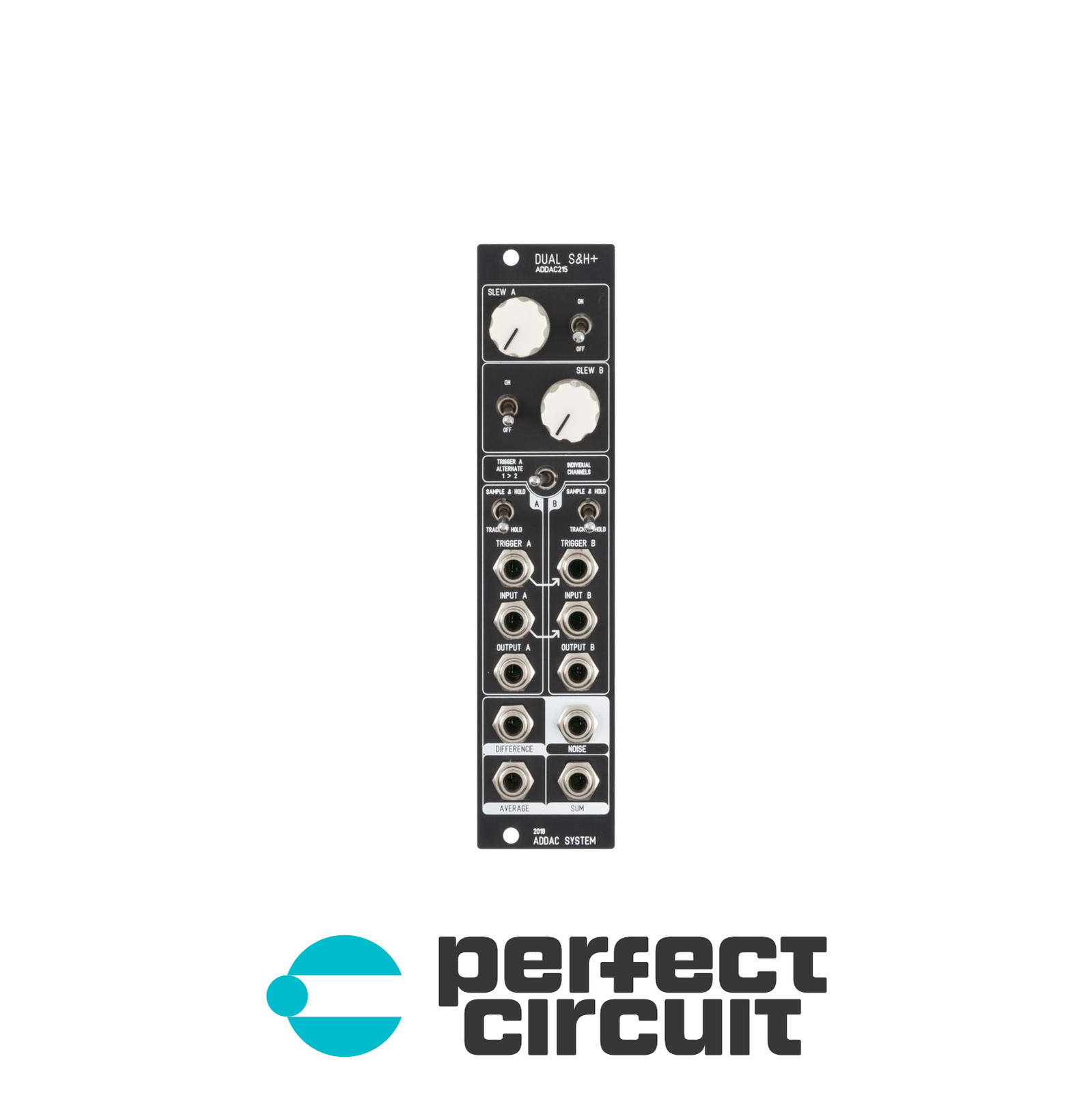
It’s easy to overlook a module this small—just 6HP, black anodized aluminum, no flashy lights or knobs that beg to be twisted. But the ADDAC System 215 Dual S&H+ is one of those quiet workhorses that, once patched in, makes you wonder how you ever composed without it. At its core, it’s a dual sample & hold with a high-quality noise source, but that description undersells it like calling a Swiss Army knife “a thing with a blade.” This module doesn’t just sample voltages—it shapes randomness, distributes modulation, cross-pollinates control signals, and even doubles as a basic analog computer with its sum, difference, and average outputs.
What sets the 215 apart isn’t just what it does, but how well it does it. Sample & hold modules have a notorious flaw: voltage droop. Left unattended, the sampled voltage slowly leaks away, turning a steady pitch into a sagging note. The 215 nearly eliminates this—documentation cites a drift of just 0.01V over 20 minutes. That’s not just impressive; it’s functional. You can sample a V/oct signal, hold it for an entire verse, and still have it land perfectly in tune. That kind of stability opens doors for generative sequences, transposed melodies, and voltage memory tricks that would fail on lesser modules.
Each channel can switch between Sample & Hold and Track & Hold modes, the latter letting the input pass through while the trigger is high and freezing it when low—ideal for smoothing chaotic signals or capturing moving voltages at precise moments. And each has its own slew processor with a single knob controlling both attack and decay, plus an on/off switch. That means you’re not just grabbing random voltages—you’re shaping them into gliding portamento or soft-edged control curves, all within the same module. The noise source is normalled to both inputs, so you don’t need to patch anything to start generating random CV. Just clock it, and you’re off.
Specifications
| Manufacturer | ADDAC System |
| Production Years | 2019– |
| Original Price | $175 |
| Width | 6 HP |
| Depth | 40 mm |
| Current Draw +12V | 50 mA |
| Current Draw -12V | 50 mA |
| Channels | 2 |
| Sample & Hold Modes | Sample & Hold, Track & Hold |
| Clock Modes | Normal, Alternate (A/B flip-flop) |
| Slew Controls | Per channel, single knob for rise/fall |
| Noise Source | White noise, internal |
| Normalled Inputs | Noise to both S&H inputs |
| Additional Outputs | Noise, Difference (A–B), Average ((A+B)/2), Sum (A+B) |
| Trigger Input | Gate/trigger compatible |
| Signal Inputs | 1 per channel |
| Signal Outputs | 1 per channel, plus 4 shared outputs |
| Weight | 120 g |
Key Features
Smart Clocking and Signal Routing
The alternate clock mode is a subtle but powerful feature: a single trigger input can toggle between channel A and B, effectively creating a round-robin distribution of random voltages. This isn’t just for novelty—it’s a compositional tool. Patch it to two oscillators, and you’ve got a generative duet where each note alternates between voices. Or route it to filter cutoffs for a stereo field that dances between left and right. The logic mirrors the Buchla 266, a nod to West Coast synthesis that ADDAC clearly respects. But unlike vintage gear, the 215 integrates this elegantly into the Eurorack standard, with no external logic required.
Sum, Difference, and Average – The Hidden Brain
Buried in the back are four extra outputs: Noise, Difference, Average, and Sum. These transform the 215 from a passive utility into an active signal processor. The Sum and Average outputs let you blend control voltages—perfect for morphing between two random sequences. The Difference output (A minus B) acts like a comparator, useful for creating opposing modulation or even crude rectification effects when patched to audio rate. At audio speeds, this can generate octave-up tones or metallic textures. It’s not a full-on wavefolder, but it’s a clever trick for such a small module. These outputs mean you can build complex modulation networks without eating up extra space for mixers or math modules.
Slew as a Creative Filter
The slew limiters aren’t an afterthought—they’re integral to the module’s character. Each channel’s slew can be engaged independently, letting you soften jagged random walks into smooth, evolving curves. Turn the knob down, and you get slow, LFO-like undulations; crank it, and you’re back to sharp, digital-seeming steps. This flexibility means the 215 can emulate everything from a gentle analog sequencer to a chaotic digital glitch source, depending on how you tune the slew. Users report that the response is fast even at low settings, requiring careful adjustment for musical results—but that precision is part of the charm.
Historical Context
The ADDAC System 215 arrived in late 2019, a time when Eurorack was bursting with utility modules but few were rethinking the classics. Sample & hold had become a commodity—cheap, often noisy, and prone to droop. The 215 stood out by treating randomness not as a gimmick, but as a serious compositional element. Lisbon-based ADDAC, known for blending analog warmth with digital precision, positioned the 215 as a “hybrid” tool: analog in signal path, digital in logic, with firmware-level attention to voltage stability.
It landed between two worlds: the minimalist utility ethos of Doepfer and the boutique complexity of Make Noise or Intellijel. Unlike the Doepfer A-148, which offers dual S&H in 8HP but no slew or math outputs, the 215 packs more functionality in less space. It also avoids the “kitchen sink” approach of modules like the ALM Busy Circuits SEQ-3, instead focusing on refinement over raw feature count. In an ecosystem where every HP counts, the 215 proved that density and elegance aren’t mutually exclusive.
Collectibility & Value
The ADDAC 215 isn’t a rare bird—still in production, widely available, and not prone to the cult status of discontinued modules. But that doesn’t make it any less valuable. On the used market, expect to pay $100–$130 for a working unit, down from the original $175. Prices stay moderate because supply is steady and demand is practical—this isn’t a module people flip; it’s one they keep.
Failures are rare, but when they happen, it’s usually power-related. The module draws 50mA on both rails, which is modest, but owners report that reversed power cables can damage the PCB. No field failures are widely documented, but service technicians note that the SMD components, while robust, aren’t user-replaceable without skill. If buying used, test all outputs: the sum, difference, and average functions can fail silently if a trace is broken. Also check the slew response—some early units had inconsistent potentiometer wear, though this seems to have been resolved in later runs.
For DIY builders, a kit version exists (SMD-Kit-2), rated “easy/medium” difficulty. It includes both surface-mount and through-hole parts, so beginners may struggle. But for those who complete it, the build quality rivals the pre-assembled version. Given the low failure rate, most collectors prefer pre-built units unless cost is a major factor.
eBay Listings
As an eBay Partner, we earn from qualifying purchases. This helps support our independent vintage technology research.