ADDAC System 207 Intuitive Quantizer (2019–)
Four channels of pitch-perfect order, wrapped in a red panel that makes your rack look like it’s running a cult.
Overview
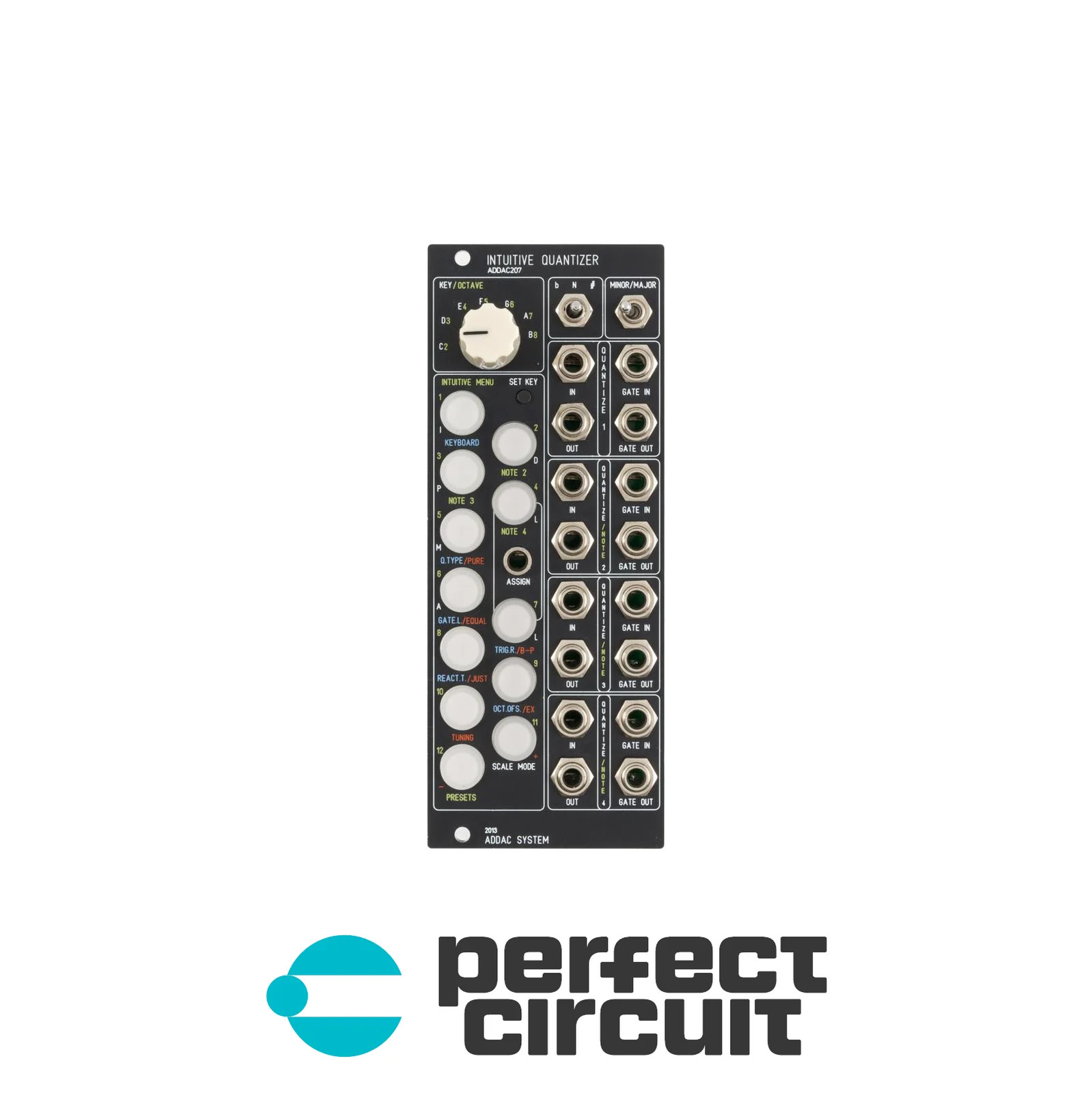
Plug in a wobbly, detuned oscillator and let the ADDAC 207 catch it mid-fall—like a safety net woven from scales and octaves. This isn’t just a quantizer; it’s a harmony engine disguised as a 12HP Eurorack module. The moment you hit that first quantized note, you feel it: the chaos of modular synthesis suddenly tamed, not neutered, but pointed toward musicality with surgical precision. It’s the difference between stumbling through a forest and walking down a path that branches exactly where you want it to. And with four independent channels, the 207 doesn’t just fix pitch—it builds chords, stacks harmonies, and turns random voltage into something that sounds like it was composed by someone who actually knows music theory.
What sets the 207 apart isn’t just that it quantizes—it’s how it invites you to interact with the process. The front panel is laid out like a command center for tonal exploration: root note, scale selection, octave shift, and chord mode all within thumb’s reach. No menu diving, no hidden functions—just knobs and buttons that do exactly what you expect. Turn the scale knob and cycle through major, minor, pentatonic, whole tone, or dive into microtonal madness with 19-TET or 24-TET tuning. It’s not locked into Western dogma, which means you can nudge your patches into Middle Eastern maqams or synthetic dreamscapes without reprogramming firmware or patching in a second module just to escape 12-TET prison.
And then there’s chord mode—where the 207 stops being a tuner and starts being a bandmate. Feed it a single CV, set a root and scale, and it sprouts three additional voices to form triads or seventh chords, each on its own output. It’s the kind of feature that makes you stop and go, “Wait, I can just… have harmony? Like that?” Suddenly, your solo drone patch becomes a rich, evolving pad with movement and tension, all without touching a keyboard. It’s not AI, it’s not algorithmic—it’s deterministic, musical, and immediate. That’s the magic of the 207: it doesn’t get in the way. It doesn’t require a PhD in patching. It just makes things sound better, faster, and more intentional.
Specifications
| Manufacturer | ADDAC System |
| Format | Eurorack |
| HP | 12 |
| Depth | 35mm |
| Current Draw +12V | 100mA |
| Current Draw -12V | 30mA |
| Inputs | 4x CV In, 4x Gate In (chord mode) |
| Outputs | 4x Quantized CV Out, 4x Quantized Gate Out |
| Control Inputs | Root CV, Scale CV, Octave CV (optional) |
| Scale Options | 21 selectable scales including major, minor, pentatonic, whole tone, diminished, augmented, chromatic, and microtonal (19-TET, 24-TET) |
| Chord Mode | Triads and seventh chords per root + scale |
| Color | Red anodized aluminum panel |
| Production Years | 2019–present |
| Original Price | $399 USD |
Key Features
Quad Channel Intelligence
Most quantizers handle one CV at a time—fine if you’re tuning a single oscillator, but a pain if you’re trying to harmonize multiple voices. The 207’s four-channel design means you can quantize an entire chord stack, a polyphonic sequence, or even multiple independent melodic lines simultaneously. Each channel has its own CV and gate I/O, but they all share the same root, scale, and octave settings—so you’re not programming four separate quantizers, you’re commanding a unified harmonic system. It’s the kind of efficiency that makes live performance possible without a patching panic. And because the channels are normalized, you can use fewer inputs and still get full functionality—patch one CV and it routes to all four, then use the gate inputs to trigger individual quantized outputs if you want staggered note entry.
Chord Mode: Harmony on Tap
This is where the 207 earns the “Intuitive” in its name. Engage chord mode, feed it a single CV and gate, and it generates three additional quantized pitches based on the selected scale—triads, major sevenths, minor sevenths, you name it. The result? One finger on a keyboard becomes a full jazz voicing. One random voltage source becomes a shifting harmonic bed. It’s not just convenient; it’s creatively liberating. Composers who struggle with harmony find it suddenly accessible. Experimental patchers discover new textures without needing theory books. And because the chord voices are output discretely, you can route each to a different oscillator, filter, or effects chain—pan them, modulate them, process them independently. The 207 doesn’t just make chords—it lets you sculpt them.
Real-Time Scale Morphing
Ever wanted to modulate from Dorian to Lydian mid-phrase? The 207 lets you do it with a CV. The scale knob isn’t just for manual selection—you can control it with an LFO, sequencer, or envelope to morph between modes on the fly. Pair that with CV control over root and octave, and you’ve got a module that can drift through tonal centers and modal landscapes like a satellite changing orbits. It’s not just quantization; it’s dynamic harmonic modulation. And because the module responds instantly, there’s no lag, no stepping artifacts—just smooth, musical transitions that feel organic, not digital. This is where the 207 transcends utility and becomes an instrument in its own right.
Historical Context
When the ADDAC 207 launched in 2019, the Eurorack world was already full of quantizers—but most were either barebones (one channel, basic scales) or overly complex (touchscreens, deep menus, firmware updates that break everything). The 207 arrived as a middle path: powerful but immediate, deep but not daunting. It fit into a growing trend of hybrid modules that blend digital brains with analog-friendly interfaces—modules like the Intellijel Quadrax or the Mutable Instruments Marbles, but focused squarely on pitch intelligence. ADDAC System, a Portuguese boutique known for blending digital precision with tactile design, positioned the 207 as a “musicality module”—not just a utility, but a creative partner.
It also arrived at a moment when modular synthesis was shifting from experimental noise-making toward more melodic, compositional use. Artists were building racks not just to generate textures, but to write songs. The 207 answered that need: a module that didn’t just process signals, but helped you make sense of them. Competitors like the Intellijel Steppy or the Make Noise Mosolov offered quantization, but none with four channels and chord generation in a single panel. The 207 carved its niche by being the module that could turn a chaotic patch into a coherent composition in seconds—no MIDI, no computer, no compromises.
Collectibility & Value
The ADDAC 207 isn’t rare—ADDAC has kept steady production since 2019—but it’s consistently in demand, and used prices reflect that. Expect to pay $350–$400 on the used market, with mint-condition units (especially the red anodized ones) holding value better than most utility modules. It’s not a “grail” in the vintage sense, but it’s becoming a modern classic—a module that new builders seek out early in their journey because it solves real problems. That said, it’s not without quirks. The red panel, while iconic, shows scratches easily, and collectors prefer units without rack rash. The knobs are sturdy, but the PCB layout is tight—service technicians observe that recapping isn’t trivial, though failures are rare. Firmware updates are handled via USB, and documentation shows that early units may need a quick flash to support the latest scale sets, so buyers should verify the version before purchasing.
Common failures? Almost none reported. It’s a digital-heavy module, so there’s little to wear out—no pots to crackle, no jacks to loosen. The biggest “failure” owners report is realizing they’ve become dependent on it. Once you’ve used the chord mode, going back to manual harmony feels like a punishment. And because it’s so deeply integrated into musical workflows, swapping it out for a cheaper or smaller quantizer often feels like a downgrade. Maintenance is minimal: clean the jacks occasionally, keep firmware updated, and avoid overvoltage on CV inputs (though it has protection). If you’re building a serious melodic rack, the 207 isn’t optional—it’s foundational.
eBay Listings

As an eBay Partner, we earn from qualifying purchases. This helps support our independent vintage technology research.