ADDAC 207 (2011–2021)
A four-voice gateway to microtonal madness, if you can tame its temperamental firmware
Overview
You know that moment when you patch in a quantizer expecting clean pitch correction and instead get a module that feels like it’s arguing with you? The ADDAC 207 Intuitive Quantizer lives in that friction—brilliant, opinionated, and just a little broken. It doesn’t just snap your CV to the nearest note; it demands you learn its language, wrestle with its menu system, and accept that sometimes, the gate input will glitch out if your pulse is too short. But when it clicks—when you’ve dialed in a Bohlen-Pierce scale across four voices and are transposing them live with an external CV—it feels like you’ve hacked into a parallel tuning universe that no other Eurorack quantizer from its era could touch. This isn’t background utility gear. It’s a lead thinker, the kind of module that reshapes how you compose.
Born in the early 2010s, when Eurorack was shedding its DIY infancy and embracing deeper digital integration, the 207 arrived as ADDAC’s answer to the growing demand for intelligent CV processing. At a time when quantizers were mostly one- or two-voice affairs with fixed temperaments, the 207 flexed hard: four independent quantization channels, user-definable scales with microtonal resolution beyond 12-TET, chord generation via interval mapping, and full CV control over transposition and menu functions. It wasn’t just a quantizer—it was a melodic brain. And yet, for all its ambition, it never quite shed the aura of a promising prototype that escaped the lab a little too early. The hardware was solid—clean black panel, Doepfer-style power connector, 10 HP footprint—but the firmware was where things got messy. Early units, particularly those with serial numbers below #600, were notorious for instability, and ADDAC eventually stopped supporting them entirely. Later firmware revisions smoothed out the worst bugs, but even updated units demand patience. The manual, while thorough, reads like code documentation, not a musical guide. You don’t just “use” the 207—you debug it, update it, recalibrate your expectations.
Positioned above basic quantizers like the Intellijel Quadratt but below full-scale sequencers like the MakeNoise René or Qu-Bit Nebulae, the 207 carved a niche as a power user’s tool. It wasn’t for someone who just wanted to fix a drifting VCO; it was for the composer knee-deep in alternate tunings, the modular veteran building complex harmonic architectures. Compared to the Mutable Instruments uScale—its most direct contemporary—the 207 offered four voices to the uScale’s one or two, but at the cost of stability and immediate playability. The uScale just worked; the 207 made you earn it. And while the Toppobrillo Quantimator offered more immediate hands-on control, it couldn’t match the 207’s scale flexibility or chord-generation depth. This was a module for the patient, the technically minded, the ones willing to trade convenience for creative possibility.
Specifications
| Manufacturer | ADDAC System |
| Production Years | 2011–2021 |
| Original Price | 365.00 € |
| Format | Eurorack |
| Width | 10 HP |
| Depth | 52 mm |
| Max Current | +140mA / -70mA |
| Bus Board Connector | 8×2 IDC (Doepfer style) |
| CV Input Range | ±5V |
| CV Output Range | +10V |
| Quantization Channels | 4 |
| Tuning Range | 10 octaves |
| Scale Types | User-definable, including Bohlen-Pierce and microtonal |
| Quantization Modes | Above, Below, Ignore |
| Gate Output Length | Definable |
| Octave Offsets | Per voice |
| Transpose Input | CV controllable |
| Fine Tuning | Per voice |
| Memory Presets | 11 user presets |
| Firmware Updates | Supported (serial #600 and above) |
Key Features
The Four-Voice Playground
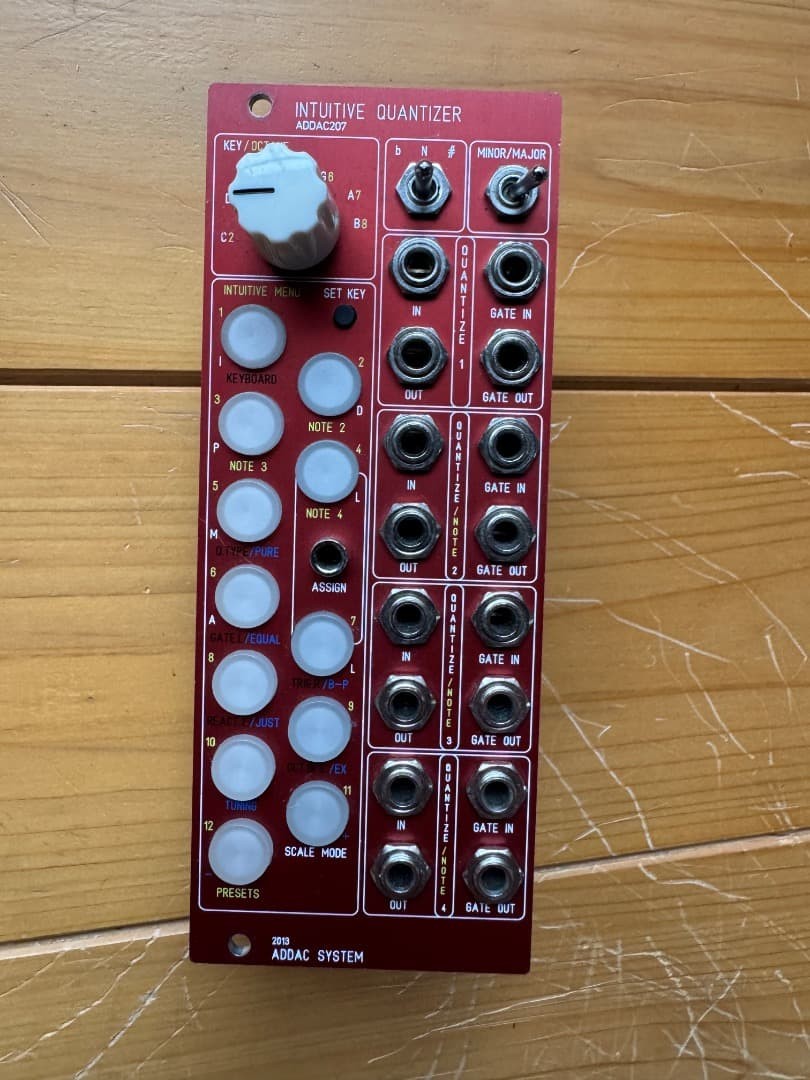
Four independent quantization channels might sound like overkill—until you’re stacking chords, harmonizing multiple VCOs, or routing each output to a different filter bank. The 207 doesn’t just quantize; it orchestrates. Each channel can be offset by octaves, fine-tuned independently, and assigned its own gate length. You can feed it a single CV and split it across all four, or run four separate sources—say, an LFO, a sequencer, a random source, and a keyboard—each snapping to the same scale but behaving differently. The “Keyboard Mode” turns the front-panel buttons into playable triggers, letting you jam out melodies directly on the module, which is especially handy when testing custom scales. But the real magic is in the chord generation: define intervals (like +4, +7 for a major triad), assign them to a voice, and suddenly your single CV input sprouts harmonies. It’s not polyphony in the traditional sense, but it’s close enough to feel like cheating.
Microtonal Freedom and the Firmware Wall
The 207’s most liberating feature is also its most frustrating: the ability to define any scale, any tuning, any interval structure. You’re not limited to 12-TET. You can build 19-TET, 31-TET, or dive into exotic systems like Bohlen-Pierce, which divides the octave (or rather, the tritave) into 13 equal steps. This isn’t just theoretical—patch in a slow LFO, quantize it to a 17-note scale, and you’ve got a melody that sounds alien yet musical. But accessing this depth means diving into the menu system, which is entirely button- and LED-driven. There’s no display, no screen—just colored LEDs that double as note indicators and menu navigators. It’s tactile, in a retro way, but also slow and error-prone. And if your firmware is outdated? Good luck. ADDAC eventually abandoned support for early units, and upgrading requires a dedicated kit and technical confidence. Even with the latest firmware, users report glitches—gates not resetting, CV mapping behaving unpredictably—especially when using complex patch configurations. This isn’t plug-and-play. It’s a project.
CV as a Control Language
Where the 207 shines is in its bidirectional relationship with control voltage. You’re not just sending CV in and getting quantized CV out—you can use CV to *control the quantizer itself*. Assign an external CV to transpose the scale, or offset incoming notes while staying in key. Want to morph between two scales over time? Patch in an LFO to the assign input and toggle between modes in the firmware update notes. The module becomes a dynamic processor, not just a static corrector. This level of integration was rare in its class, putting it closer to a hybrid sequencer/processor than a utility module. But again, it demands setup. You can’t just twist a knob and hear the change; you have to map it, save it, test it. The payoff is worth it, but only if you’re willing to invest the time.
Historical Context
The ADDAC 207 emerged during Eurorack’s mid-2010s explosion, when modules stopped being just oscillators and filters and started becoming intelligent agents in the patch. This was the era of the “Eurorack computer”—modules with embedded microcontrollers doing complex math, storing data, reacting to inputs in non-linear ways. The 207 fit right in, but with a distinctly European flavor: less polished than Mutable Instruments, less immediate than Intellijel, but deeply ambitious. It reflected a moment when boutique builders were pushing the limits of what analog-digital hybrids could do, often at the expense of reliability. Competitors like the Expert Sleepers FH-2 offered deeper DAW integration, while the Intellijel Quadratt focused on rock-solid performance over flexibility. The 207 aimed for the middle—deep programmability with hands-on control—but landed in a no-man’s-land where its complexity scared off beginners and its bugs frustrated experts. It was discontinued around 2021, likely because ADDAC shifted focus to more stable, skiff-friendly designs like the 700-series “Analog Heritage” line. The 207 remains a cult object—not widely owned, but fiercely loved by those who cracked its code.
Collectibility & Value
Today, the ADDAC 207 trades in a narrow, cautious market. Used units hover between $250 and $400, depending on condition and, crucially, firmware version. Units with serial numbers below #600 are red flags—they can’t be updated, and their instability is well-documented. Even functional ones are risky; buyers should insist on a video demo showing all four channels responding to CV and gate inputs without glitching. The gate input’s sensitivity to pulse width is a known flaw: short triggers (under 10ms) can cause erratic behavior, so pairing it with a gate conditioner like the Intellijel Dual OR or a dedicated pulse extender is often necessary. Maintenance is mostly about firmware: if the module isn’t already updated, sourcing the ADDAC Firmware Kit (ADDAC0015) and a compatible programmer (like a PICkit) is essential. Without it, you’re stuck with a beautiful paperweight. Repairs are rare but possible—service technicians note that the main PCB is robust, but the IDC power connector can loosen over time, causing intermittent power issues. For collectors, the 207 is a “know what you’re getting into” purchase. It’s not a daily driver. It’s a specialist tool, a conversation piece, a reminder that sometimes, the most powerful gear is also the most demanding.
eBay Listings

As an eBay Partner, we earn from qualifying purchases. This helps support our independent vintage technology research.