ADDAC 107 (2023)
A 9 HP Eurorack module that stumbled into greatness by becoming the squelchy, unpredictable heart of acid techno—when it was supposed to be a drum machine.
Overview
There’s a moment when you twist the resonance knob past 12 o’clock on the ADDAC 107 and the filter starts to howl like a TB-303 with a fever dream—suddenly you’re not just making sound, you’re wrestling with something alive. That’s the magic of this little black module: it was never meant to be an acid monster. ADDAC originally designed the 107 as a complex percussion source, something to generate clattering, organic hits. But somewhere in the prototyping phase, someone cranked the filter, ran a squelchy sequence through it, and realized they’d accidentally built a full monophonic synth voice that could melt faces. So they leaned in. And thank whatever gods of circuit bending they did.
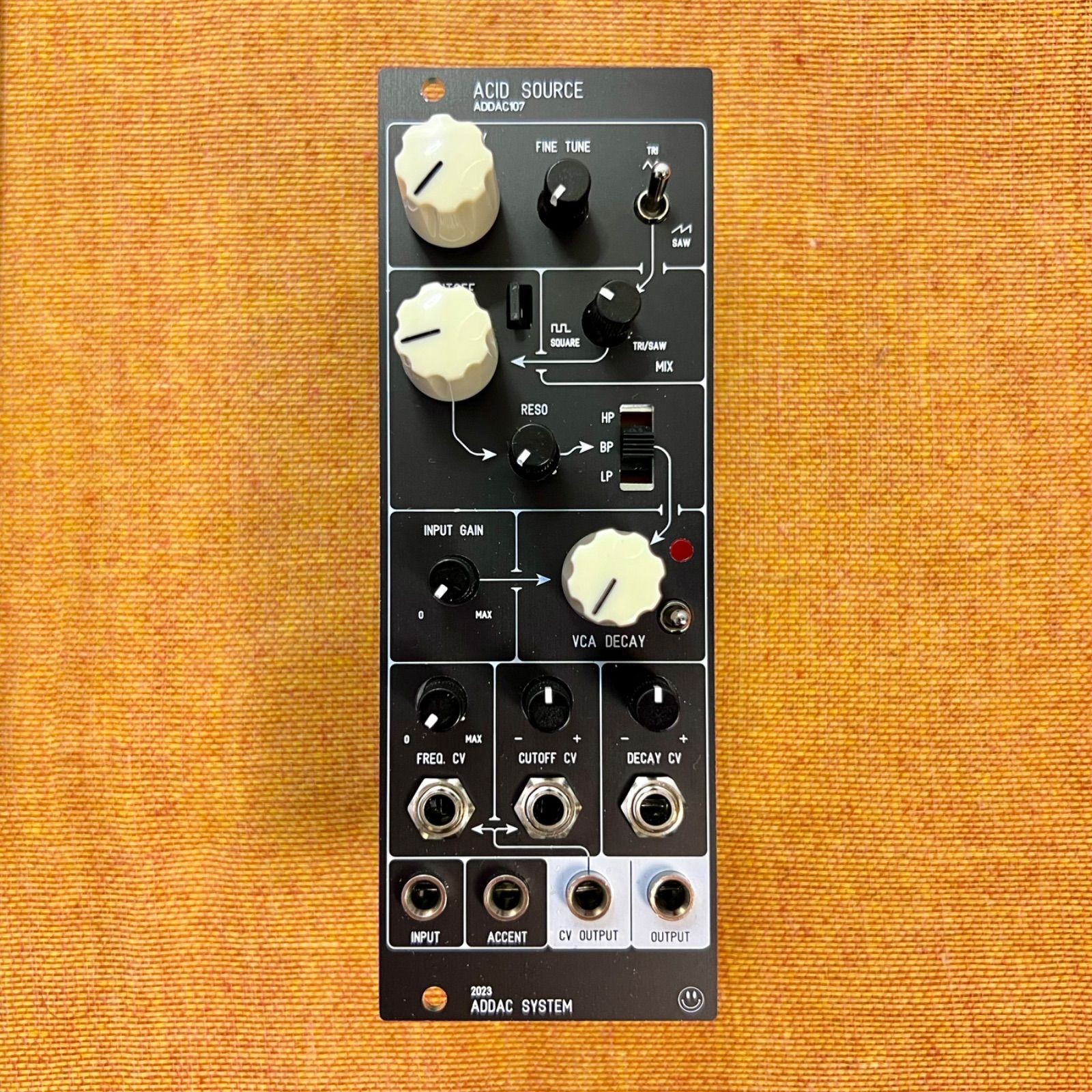
At just 9 HP, the 107 packs a VCO, multimode filter, VCA, and envelope into a space barely wider than a credit card. It’s not trying to be a Swiss Army knife—it’s a scalpel for carving out that unmistakable acid tone: wet, rubbery, unstable in the best way. The VCO gives you a choice between sawtooth and triangle waveforms, but the real character comes from blending that with a square wave before it hits the filter. That mix control isn’t labeled, it’s not even a knob—it’s a pair of jumpers on the front panel that feel like a circuit-bending prank. You adjust the balance by physically moving a tiny metal clip between solder points. It’s janky. It works. And once you find the sweet spot, you leave it there, because this isn’t a module for subtle timbral shifts—it’s for committing.
What makes the 107 feel so immediate is how it encourages abuse. The VCA doesn’t just amplify—it can push the signal past unity gain, up to double, which introduces a gritty, almost speaker-rattling distortion. Patch in a gate above +5V? The module doesn’t clip quietly—it saturates hard, feeding back into the filter in ways that feel barely under control. That’s not a bug; it’s the point. This thing thrives on being pushed too far. And the AD envelope—short attack, variable decay—means every note pops with that classic acid punch, whether you’re sequencing it or playing live. It’s not the most flexible voice in a rack, but it doesn’t need to be. It’s a specialist. And when you need that sound—the one that makes people in a dark room turn their heads and say “what the hell is that?”—the 107 delivers.
Specifications
| Manufacturer | ADDAC System |
| Production Years | 2023–present |
| Original Price | $249 (assembled), €202 (DIY kit) |
| Format | Eurorack |
| Width | 9 HP |
| Depth | 40 mm |
| Power Consumption +12V | 80 mA |
| Power Consumption -12V | 80 mA |
| VCO Waveforms | Sawtooth, Triangle, Square (mixed) |
| VCO Range | 4 octaves |
| Filter Types | Lowpass, Bandpass, Highpass |
| Filter Cutoff CV Input | Yes, with attenuverter |
| VCO Frequency CV Input | Yes, with attenuator |
| Envelope Type | AD (Attack fixed short, Decay variable) |
| VCA Gain | Up to 2x (unity gain and beyond) |
| VCA Input | Gate, Trigger, or CV (accepts signals above +5V) |
| Accent Input | Yes |
| External Audio Input | Yes (via jumper removal) |
| CV Output | Mixed Frequency and Cutoff CV, normalled |
| DIY Kit Available | Yes (SMD-Kit-2, medium difficulty) |
Key Features
The Filter That Fights Back
The multimode filter is where the 107 earns its name. Switch between lowpass, bandpass, and highpass with a satisfyingly stiff toggle, and then prepare for the resonance to take over. This isn’t a polite, linear filter—it gets gnarly fast. Push the cutoff and resonance together and you’ll hear it start to oscillate, not in a clean sine wave way, but with a gritty, unstable growl that feels more like a malfunction than a feature. And yet, it’s perfectly musical. Patch in a sequencer with accenting, tweak the decay on the VCA envelope, and suddenly you’re in “Acid Tracks” territory. The filter’s CV input has an attenuverter, so you can modulate the cutoff with positive or negative control voltages, letting you create everything from subtle sweeps to violent, stuttering licks. It’s not modeled after the 303—it’s more chaotic than that—but it captures the spirit: unpredictable, slightly broken, and absolutely addictive.
DIY by Design, Not Just by Price
The 107 is sold both as a DIY kit and a pre-assembled module, but the kit isn’t just a budget option—it’s baked into the ethos. The SMD-Kit-2 classification means it’s not for beginners: it includes surface-mount components alongside through-hole parts, requiring decent soldering skills and patience. But that’s part of the charm. The jumpers that control waveform mix? They’re exposed on the front panel, right next to the knobs, like something out of a homebrew synth project. There’s no software, no firmware, no hidden menus—just copper traces and discrete components you can see and touch. For builders, that’s a feature. You’re not just assembling a module; you’re participating in its quirks. And ADDAC doesn’t hide the complexity—they embrace it, offering full build guides, manuals, and videos. This isn’t a module that pretends to be plug-and-play. It wants you to get your hands dirty, because the sound lives in those imperfections.
VCA as a Weapon
Most VCAs are about control—taming signals, shaping dynamics. The 107’s VCA is about destruction. The input gain knob goes past unity, up to double amplification, and when you push it, the signal starts to clip in a way that’s more like overdriving a tube amp than digital limiting. It’s not clean. It’s not subtle. But it’s exactly what acid needs: a little grit, a little instability, a little “oh no, is it breaking?” That the VCA can accept CV, gate, or trigger inputs—any signal, really—means you can patch in wild modulation sources and let them run wild. A random voltage? A feedback loop? A gate that spikes to +8V? The 107 doesn’t complain. It distorts. It screams. It becomes something else. And the slewed output from the envelope is duplicated to a CV Out, so you can use that same squelchy contour to modulate other modules in your rack. It’s not just a voice—it’s a modulation source in disguise.
Historical Context
The ADDAC 107 landed in 2023, a time when Eurorack was already overflowing with complete voice modules, from clean digital oscillators to analog emulations of vintage synths. What made the 107 stand out wasn’t innovation for innovation’s sake—it was focus. While other modules chased versatility, the 107 leaned into a single, obsessive sonic goal: acid. And it did so at a moment when analog synthesis was being re-evaluated not for its fidelity, but for its flaws. The 303’s legacy isn’t about precision—it’s about instability, about resonance that oscillates, about filters that sound “wrong” in the most right way possible. The 107 taps into that same energy, but without being a clone. It doesn’t try to replicate the 303’s circuit—it builds something new that feels just as unpredictable.
ADDAC, based in Lisbon, has always straddled the line between analog warmth and digital control, but the 107 is a return to pure analog attitude. It arrived alongside other “dirty” modules like the 714 Vintage Clip and 712 Vintage Pre, suggesting a broader design philosophy: in a world of pristine digital modules, sometimes the most musical thing you can do is introduce chaos. Competitors like Intellijel’s Steiner-Parker filter or the Doepfer A-111-6 offer similar functionality, but the 107’s combination of compact size, aggressive character, and DIY accessibility carved out its own niche. It’s not the first Eurorack module to chase the acid sound, but it might be the first to do it with such unapologetic enthusiasm.
Collectibility & Value
As of 2026, the ADDAC 107 is still in production, so it’s not a vintage item in the traditional sense—but it’s already developed a cult following. The DIY kit sells for €202 and the assembled version for $249, but on the secondhand market, prices vary wildly based on build quality and condition. Assembled units in good working order typically go for $220–$280, while well-documented, cleanly built DIY versions can command a premium, especially if they include custom panel mods or upgraded jacks.
The biggest risk with the 107 isn’t circuit failure—it’s user error during assembly. Because it’s a medium-difficulty SMD kit, poorly soldered joints or misaligned components can cause intermittent issues, particularly with the jumpers and CV inputs. Service technicians observe that the most common failure points are the power pins and the VCA input stage, especially if users regularly patch in hot signals above +5V without attenuation. While the module is designed to handle overvoltage, repeated abuse can degrade the op-amps over time. Before buying a used 107, test the filter resonance sweep for smoothness, check that the VCA gain pushes past unity without crackling, and verify that the CV inputs respond predictably. If it’s a DIY unit, ask for build photos—clean soldering is a good sign.
For collectors, the 107 isn’t about rarity—it’s about character. It’s not going to appreciate like a vintage Roland, but it’s already become a staple in techno and industrial rigs. Modules that sound this aggressively musical don’t stay under the radar for long. And the fact that ADDAC offers full documentation and support means these units are more likely to survive decades of use than some obscure, unsupported boutique modules. It’s not a museum piece. It’s a tool. And the best ones will be the ones that look like they’ve been played hard.
eBay Listings


As an eBay Partner, we earn from qualifying purchases. This helps support our independent vintage technology research.