ADDAC 310 (2024)
Plug in the tube, take a breath, and watch your synth respond like it’s alive.
Overview
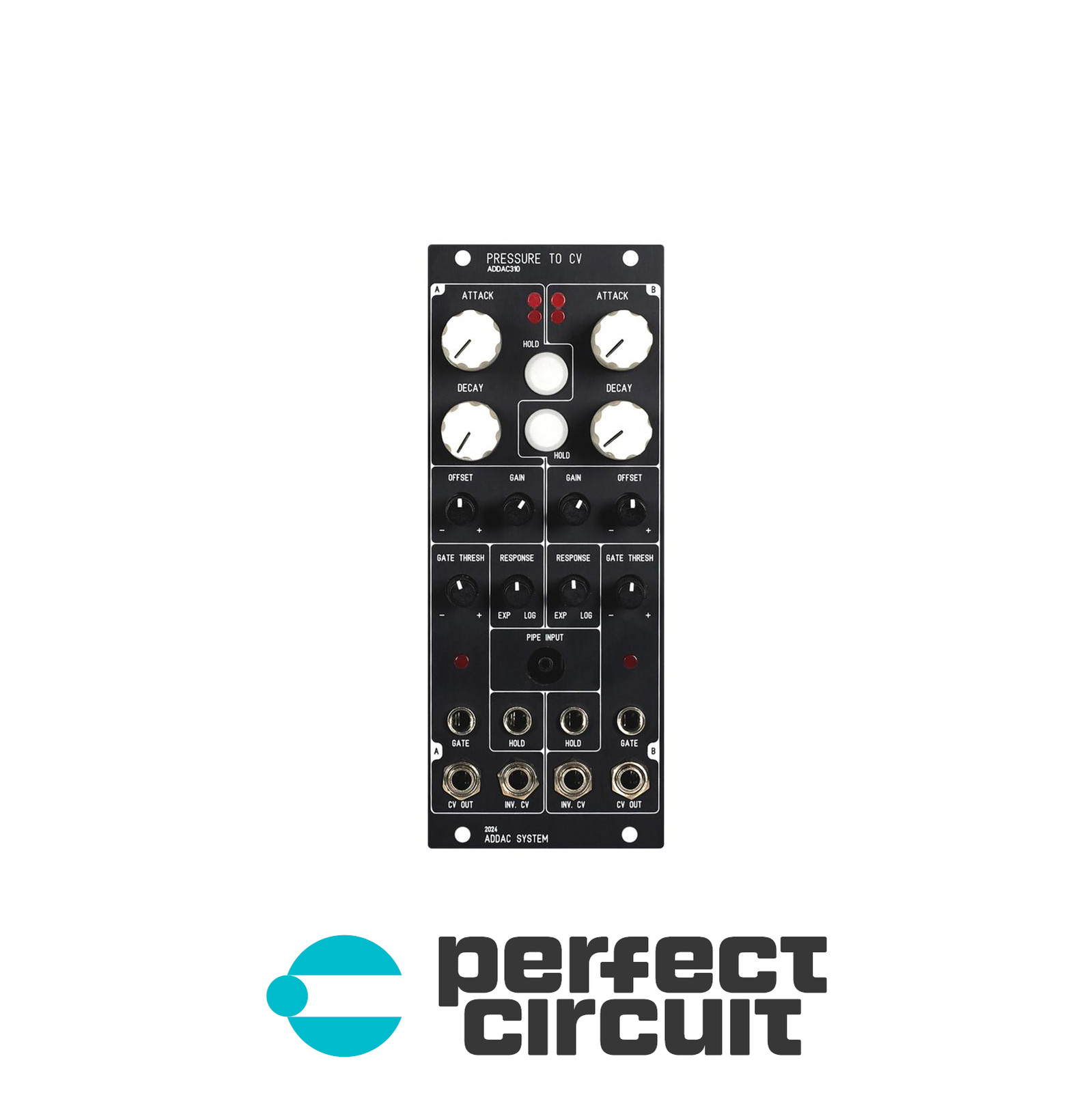
There’s something quietly revolutionary about blowing into a synth module like you’re playing a flute. The ADDAC 310 Pressure to CV doesn’t ask you to twist knobs or tap pads—it wants your breath, your puff, your sigh. It’s not a sound generator, but a nervous system extension, turning lung pressure into control voltages that can modulate filters, shape envelopes, or warp pitch in real time. At first glance, it looks like any other Eurorack utility—clean white panel, minimal labeling, two mirrored channels—but that melodica-style tube jutting from the front tells you this one’s different. It’s not just another CV source; it’s a performance interface that treats your exhalation as a musical gesture, as expressive as a ribbon controller or a theremin, but with the intimacy of your own body.
Designed by the Lisbon-based ADDAC System, known for their thoughtful, musician-first approach to modular design, the 310 sits in their 300 Series of “Expressive Controls.” That’s no marketing fluff—this module genuinely opens up new performance dimensions. While most Eurorack players are tethered to hands-on patching or MIDI controllers, the 310 frees up your hands completely. You can be tweaking a filter cutoff with one hand, adjusting a delay feedback with the other, all while using breath pressure to swell a reverb mix or morph between waveforms. It’s the kind of control that feels almost biological, especially when you dial in the response curve to match your natural breathing rhythm. And because it has two fully independent channels, you can route breath pressure to two different destinations with separate attack, decay, offset, and gain settings—say, one channel opening a filter while the other modulates oscillator pitch, each with slightly different timing for a more organic, evolving texture.
It’s not a module you’ll reach for every day, but when you do, it changes how you think about modulation. Instead of programming an LFO or recording an envelope, you’re performing the modulation itself. It demands a little practice—controlling breath pressure evenly isn’t as easy as turning a knob—but once you get it, the results feel deeply personal. It’s especially powerful in ambient or cinematic patches, where subtle swells and fades matter more than rhythmic precision. And because the tube connects directly to a pressure sensor (not a microphone), there’s no audio signal involved—just pure control voltage, clean and stable, ready to be shaped by the onboard controls.
Specifications
| Manufacturer | ADDAC System |
| Production Years | 2024–present |
| Original Price | €340 / £344 |
| Width | 10 HP |
| Depth | 45 mm |
| Power Consumption | 70 mA (+12V), 40 mA (-12V) |
| Inputs | Hold CV, Gate CV (per channel) |
| Outputs | CV Out, Inverted CV Out, Gate Out (per channel) |
| Controls | Attack, Decay, Offset, Gain, Response Curve (exponential/logarithmic), Hold button (per channel) |
| Indicators | Three LEDs per channel: CV level, gate, and hold status |
| Interface | Front-mounted melodica-style breath pipe with internal pressure sensor |
| Construction | Aluminum faceplate, recessed jacks, secure tube coupling |
Key Features
Two Independent Breath Channels
The ADDAC 310 isn’t just a single breath controller—it’s a dual-channel system, each side fully self-contained with its own set of controls and outputs. This means you can use one breath input to generate two completely different CV responses. Want one channel to trigger a gate when you inhale sharply, while the other slowly ramps up a filter cutoff on a long exhale? Done. The independence extends to the response settings: you can set one side to react instantly with a short decay, while the other lingers, creating a swell that outlasts your breath. This dual architecture turns a single physical gesture into layered, evolving modulation—something no single-output breath controller can match.
Response Curve Shaping
Not all breath feels the same—sometimes you want a linear response, other times an exponential swell that starts slow and accelerates. The 310’s response curve knob lets you blend between logarithmic and exponential response curves, giving you precise control over how pressure translates to voltage. This is where the module stops feeling like a novelty and starts feeling like an instrument. Set it to logarithmic, and soft breaths create noticeable movement, perfect for delicate ambient textures. Flip it toward exponential, and you’ll need more pressure to get a response, ideal for dramatic swells or percussive bursts. It’s a subtle but critical detail that makes the 310 adaptable to different playing styles and musical contexts.
Hold Function with CV Control
One of the smartest design choices is the hold function, which latches the current CV level even after you stop blowing. This turns breath into a sustained control source—perfect for holding a filter open or maintaining a drone without needing constant airflow. The hold can be toggled manually with a front-panel button or triggered via CV, opening up sequenced or automated possibilities. Imagine a patch where a clock signal triggers the hold at regular intervals, capturing your breath pressure like a sample-and-hold—but one driven by your lungs instead of random voltage. It’s a small feature with outsized creative potential.
Historical Context
The ADDAC 310 didn’t emerge in a vacuum. Breath controllers have been around since the 1980s, most famously in instruments like the Yamaha BC1 or the Steiner EVI, but they’ve always been niche—too expensive, too finicky, or too divorced from mainstream synth workflows. The 310 reimagines that concept for the Eurorack era, where modularity and experimentation are the norm. Instead of being a standalone instrument, it’s a utility module, designed to integrate seamlessly into an existing system. It arrives at a time when modular synthesis is maturing beyond pure sound generation and into performance interfaces—think touch plates, light sensors, and motion controllers. The 310 fits right into that evolution, offering a tactile, bodily way to interact with voltage that feels more immediate than a MIDI fader or a ribbon.
ADDAC System has always leaned into expressive control, from their muscle-sensing modules to their foot-operated interfaces, and the 310 is a natural extension of that philosophy. Unlike some boutique brands that prioritize complexity, ADDAC focuses on usability and immediacy. The 310 has no menus, no firmware updates, no calibration routines—just plug in the tube and start breathing. That simplicity is deliberate, and it sets the 310 apart from digital alternatives that require setup and configuration. In an age where many modular modules are becoming more software-dependent, the 310 feels refreshingly analog in spirit, even if the signal path is technically electronic.
Collectibility & Value
As of 2026, the ADDAC 310 is still in production and readily available from authorized dealers and the manufacturer’s direct store. With an original price of €340, it’s positioned as a premium module—more expensive than a basic CV source, but justified by its unique functionality and solid build quality. Used units are beginning to appear on the secondhand market, typically selling for €250–€300 depending on condition, though supply remains limited due to its 2024 release date. It’s not yet a “collector’s item” in the vintage sense, but it’s already gaining a reputation as a must-have for performers and sound designers who value physical expressiveness.
There are no known failure points specific to the 310. The pressure sensor is sealed and has no moving parts, and the tube coupling is robust, designed to withstand regular plugging and unplugging. The only real wear item is the silicone mouthpiece, which can degrade over years of use or with exposure to oils and moisture—though replacements are simple to source or 3D-print. The module draws modest current and doesn’t generate significant heat, so power-related issues are unlikely. That said, because it’s a relatively new design, long-term reliability data is still emerging. Owners report no firmware bugs or design recalls, and ADDAC’s customer support has a strong reputation for responsiveness.
If you’re considering buying one, the main thing to watch for is the tube itself—make sure it’s not cracked or warped, and that it seats firmly in the front panel. Since the tube isn’t removable in most listings (it ships pre-attached), inspect photos carefully. Also, be aware that the tube can be awkward in a densely packed rack; some users have already started designing 3D-printed brackets to secure it to the case or nearby modules. It’s not a flaw, just a quirk of a design that prioritizes function over form. For live performers, this might be a bigger concern than for studio users.
eBay Listings
As an eBay Partner, we earn from qualifying purchases. This helps support our independent vintage technology research.