ADDAC 310 Pressure to CV (2024–)
A breath of fresh air—or rather, a pressurized puff from your lungs—turns your body into a modulation engine for Eurorack.
Overview
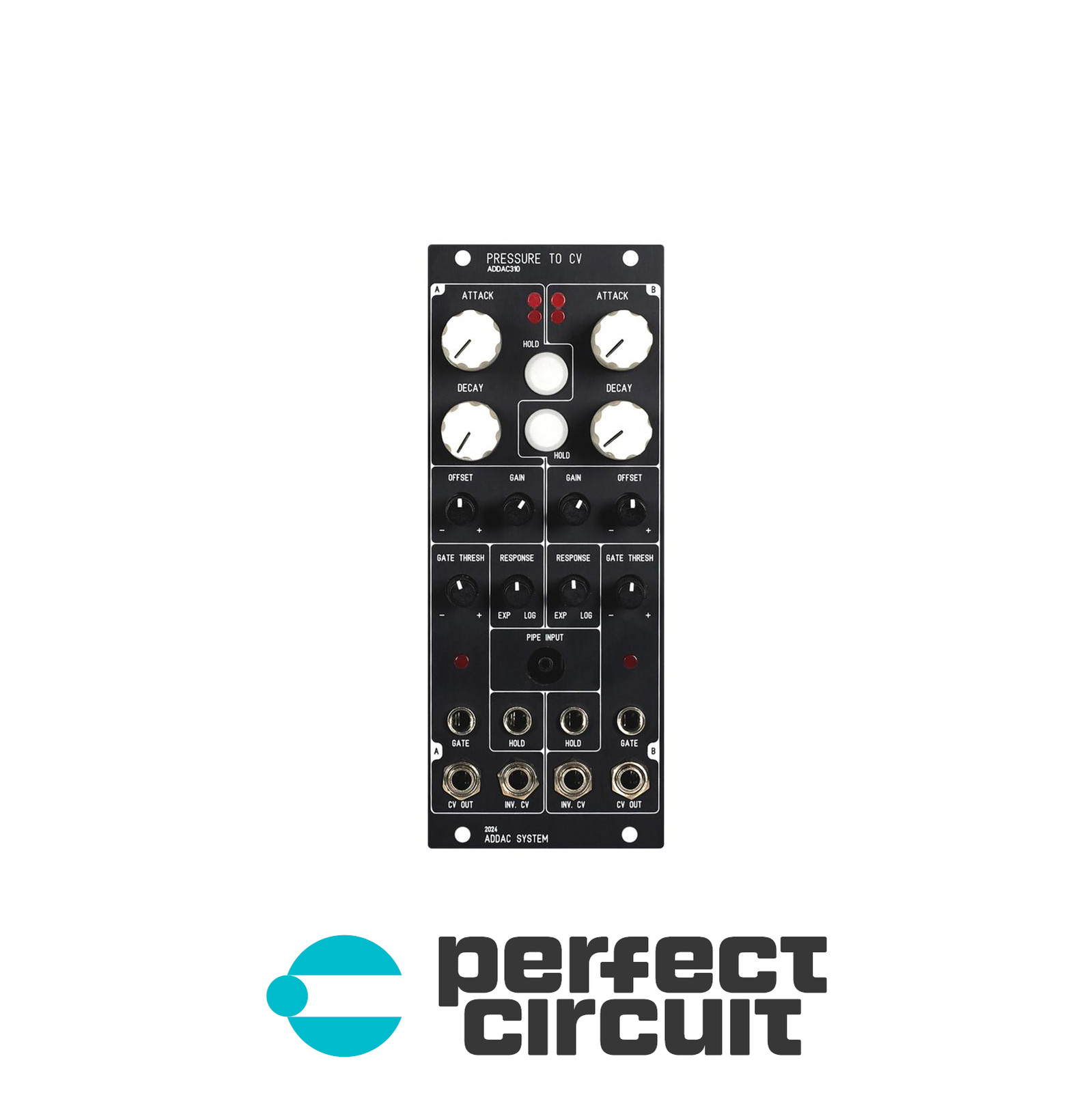
Plug in the melodica-style pipe, seal your lips around it, and suddenly your breath becomes voltage—raw, living, responsive CV that pulses with the rhythm of your lungs. The ADDAC 310 Pressure to CV doesn’t just add expression to your modular rig; it rewires your relationship with it. This isn’t a MIDI wind controller with reeds and sensors mimicking saxophones—it’s something more primal. There’s no air escape. You build pressure in your mouth like holding a note on a didgeridoo, but instead of sound, you’re generating control signals. That sealed-tube design is the secret: it lets you sustain pressure indefinitely while breathing through your nose, bypassing the need for circular breathing mastery. It’s deceptively simple, but the moment you dial in a filter sweep that rises and falls with your inhalation, or modulate a delay feedback with a slow exhale, you realize you’re not just playing the synth—you’re breathing life into it.
And yes, it will make you lightheaded. Not because it’s flawed, but because it asks for real physical engagement. Most modular control is abstract—twist a knob, press a button, patch a sequence. The 310 demands stamina. It rewards breath control like a wind player, but with no pitch to worry about, you’re free to sculpt dynamics, timbre, and space purely through airflow. It’s expressive in a way joysticks and touch strips can’t match, because breath is inherently musical—it swells, decays, stutters, and surges with emotion. The module captures that, then hands it to you in two fully independent channels, each capable of sending CV, gate, and inverted CV signals. You could use one to open a filter while the other triggers envelopes, or modulate panning and reverb wetness in tandem. The duality means you can create interlocking, breath-driven rhythms or layered swells that feel organic, never mechanical.
Specifications
| Manufacturer | ADDAC System |
| Production Years | 2024– |
| Original Price | €340 |
| Format | Eurorack |
| Width | 10 HP |
| Depth | 45 mm |
| Power Consumption | 70 mA (+12V), 40 mA (-12V) |
| Channels | 2 independent |
| Control Voltage Output | 0–10 V (adjustable) |
| Inverted CV Output | Yes, per channel |
| Gate Output | Yes, per channel |
| Hold Function | Manual button and CV control, latching and momentary modes |
| Response Curve Control | Adjustable from logarithmic to exponential (linear at center) |
| Attack/Decay Envelope | Per channel, for shaping breath response |
| Offset | Adjustable per channel |
| Gain | Adjustable per channel |
| Gate Threshold | Bipolar knob per channel |
| Pipe Type | Standard melodica pipe with silicone tubing and air filter |
| LED Indicators | Monitoring LEDs for CV level and hold status per channel |
Key Features
No Escape, Just Pressure
The 310’s defining trick—the sealed breath path—changes everything. Most breath controllers measure airflow, which means you’re constantly exhaling, limited by lung capacity. The 310 measures pressure, not flow. Once you seal the pipe, every puff you blow increases internal pressure, which the sensor converts directly to voltage. You can hold a peak pressure indefinitely while breathing through your nose, letting you sustain modulations without fading out. It’s a game-changer for ambient textures, slow filter ramps, or holding a reverb swell while your hands sculpt other parameters. Woodwind players might find it counterintuitive at first—no need to keep air moving—but within minutes, it clicks. You’re not blowing *through* it; you’re pressing *against* it, like a theremin player sensing space, but with your diaphragm.
Twin Channels, Twice the Expression
Duplicating the signal path wasn’t just about convenience—it opened up performative depth. Each channel has its own attack, decay, offset, gain, response curve, and gate threshold, so you can set them to behave completely differently from the same breath input. Imagine a soft inhale triggering a gentle low-pass filter sweep on channel one, while a sharp exhale blasts open a wavefolder on channel two. Or set one to respond logarithmically (sensitive to light pressure) for subtle vibrato, and the other exponentially (responsive to strong bursts) for percussive accents. The hold function, activatable via front-panel button or external CV, lets you freeze a voltage—perfect for locking in a filter state while switching patches or layering breath gestures over a held chord. And with both normal and inverted CV outputs, you can create push-pull modulation: one parameter opens as the other closes, all from a single breath.
Designed for the Real World (and Moisture)
ADDAC didn’t just slap a sensor on a pipe and call it done. The melodica-style mouthpiece feeds into an air filter—a small chamber that traps condensation before it reaches the sensor. This isn’t optional; it’s essential. Blow into any tube long enough and you’ll fog it up with saliva and moisture. Without that filter, the sensor would corrode or drift, leading to erratic CV and eventual failure. The filter acts like a baffle, letting pressure transmit while catching liquid. It’s a small but critical detail that shows ADDAC thought beyond the circuit—this module is built to survive actual use, not just demo videos. The silicone tubing is replaceable, and spare pipes are available for €15, so if you’re performing regularly or sharing the module, you won’t be stuck with a soggy mouthpiece.
Historical Context
The ADDAC 310 didn’t emerge from a vacuum. It lands in a Eurorack ecosystem hungry for new forms of expression. After years of sequencers, LFOs, and random voltage sources, players started craving more human interfaces—things you could *feel*, not just program. Modules like the Buchla Thunder, Make Noise Pressure Points, and Bastl Soft Touch explored touch and force sensitivity, but breath remained a niche. Traditional wind controllers like the Akai EWI or Yamaha WX5 were complex, expensive, and often felt like compromises—designed for keyboardists who wanted to play sax lines, not for modularists seeking organic modulation. The 310 sidesteps that entirely. It’s not an instrument; it’s a control surface powered by physiology. It shares DNA with the EMS Synthi 100’s pressure pad and the Synthi AKS’s joystick, but replaces hand gestures with breath. In that sense, it’s part of a quiet revolution—modules that treat the body as a source of voltage, not just fingers on knobs. It also fits neatly into ADDAC’s 300-series of expressive controls, sitting alongside the 307 Heart Sensing and 301 Floor Control as tools for turning biological signals into synthesis.
Collectibility & Value
As of 2026, the ADDAC 310 is too new to be “vintage,” but it’s already carving a niche among modular performers and ambient artists. It’s not a utility module you buy once and forget; it’s a performance centerpiece, so condition matters. Since it launched at €340 (around $370), prices have held steady, with used units trading between $300 and $350 depending on wear. There are no known production flaws or widespread failures, but the air filter is the weak point—neglect it, and moisture can seep into the sensor, causing drift or dead zones in the response curve. Before buying used, ask if the filter has been cleaned or replaced. Also check that both channels respond evenly; mismatched calibration can happen if the module was dropped or stored improperly. The pipe itself is standard melodica hardware, so replacements are easy, but the silicone tubing can degrade over years of use, especially if exposed to heat or UV light. Replacement tubes are available from ADDAC, but it’s worth inspecting for cracks or stiffness. For long-term ownership, treat it like a wind instrument: wipe the mouthpiece after use, store it upright, and occasionally blow through it with the filter removed (then reassemble) to clear any buildup. No firmware, no calibration screws—just a robust analog design that should last decades if treated with basic care.
eBay Listings
As an eBay Partner, we earn from qualifying purchases. This helps support our independent vintage technology research.