ADDAC 814 (2024–)
A 6x6 stereo matrix mixer that turns your Eurorack into a labyrinth of sound, light, and feedback—modular’s most flexible traffic controller.
Overview
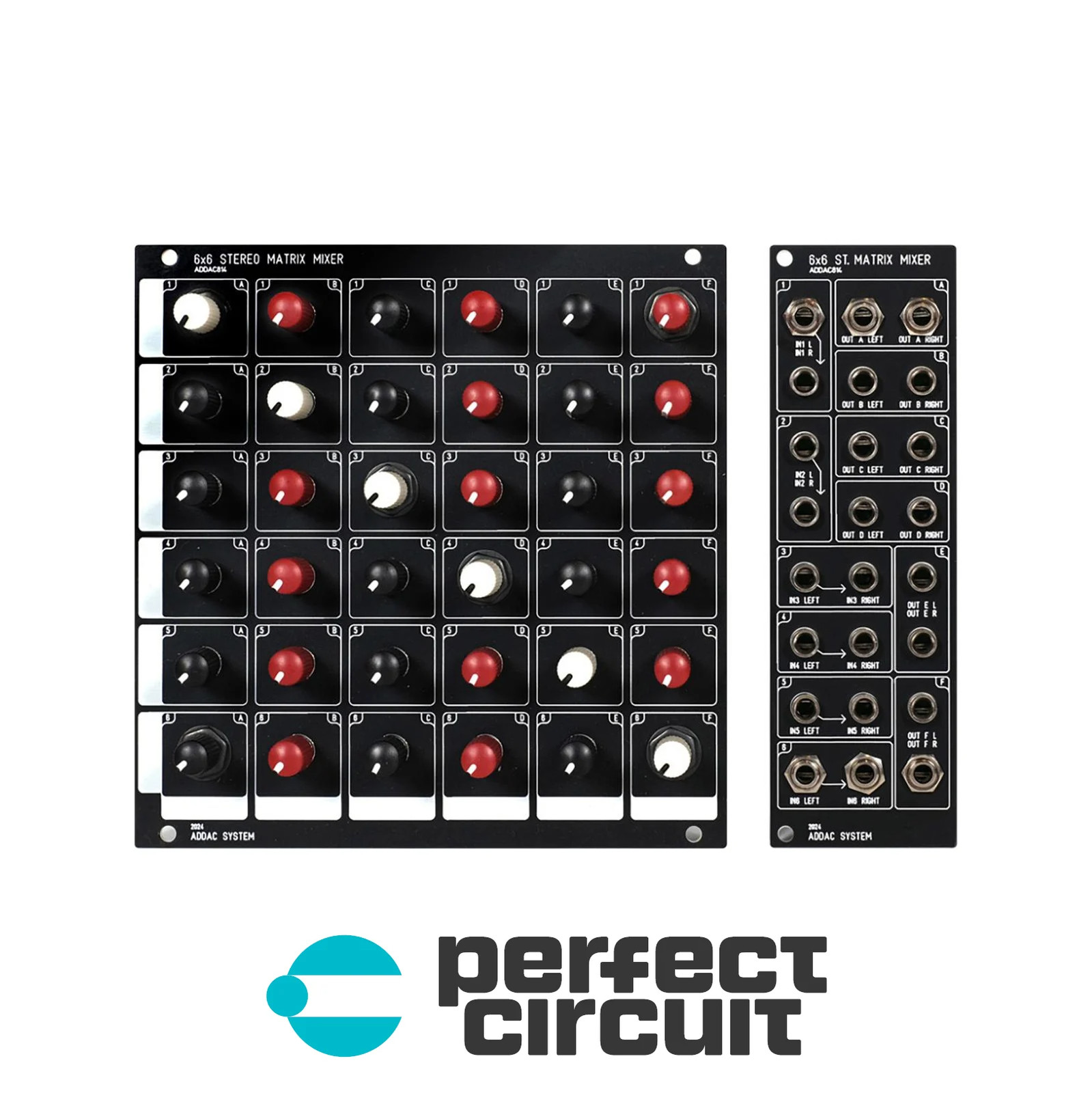
You know that moment when your patch starts feeling too linear—same signal path every time, same blend, same results? That’s when you need something like the ADDAC 814. It doesn’t just mix; it reroutes, redirects, and reimagines how signals flow through your system. At first glance, it looks like a grid of tiny knobs and jacks—36 of each, to be exact—but what it actually is, is a modular nervous system upgrade. Each knob is a gatekeeper, deciding how much of input A gets sent to output B, or C, or all six outputs at once. You can send one LFO to modulate three different VCOs at different intensities, then route the audio outputs back into a filter, split that into two reverbs, and blend them all in real time—without repatching. It’s not just a mixer. It’s a patching philosophy.
And yes, it’s big—33HP total—but that space buys you something rare in Eurorack: clarity. The ADDAC 814 splits its functionality into two modules: one with all the controls (25HP), the other with the jacks (8HP). That means you can tuck the jack panel off to the side, freeing up front-panel real estate for the knobs. No more cables blocking your view or getting in the way of your hand as you tweak. In a live set, that’s not just convenient—it’s essential. The control module sits front and center, knobs neatly arranged in a 6x6 grid, each color-coded: black for odd-numbered outputs (A, C, E), dark red for even (B, D, F), and cream for the diagonal where feedback loops live—1A, 2B, 3C, and so on. It’s a small touch, but when you’re knee-deep in a complex patch, that visual cue can save you from a feedback avalanche—or help you trigger one on purpose.
It’s DC-coupled, so it handles both audio and CV with equal ease. Want to mix six different envelope generators and route them to multiple destinations? Done. Need to blend modulation sources before they hit a waveshaper? Easy. The module’s flexibility means it’s just as useful in a minimalist setup as it is in a 16U monster rig. And if 6 inputs and 6 outputs aren’t enough? That’s where the expandability kicks in. With ribbon cables and expansion modules, you can stack multiple 814s into 12x12, 18x18, or even larger configurations. It’s modular scalability at its most logical—no awkward workarounds, just clean, expandable architecture.
But it’s not without quirks. The knobs are Thonk Trimmer Toppers—tall, narrow caps that fit over potentiometers typically used for calibration, not performance. Some users love the precision; others hate how they feel under the fingers, especially in fast-moving patches. You can swap them out for regular knobs, but that’s 36 knobs to source, buy, and install—no small task. And while the jacks being on a separate panel keeps the front clean, it does mean you need to think about cable management differently. You’re not just patching to a module; you’re patching to a satellite panel that might be inches or even feet away. It works, but it changes how you interact with it. This isn’t a “set and forget” module. It’s a performance instrument in its own right—one that demands attention, rewards experimentation, and punishes carelessness with runaway feedback or silent outputs.
Specifications
| Manufacturer | ADDAC System |
| Production Years | 2024– |
| Original Price | 340€ (full 6x6 system) |
| Module Type | 6x6 Stereo Matrix Mixer |
| HP Size | 25HP (control) + 8HP (jacks) = 33HP total |
| Depth | 4.5 cm (45 mm) |
| Current Draw +12V | 140 mA |
| Current Draw -12V | 140 mA |
| Inputs | 6 stereo inputs (12 total), left normalled to right |
| Outputs | 6 stereo outputs (12 total) |
| DC Coupled | Yes (for audio and CV) |
| Level Selection | Jumper-selectable per channel (Line or Synth Level) |
| Internal Connection | 34-wire ribbon cable between control and jack modules |
| Expansion Options | Supports 6x12, 12x6, 12x12, 18x18 via expansion modules and custom cables |
| Potentiometers | Metal-shaft Alpha T18 pots with Thonk Trimmer Topper knobs |
| Panel Features | Scribble strips for labeling inputs/outputs, color-coded knobs |
| Expandability | Extra IDC sockets for daisy-chaining multiple units |
| DIY Availability | Yes (separate kits for jack, control, and expansion modules) |
Key Features
Modular by Design, Expandable by Nature
The ADDAC 814 isn’t just a standalone module—it’s a system. The separation of controls and jacks isn’t a gimmick; it’s a design decision that pays off in larger racks. You can mount the jack panel on a different row, even a different case, while keeping the knobs within easy reach. This is especially useful in live setups where you want to minimize cable clutter on the main panel. But the real magic is in expansion. Need more inputs? Add another jack module. More outputs? Stack on another control panel. The system supports configurations up to 18x18, and while custom cables are needed beyond 12x12, ADDAC provides the schematics and support to make it happen. It’s one of the few matrix mixers that doesn’t force you into a dead end. If your system grows, the 814 grows with it.
Color-Coded Chaos Control
Matrix mixers can feel overwhelming—dozens of knobs, no obvious signal path, no clear starting point. ADDAC tackles this with thoughtful visual design. The cream-colored knobs along the diagonal (1A, 2B, etc.) are your feedback zones. Turn them up, and you’re feeding output back into its corresponding input—great for self-oscillation, chaotic textures, or evolving drones. The black and red knobs make it easy to track which outputs you’re adjusting, especially when you’re blending stereo pairs. And the blank scribble strips? They’re not an afterthought. They’re an invitation. Write down what’s patched where, draw little diagrams, use symbols—whatever keeps your patch organized. In a format where memory is short and distractions are constant, these small details make the 814 feel less like a puzzle and more like a tool.
Line or Synth Level? You Choose
One of the quiet superpowers of the 814 is its jumper-selectable input levels. Each channel can be set to either line level or synth level via tiny switches on the back of the module. This means you can plug in external gear—guitar pedals, outboard effects, mixers—without worrying about impedance mismatches or signal clipping. It’s a rare feature in Eurorack, where most modules assume everything speaks the same voltage language. Here, the 814 acts as a translator, letting analog synths, digital processors, and even acoustic instruments coexist in the same patch. Want to run a guitar through your modular effects chain? Set the input to line level. Need to blend two VCOs with an LFO? Switch to synth level. It’s a small detail, but one that vastly increases the module’s utility beyond the Eurorack ecosystem.
Historical Context
Matrix mixers have always been the quiet geniuses of modular synthesis. They’ve been around since the days of Buchla and Serge, but in Eurorack, they’ve been oddly scarce—especially in stereo. For years, users had to rely on multiple VCAs, splitters, and mixers to approximate matrix functionality. Then, in the early 2020s, companies like AI Synthesis, Bear Audio, and SetonixSynth started releasing dedicated stereo matrix mixers. The ADDAC 814 arrived in 2024, not as the first, but as one of the most thoughtfully engineered. It didn’t reinvent the concept, but it refined it—splitting the interface, adding expandability, and focusing on usability. At a time when Eurorack was becoming more digital, more menu-driven, the 814 was a return to tactile, hands-on patching. It’s a module for people who still believe that turning a knob should feel like turning a knob, not navigating a submenu.
Its closest competitors—the AI Synthesis 018, the Bear Audio M6, the SetonixSynth Shaka—each have their strengths. The AI 018 is more compact. The Bear M6 has motorized faders. The Shaka is VC-controlled. But the 814 stands out for its expandability and clarity of design. It’s not trying to be everything to everyone. It’s trying to be the most flexible, most reliable matrix mixer for people who actually use one. And in that niche, it’s hard to beat.
Collectibility & Value
The ADDAC 814 is too new to be “vintage” in the traditional sense, but it’s already carving out a place in the collector’s ecosystem—not as a relic, but as a benchmark. At €340 for the full 6x6 system, it’s not cheap, but it’s not outrageous for what it offers. The price reflects its build quality, expandability, and the fact that it solves real problems in modern Eurorack setups. On the used market, expect to see complete systems selling for €280–€320 in good condition, depending on location and demand. Individual modules—especially the control unit—hold value better than the jack panel, since the knobs and circuitry are the core of the experience.
Failures are rare, but not unheard of. The ribbon cable connection between modules is robust, but if it’s bent or stressed repeatedly, it can fail—especially in mobile setups. There are no known issues with the potentiometers themselves; they’re high-quality Alpha T18s with metal shafts, not the fragile plastic trimmers some modules use. The main wear point is the jack panel: if it’s mounted in a high-traffic area, the jacks can loosen over time. But since it’s a separate module, it can be replaced or repaired without touching the control unit.
When buying used, check that all knobs turn smoothly and that there’s no crackling in the audio path. Test both line and synth level settings with different sources. Make sure the ribbon cable is intact and that the modules communicate properly—some users have reported issues when third-party cables are used. And if you’re buying a DIY kit build, verify that it was assembled correctly; misaligned jumpers or cold solder joints can cause intermittent issues.
For those who want to customize, the DIY kit option is a major plus. At €260 for the full 6x6 kit (jacks and controls), it’s a savings of €80 over the pre-built version. But it’s not for beginners—36 pots, 72 jacks, and a dense PCB mean this is an intermediate-to-advanced build. Still, for tinkerers, it’s a chance to tailor the module—swap out the trimmer toppers for regular knobs, add backlighting, or even modify the circuit for different response curves.
eBay Listings
As an eBay Partner, we earn from qualifying purchases. This helps support our independent vintage technology research.