ADDAC 307 (2019–present)
A pulse from your finger becomes a gate, an envelope, a living rhythm—this module doesn’t just respond to you, it listens.
Overview
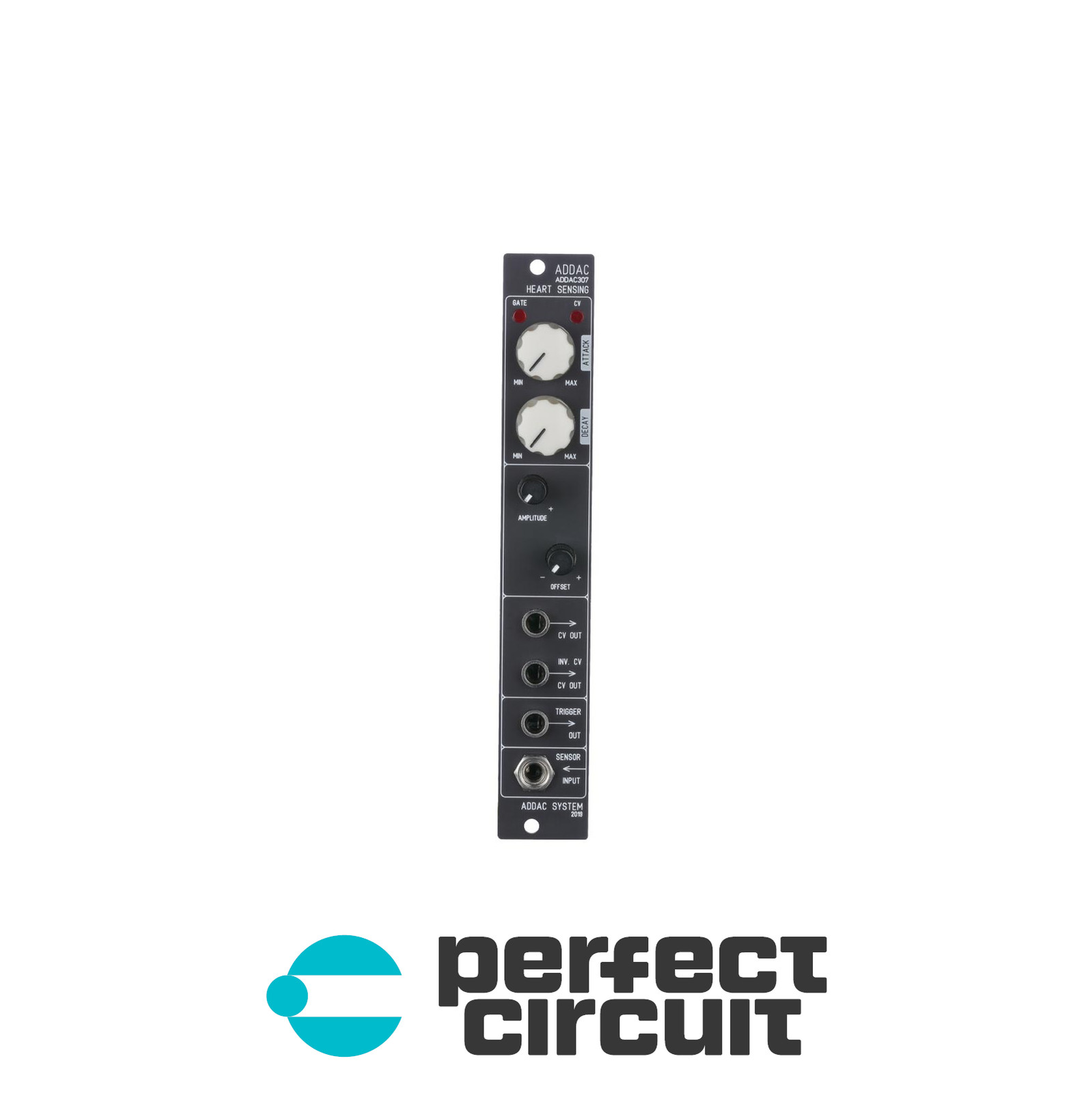
There’s something quietly radical about clipping a small sensor to your fingertip and watching your heartbeat become a trigger that fires a synth note, or an envelope that swells with each pulse. The ADDAC 307 Heart Sensing module doesn’t generate sound—it generates response. It’s a bridge between biology and circuitry, turning the quiet thump beneath your skin into a control voltage that can shape a patch in real time. In a world where modular synthesis often leans on precision clocking and mathematical sequencing, the 307 is gloriously imperfect. It wavers, it hesitates, it speeds up when you get excited—because it is you, translated into voltage. This isn’t just another envelope generator; it’s a biofeedback instrument, a performance tool, and a conceptual statement wrapped in a 4HP panel.
Born from ADDAC’s Expressive Controls Series—the same line that gave us the muscle-sensing ADDAC303—the 307 leans into the idea that your body can be the most expressive controller of all. It follows a lineage of experimental controllers from the 1970s and 80s, but with modern reliability and Eurorack integration. The module uses a clip-on optical sensor, similar to a pulse oximeter, that detects blood flow changes with each heartbeat. That signal is then converted into a 0–5V gate and a corresponding 0–10V AD (attack-decay) envelope, both of which can be shaped and offset. The result is a rhythmic source that’s inherently human: irregular, emotional, and alive.
It’s not the kind of module you reach for when you need a metronomic pulse. But when you want a sequence that breathes, a drone that swells with your anxiety, or a live performance that responds to your physical state, the 307 becomes indispensable. Artists working in generative music, bio-art installations, or immersive performance have found it especially compelling. It’s as much at home in a gallery piece where audience members wear the sensor as it is in a dark studio where a composer lets their resting heart rate modulate a filter cutoff. The magic isn’t in its precision—it’s in its vulnerability.
Specifications
| Manufacturer | ADDAC System |
| Production Years | 2019–present |
| Original Price | $201 / €130.90 |
| Format | Eurorack |
| Width | 4 HP |
| Depth | 35 mm |
| Current Draw +12V | 60 mA |
| Current Draw -12V | 10 mA |
| Current Draw +5V | 0 mA |
| Trigger Output | 0 to +5V |
| Envelope Output | 0 to +10V |
| Envelope Controls | Attack, Decay, Amplitude, Offset |
| LED Indicators | Trigger and Envelope status |
| Sensor Type | Optical clip-on (included) |
| Sensor Connection | 3.5mm jack |
| Outputs | Gate, Envelope (normal and inverted) |
| Power Connector | Standard Eurorack 16-pin ribbon |
| DIY Kit | Yes (SMD and through-hole components) |
| Panel Color | Black anodized aluminum |
Key Features
The Pulse as a Performative Element
Most envelope generators start with a gate and end with a shape. The 307 reverses that logic: it starts with a biological event and ends with musical expression. The optical sensor detects each pulse by measuring changes in blood volume under the skin, converting that into a clean gate signal. That gate then feeds an internal AD envelope with user-adjustable attack and decay—so you’re not just getting a trigger, you’re getting a dynamically shaped response to your physiology. The amplitude control scales the output voltage, letting you dial in how much sway your heartbeat has over a filter or VCA, while the offset knob shifts the baseline, useful for tuning the envelope to modules that respond to different CV ranges. It’s surprisingly musical: a resting pulse might give you a slow, meditative swell, while a raised heart rate from physical movement or emotional intensity creates tighter, more urgent bursts.
Human Rhythm vs. Machine Time
The 307 doesn’t lock to a tempo, and that’s the point. Its variations—the slight gaps between beats, the natural accelerando when you get excited—are not flaws but features. In a patch, this translates to sequences that feel organic rather than programmed. Pair it with a quantizer and a sequencer, and you’ve got a rhythm generator that evolves with your state. Use it to modulate a delay feedback knob, and the repeats grow denser as your pulse quickens. The inverted envelope output adds another layer, letting you create complementary movements—while one parameter opens up, another closes down, all in sync with your circulation. The two front-panel LEDs give visual feedback: one blinks with each trigger, the other pulses with the envelope’s rise and fall, making it easy to see if the sensor is picking up a signal, even in low-light performance settings.
Integration and Limitations
Despite its conceptual novelty, the 307 is straightforward in operation. It requires no firmware, no USB connection, no software—just power and the sensor. The 3.5mm sensor input is not a standard CV input; it supplies power to the sensor and expects a specific analog signal in return. Forum reports confirm that plugging in a regular LFO or gate into the sensor jack can damage the module, as the input is designed to source voltage, not receive it. This means you can’t repurpose the 307 as a standalone envelope generator without the sensor attached. While some users have experimented with alternative sensors—like modified contact mics or photodiodes—these are unreliable and not recommended. The module is meant to be used as intended: with a living pulse at its core.
Historical Context
The ADDAC 307 emerged in 2019, a time when Eurorack was deep into its golden age of expansion—not just in sonic capabilities, but in how sound could be generated and controlled. While many manufacturers focused on complex digital algorithms or hyper-precise analog circuits, ADDAC carved a niche with the Expressive Controls Series, asking a different question: what if the most expressive parameter wasn’t voltage, but physiology? The 307 followed the ADDAC303 Muscle Sensing module, which used EMG signals from muscle contractions, and together they formed a pair of bio-responsive tools that felt more like instruments than utility modules.
This wasn’t the first time biometrics entered electronic music. In the 1960s, Alvin Lucier used brainwaves in *Music for Solo Performer*. In the 1970s, David Rosenboom composed works using EEG feedback. But those setups required rooms full of gear and custom patching. The 307 brings that concept into the modern modular world with plug-and-play simplicity. It arrived alongside other experimental controllers—like the Critter & Guitari EYES or the Sensel Morph—but unlike those, it doesn’t generate sound or MIDI; it generates control data, making it more akin to a sensor than a synth. In an era where modular often feels like a puzzle to be solved, the 307 reintroduces unpredictability, not as a bug, but as a feature.
Collectibility & Value
The ADDAC 307 has settled into a stable secondary market, with used units trading between $160 and $200 depending on condition and region. New old stock or sealed DIY kits occasionally appear on eBay for around $220, reflecting its niche appeal and consistent demand. Because it was sold as a DIY kit (though pre-built versions exist from third parties), condition varies widely. Factory-assembled units are rare—most were built by users—and signs of poor soldering or misaligned jacks are not uncommon. The optical sensor is generally reliable, but the clip can become brittle over time, especially if stored in direct sunlight or extreme temperatures. Replacement sensors are available from medical supply outlets, but the exact model used by ADDAC (a standard 3.5mm pulse oximeter probe) must be confirmed before substitution.
Failures are uncommon but usually traceable to incorrect assembly, particularly in DIY builds. The most frequent issue reported is no signal from the sensor, often due to a cold solder joint on the input jack or a misoriented LED/photodiode pair on the sensor itself. Power draw is modest (60mA on +12V, 10mA on -12V), so it won’t stress a bus board, and the 35mm depth makes it skiff-friendly. For buyers, the key is verifying that the sensor works: ask for a demo video showing the LEDs responding to a pulse. Avoid units advertised as “tested without sensor”—if the seller didn’t test it properly, there’s no guarantee it functions. Given its specialized role, the 307 isn’t a must-have for most racks, but for performers and installation artists, it’s a unique tool worth the investment.
eBay Listings
As an eBay Partner, we earn from qualifying purchases. This helps support our independent vintage technology research.