ADDAC 307 Heart Sensing (2019–)
Your pulse becomes a synth parameter—and suddenly, your music breathes with you.
Overview
It starts with a little red glow pressed to your fingertip, a faint flicker syncing to something deep and involuntary—your heartbeat. Plug that signal into the ADDAC 307 Heart Sensing module, and within seconds, your pulse is no longer just a biological rhythm; it’s a gate, an envelope, a living control voltage coursing through your Eurorack. This isn’t just another modulation source. It’s a bridge between body and machine, a way to make your synthesizer feel less like a tool and more like an extension of your nervous system. You don’t program it—you inhabit it. And when your heart rate climbs during a tense musical passage, the synth responds in kind, as if it’s feeling the same adrenaline.
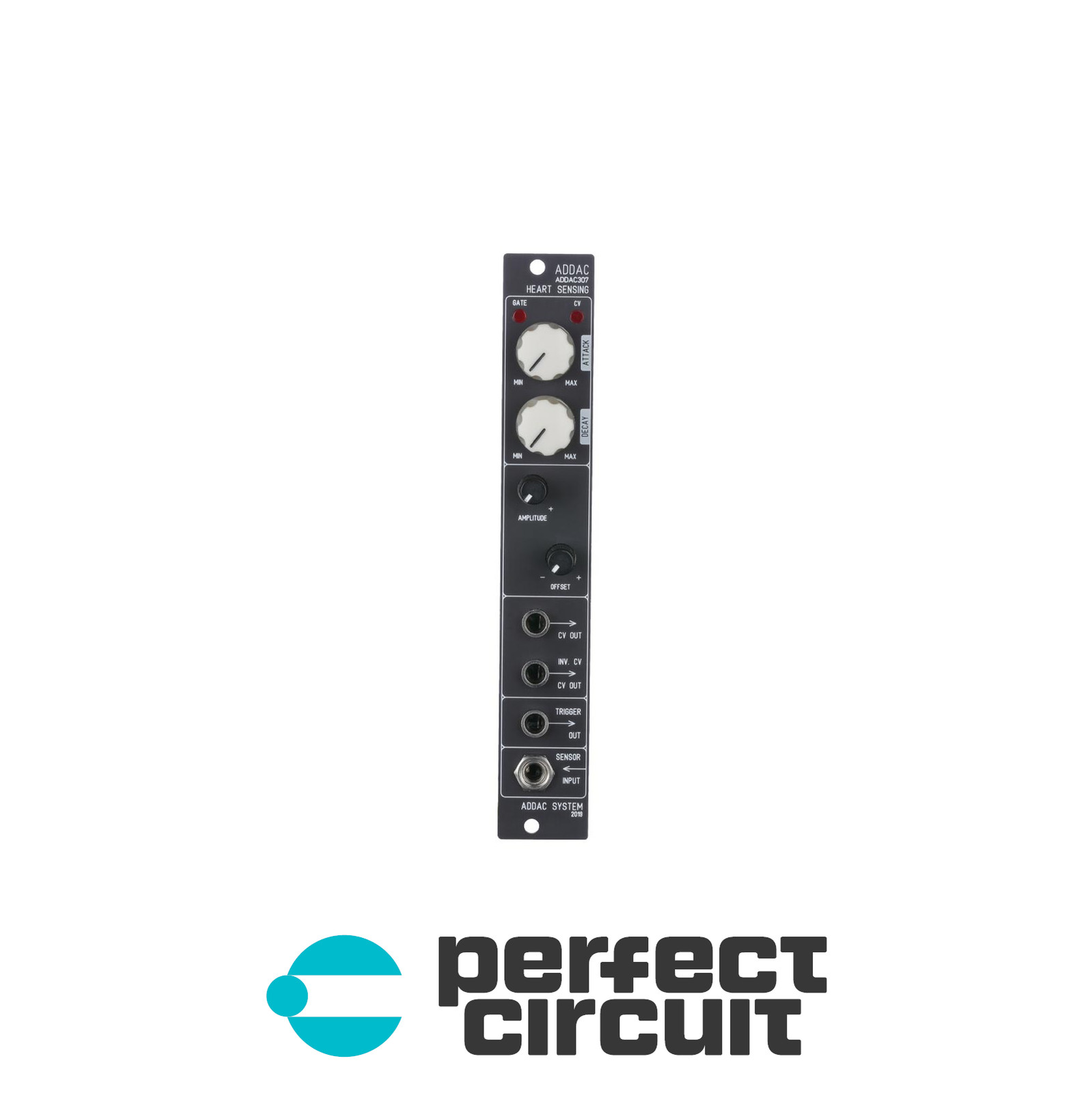
Part of ADDAC’s 300 Series of “Expressive Controls,” the 307 follows the 303 Muscle Sensing module as the second in a line dedicated to using the human body as an interface. Where most modular gear asks you to turn knobs or patch cables, the 307 asks you to be still, to breathe, to notice how your physiology shapes the sound. It’s equal parts biofeedback device and performance instrument. The module ships with a clip-on optical sensor—meant for a fingertip or earlobe—that detects blood flow changes with each pulse. That raw signal is then converted into two outputs: a 0 to +5V trigger and a 0 to +10V AD (attack-decay) envelope. The envelope side is where things get expressive: four front-panel controls—Attack, Decay, Amplitude, and Offset—let you shape how your heartbeat translates into voltage. Want a sharp, snappy response? Crank the attack. Looking for something more languid, like a slow-motion throb? Dial in a longer decay. The offset control is especially useful, letting you lift the baseline of the envelope so it doesn’t bottom out at zero, which can be crucial when modulating parameters that need a minimum voltage to stay active.
Despite its conceptual novelty, the 307 isn’t a gimmick. In practice, it’s surprisingly musical. Patch the trigger output to a sequencer clock input, and suddenly your resting heart rate becomes a tempo—around 60–80 BPM for most people, give or take. Speed it up with exercise or stress, and the sequence accelerates. Feed the envelope into a filter cutoff, and your pulse becomes a rhythmic wah, swelling with each beat. One patch popular among users involves sending the envelope to a VCA, turning the module into a self-modulating gate that opens and closes in time with your heart—ideal for ambient textures or meditative drones. The module also includes dual LEDs to monitor the trigger and envelope outputs in real time, so you can see your pulse dancing across the panel even in a dark studio.
Specifications
| Manufacturer | ADDAC System |
| Production Years | 2019– |
| Original Price | €170 (assembled), €100 (DIY kit) |
| Format | Eurorack |
| Width | 4HP |
| Depth | 35mm |
| Power Requirement (+12V) | 60mA |
| Power Requirement (-12V) | 10mA |
| Trigger Output | 0 to +5V |
| Envelope Output | 0 to +10V |
| Controls | Attack, Decay, Amplitude, Offset |
| Indicators | LED for Trigger, LED for Envelope |
| Inputs | Sensor input (3.5mm) |
| Outputs | Trigger (3.5mm), Envelope (3.5mm), Inverted Envelope (3.5mm) |
| Included Accessories | Optical heart rate sensor (clip-on) |
| DIY Option | Available as SMD/through-hole kit |
| Panel Color | Black (standard), custom colors available |
| Series | ADDAC300 Expressive Controls |
Key Features
The Body as Interface
What sets the 307 apart isn’t just that it reads your heartbeat—it’s how seamlessly it integrates that data into the modular workflow. Unlike MIDI-based bio-sensors that require computers or complex mapping, the 307 outputs standard CV and gate signals, making it immediately useful in any Eurorack system. The optical sensor is passive, requiring no batteries, and draws power directly from the module via the 3.5mm input. It’s sensitive enough to detect a pulse on most people, though results can vary based on skin tone, circulation, or ambient light. Some users report better reliability with the earlobe clip versus the fingertip, especially in bright environments where stray light can interfere with the sensor. The module doesn’t output heart rate as a numerical BPM—it’s purely analog, translating each pulse into a voltage spike. That means no digital processing lag, just a direct, almost primal connection between flesh and circuit.
Envelope Shaping with Biological Precision
The AD envelope generator is where the 307 transforms from novelty to utility. Most envelope generators require a trigger to start; here, the heartbeat itself provides that trigger, creating a self-contained rhythm source. The Attack and Decay controls let you smooth or sharpen the envelope’s rise and fall, effectively letting you “filter” your pulse. Turn Decay high, and each heartbeat swells into a slow ramp, perfect for modulating LFO rate or reverb mix. Lower it, and you get a tight, percussive burst—ideal for triggering drums or stabs. The Amplitude control scales the envelope’s peak voltage, while Offset lifts its floor, preventing it from dipping below zero. This is crucial when modulating parameters that respond poorly to negative voltages, like oscillator pitch or filter resonance. The inclusion of an inverted envelope output adds further flexibility, letting you create complementary modulations—say, one voice opening while another closes, all in sync with your pulse.
DIY Accessibility and Customization
ADDAC offers the 307 as a DIY kit for €100 (excluding VAT), making it one of the more affordable entry points into bio-responsive modular synthesis. The kit is classified as “SMD-Kit-2,” meaning it includes both surface-mount and through-hole components, aimed at intermediate builders. The assembly guide is well-documented, with clear diagrams and step-by-step photos, and the community around ADDAC kits is active and supportive. For those who want a personal touch, custom front panels are available in a range of colors—red, green, blue, white, silver gray, yellowed silver, and bronze—with print colors chosen to contrast the panel. These aren’t mass-produced; each custom panel is ordered individually, taking 4–6 weeks to arrive, which keeps them rare and desirable. The standard black aluminum panel has a clean, clinical look that suits the module’s medical aesthetic, but a red or bronze face can turn it into a striking visual centerpiece.
Historical Context
The ADDAC 307 emerged in 2019, a time when Eurorack was expanding beyond traditional synthesis into experimental control and interface design. While companies like MakeNoise and Intellijel were pushing the boundaries of Buchla-inspired touch plates and pressure-sensitive interfaces, ADDAC took a different path—looking inward, literally. The 307 wasn’t the first attempt to use biometrics in music—David Rosenboom’s brainwave-controlled performances in the 1970s and the MIDI-based BioMuse systems of the 1990s paved the way—but it was among the first to bring that concept into the modular mainstream at an accessible price. It arrived alongside a wave of interest in embodied performance, where musicians sought more intimate, physical connections to their instruments beyond the keyboard. In a market flooded with digital oscillators and quantized sequencers, the 307 offered something refreshingly analog and unpredictable: a control source that couldn’t be perfectly replicated, only experienced.
It also reflected ADDAC’s broader philosophy of hybrid design—blending analog circuits with digital concepts, often in unexpected ways. While the 307 is entirely analog in its signal path, its function relies on a digital sensor, creating a subtle but meaningful fusion. The module doesn’t try to “perfect” the heartbeat signal with smoothing or averaging; instead, it embraces the irregularity. Skipped beats, arrhythmias, and natural variations in pulse strength all come through, making each performance uniquely human. In an era where AI-generated music threatens to flatten expression into predictable patterns, the 307 stands as a quiet rebellion—a reminder that imperfection, vulnerability, and biology still have a place in electronic music.
Collectibility & Value
The ADDAC 307 isn’t a rare module, but it’s not common either. Since it’s still in production, it doesn’t carry the scarcity premium of discontinued gear. New units sell for around $229 from retailers like Perfect Circuit, while used ones typically go for $150–$180, depending on condition and whether the sensor is included. The DIY kit remains available directly from ADDAC, which keeps prices stable and prevents scalping. Because the module has no moving parts and minimal circuitry, failure rates are low. The most common issue reported is sensor degradation—over time, the optical clip can lose sensitivity, especially if the LED dims or the photodiode gets dirty. Replacement sensors are not officially sold, but third-party pulse oximeter clips with compatible 3.5mm jacks can often be used as substitutes, though results vary.
For collectors, the 307 is less about investment value and more about conceptual significance. It’s a conversation piece, a module that sparks curiosity in any rack. Those seeking custom panels may find them on the secondary market, where they occasionally sell for 20–30% above retail. Because the module is still supported, firmware updates aren’t a concern (it has none), and technical obsolescence is unlikely. The real barrier to ownership is psychological: some musicians find the idea of using their heartbeat too intimate, too exposed. Others embrace it fully, using the 307 in live performances where their pulse becomes part of the narrative. If you’re considering a purchase, test it if possible—some people simply don’t get a strong enough signal, especially in cold environments or with certain skin types. And remember: this isn’t a module you use every day. It’s a special tool, best saved for moments when you want your music to feel alive.
eBay Listings
As an eBay Partner, we earn from qualifying purchases. This helps support our independent vintage technology research.