ADDAC System ADDAC220 Dual Envelope Follower +
It doesn’t make sound — it listens, interprets, and turns audio into control voltage with surgical precision and a dash of digital polish.
Overview
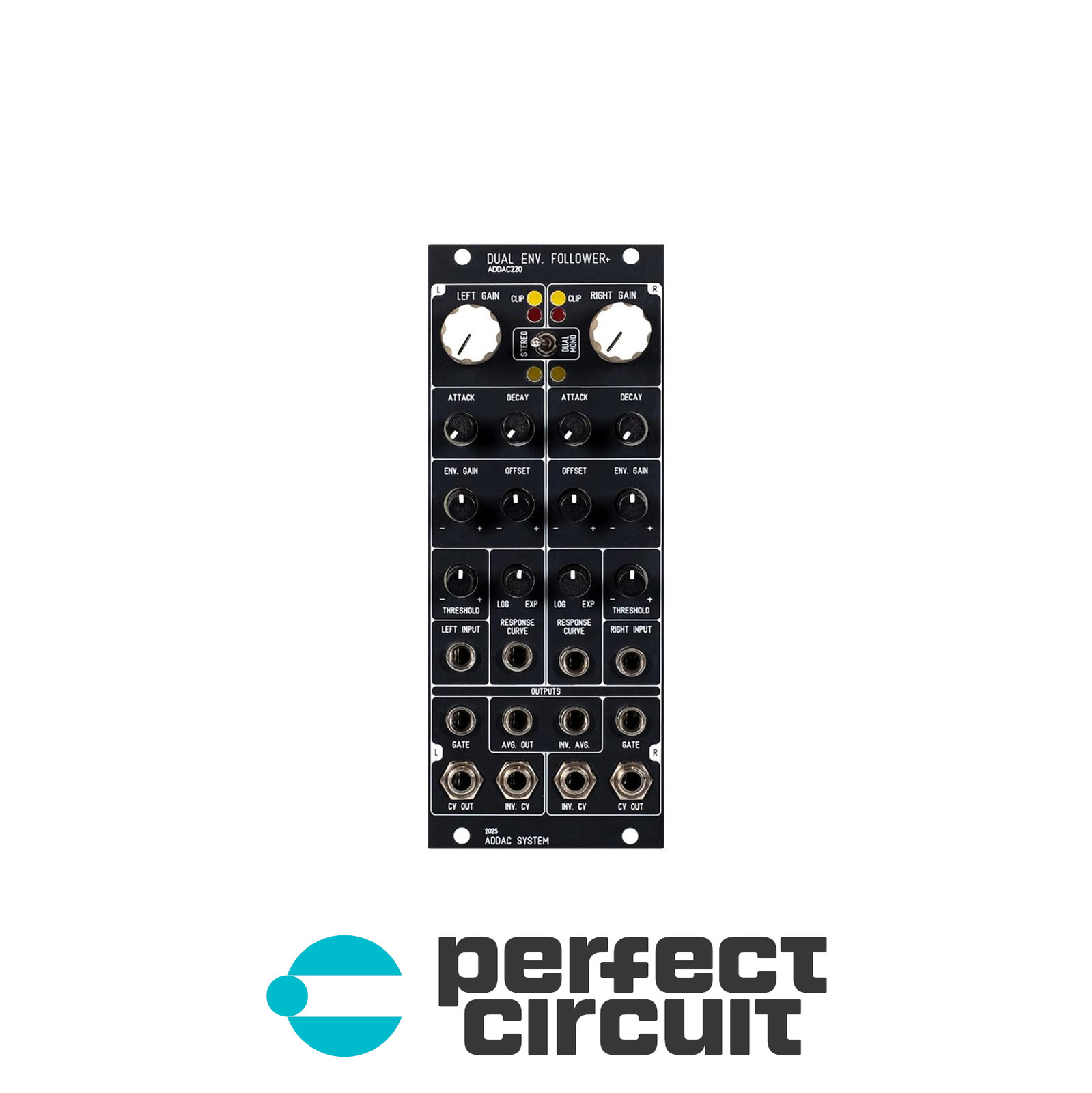
The ADDAC System ADDAC220 Dual Envelope Follower + isn’t the flashiest module on your rack, but it’s the quiet brain that can completely reshape how your system responds to dynamics. Built as an analog/digital hybrid, it bridges the raw immediacy of analog envelope detection with the stability and filtering power of digital processing. This is a module that doesn’t generate — it observes. You feed it audio, and it gives back CV: a voltage representation of how loud or soft your signal is over time, cleaned up, smoothed, and ready to modulate filters, amps, delays, or anything else hungry for control.
Designed for Eurorack systems, the ADDAC220 sits in the ADDAC200 Series lineup, a family known for utility and intelligent signal manipulation. It’s a dual-channel unit, meaning you can track two separate audio sources independently or run in stereo mode where the left side’s controls govern the right, simplifying stereo tracking. The left input is normalled to the right, so if you only plug into the left, the same signal feeds both sides — a small but meaningful convenience for mono operation or quick stereo linking. Whether you're extracting rhythmic envelopes from drum loops, using vocals to modulate a filter, or creating self-regulating feedback patches, the ADDAC220 is the translator between sound and motion in your modular world.
What sets it apart from simpler analog followers is its hybrid architecture. It starts in the analog domain: incoming signals hit a [GAIN] control, get fully rectified, and pass through an analog envelope follower with a fixed short attack and decay. But then it goes digital — that analog envelope is sampled by a 12-bit ADC inside a microcontroller unit (MCU). From there, a Savitsky-Golay filter reduces noise and jitter, giving you a cleaner, more stable CV output than many purely analog designs. The MCU also keeps a history of signal peaks, dynamically mapping the minimum and maximum levels to 0V and the full output range, which helps maintain consistent modulation depth even if your input volume wobbles.
It’s not a sound generator, but it’s a performance catalyst. And while it doesn’t scream “vintage,” its design philosophy — clean, precise, flexible — feels like a modern evolution of the envelope followers that shaped early synth dynamics, just rebuilt for the modular renaissance.
Specifications
| Manufacturer | ADDAC System |
| Model | ADDAC220 Dual Envelope Follower + |
| Format | Eurorack |
| Dimensions | 10 HP |
| Depth | 45 mm |
| Current Draw | 70 mA +12V, 40 mA -12V, 0 mA 5V |
| Channels | dual/stereo |
| Outputs | CV and gate outputs |
| Price | $355 |
| CV OUT | 0 to +10V |
| INV. CV Output | -10V to 0V |
| AVG. OUT | 0 to +10V |
| INV. AVG. | -10V to 0V |
Key Features
Analog front end, digital refinement
The ADDAC220 doesn’t just average voltage — it interprets dynamics. After the initial analog envelope stage, the signal is digitized and filtered using a Savitsky-Golay algorithm, a technique borrowed from data smoothing that excels at preserving shape while eliminating noise. This means you get a responsive envelope without the jitter or instability that can plague analog followers, especially on complex or quiet signals. It’s the kind of refinement that doesn’t announce itself — you just notice your filter sweeps are smoother, your amplitude modulation more consistent.
Precision control with [ATTACK] and [DECAY]
Once digitized, the envelope is slewed using dedicated [ATTACK] and [DECAY] controls. These don’t just shape the CV — they give you fine-grained control over how quickly the module responds to incoming transients and how long it holds or releases. Unlike some followers locked into fixed response times, the ADDAC220 lets you dial in snappy drum detection or slow, swelling swells from pads. The response isn’t just linear — the [RESPONSE CURVE] control adjusts the behavior like a traditional AD envelope, offering logarithmic to exponential characteristics so you can match the feel to your source material or desired modulation effect.
Flexible gain and offset shaping
The [ENV. GAIN] attenuverter is a powerful tool — it doesn’t just scale the CV, it can amplify it up to 2x, letting you overdrive downstream modules or stretch modulation ranges. Pair that with the [OFFSET] control, which shifts the entire CV range up or down, and you can precisely position your envelope within the control voltage landscape of your system. Need a filter to start closed and open only slightly? Offset down and boost gain. Want a VCA to ride just above silence? Offset up. These aren’t afterthoughts — they’re central to the module’s utility.
Smart stereo and dual-mono operation
The [STEREO / DUAL MONO] switch is where the dual nature of the module really shines. In stereo mode, the left channel’s [ATTACK], [DECAY], [RESPONSE CURVE], and [ENV. GAIN] controls govern both sides, with only the right channel’s [GAIN] remaining independent — perfect for tracking stereo material with unified dynamics processing. Flip to dual mono, and both channels operate completely independently, letting you track two different sources with separate settings. The normalled left-to-right input means you can start mono and expand later without patching extra cables.
Threshold-based gate generation
Beyond CV, the ADDAC220 gives you a [GATE] output that triggers when the envelope signal exceeds a user-set [THRESHOLD]. This turns dynamic peaks into rhythmic triggers — think of turning snare hits into clock resets, kick drums into sequencer advances, or vocal bursts into effect toggles. It’s a simple but powerful addition that expands the module from a modulator into a timing source, all derived from the audio you feed it.
Visual feedback and signal monitoring
A red LED monitors the ENV. GAIN level, giving you a real-time visual of the envelope’s amplitude. It’s not a full waveform display, but it’s enough to confirm signal presence, check for clipping, or see how your response settings affect the envelope’s shape. In a dark-lit rack, that little blink becomes part of the performance — a pulse synced to your music.
Collectibility & Value
The ADDAC220 is a modern module without vintage scarcity, but its utility keeps it in steady demand. New units list around $439 on Reverb and $422.84 on eBay, slightly above the $355 price listed in the manufacturer’s channel data — a common spread reflecting retailer markup and platform fees. Used examples do appear, with one listing in the EU priced at €269.00 in December 2025, suggesting moderate depreciation but continued value retention for a functional utility module.
Condition appears well-maintained in the market: one eBay buyer noted their unit arrived sealed in the original box with all manuals, cabling, and warranty information, ideally packaged to prevent shipping damage. This suggests ADDAC System’s packaging and distribution support long-term resale integrity. However, no data exists on common failures, maintenance needs, or long-term reliability — a gap for potential buyers. Since it’s a hybrid design with both analog circuitry and a microcontroller, firmware issues or ADC failures could theoretically arise, but there’s no evidence of such patterns in the available data.
It’s not a grail module, but it’s not disposable either. For Eurorack users building a dynamic, responsive system, the ADDAC220 is a trusted tool — and that kind of quiet reliability often translates to stable resale value.
eBay Listings
As an eBay Partner, we earn from qualifying purchases. This helps support our independent vintage technology research.