ADDAC System ADDAC200 (2010–)
The tiniest traffic cop in your Eurorack, quietly multiplying signals without sucking power or space.
Overview
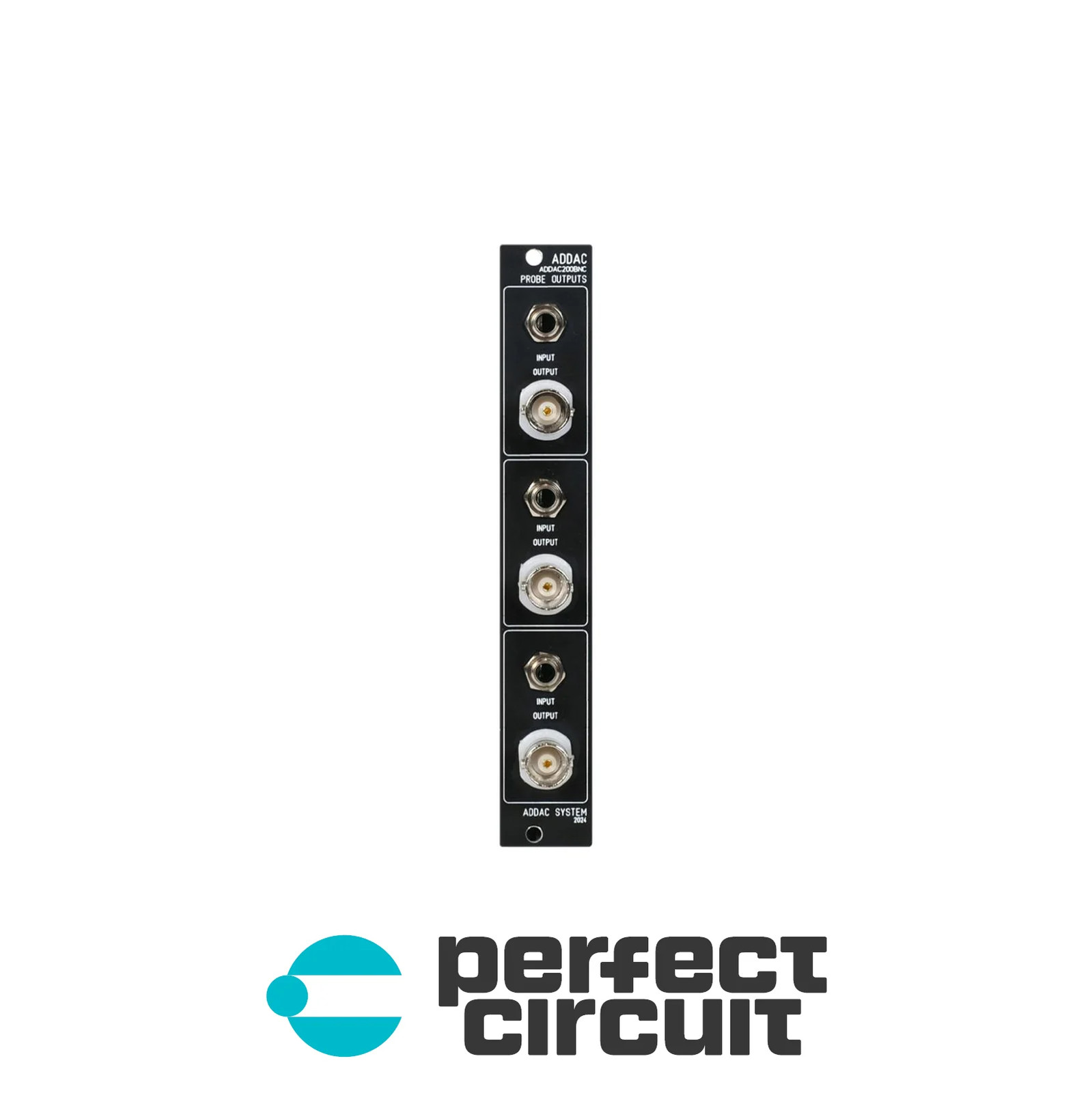
It’s easy to overlook a module that does nothing but split signals—no envelopes, no oscillation, no flashy lights. But open any well-used Eurorack case and you’ll find at least one passive multiple hiding in a corner, quietly doing the unglamorous work of routing the same CV or audio to multiple destinations. The ADDAC200 is that module, stripped down to its essence: two sets of four 3.5mm jacks, crammed into a mere 2HP of panel space. It doesn’t amplify, it doesn’t buffer, it doesn’t even draw power. It just passes voltage through, clean and simple. And in a world where every volt and milliamp counts, that simplicity is a virtue. You plug a clock into one side, fan it out to four sequencers, and forget it. You send a modulation source to multiple filters, and the ADDAC200 doesn’t color the signal, doesn’t load it down—it just works. There’s a quiet satisfaction in using a tool so purpose-built that it feels almost invisible. That said, it’s passive, which means it’s not immune to signal degradation when driving multiple high-impedance inputs. But for most patches, especially in a moderately sized system, it’s more than sufficient. It’s the utility module equivalent of a well-placed junction box in an old house—unseen, uncelebrated, but absolutely essential.
The ADDAC200 is part of the broader ADDAC200 Series, a family of utilitarian modules designed to solve small but persistent problems in modular synthesis. While other manufacturers might bundle multiples into multi-function modules, ADDAC System went the opposite direction: one job, done right, in the smallest footprint possible. This isn’t a module for sonic experimentation—it won’t shape your sound, modulate your filters, or generate new textures. It’s infrastructure. But like any good infrastructure, when it’s missing, you feel the absence immediately. The build quality is consistent with ADDAC’s reputation: sturdy aluminum panel, cleanly labeled jacks, and a minimalist aesthetic that blends into any case. It’s available in black as standard, with custom colors available directly from the manufacturer, though those come at a premium and with a wait. Given its role, most users stick with stock, and that’s fine—the ADDAC200 isn’t meant to stand out. It’s meant to disappear into the patch, doing its job without fanfare.
Specifications
| Manufacturer | ADDAC System |
| Production Years | 2010– |
| Original Price | 55.00 € |
| Format | Eurorack |
| Width | 2 HP |
| Depth | 1.5 cm |
| Power | Passive (no power draw) |
| Electrical Type | Passive multiple |
| Number of Multiples | 2 x 4-fold |
| Jacks | 8 x 3.5mm |
| Signal Type | Audio and CV compatible |
| Impedance | High impedance (passive) |
| Attenuation | None |
| Buffering | No |
| Color Options | Black (standard), custom colors available |
| Mounting Holes | 2 |
| Weight | Negligible |
| Country of Origin | Portugal |
Key Features
Ultra-Compact Passive Design
At just 2HP wide, the ADDAC200 is among the most space-efficient multiples available. In a format where every horizontal millimeter counts, especially in skiffs or travel cases, this kind of density matters. It doesn’t require any power, so it doesn’t contribute to PSU load—a small but meaningful detail when you’re running close to your supply’s limits. The passive nature means it introduces no noise, no coloration, and no latency. What goes in comes out, unchanged. That’s ideal for clock signals, gate triggers, or any CV that needs to stay pristine. However, because it’s unbuffered, chaining too many inputs from a single output can lead to voltage drop, especially with lower-output modules. It’s not a flaw—just a limitation of physics. For most users, this isn’t an issue, but in large systems with complex fan-out patches, a buffered multiple like the ADDAC200B might be a better fit.
Dual 4-Fold Multiple
The module provides two independent 1-to-4 splits, each with its own row of jacks. This layout is intuitive: plug your source into the first jack, and the signal appears on the next three. No switches, no routing matrix—just direct connectivity. The dual configuration means you can handle two separate distribution tasks without stacking modules. Need to split a master clock and a pitch CV at the same time? Done. The jacks are standard 3.5mm, compatible with all Eurorack cabling, and spaced to accommodate even the bulkiest patch cables without strain. The panel labeling is minimal but clear, with “MULT” marked above each row and no unnecessary graphics. It’s a design philosophy that prioritizes function over flair, and it works.
Build Quality and Customization
ADDAC System, based in Lisbon, Portugal, has built a reputation for clean, durable module construction, and the ADDAC200 is no exception. The anodized aluminum panel resists scratching, and the silkscreen remains legible even after years of use. The jacks are mounted securely, with no wobble or play, which is crucial for a module that will see constant plugging and unplugging. One unique aspect of ADDAC’s offering is the option for custom panel colors—something usually reserved for boutique or limited-run builders. For an additional fee and a 4–6 week lead time, users can order the ADDAC200 in red, green, blue, white, silver gray, yellowed silver, or bronze, with matching print colors. While most buyers stick with the standard black, the option adds a personal touch for those who like their systems to reflect individuality, even in the smallest details.
Historical Context
The ADDAC200 emerged during the early 2010s, a period of explosive growth in the Eurorack modular synthesizer market. As more musicians and sound designers adopted modular systems, the need for compact, reliable utility modules became apparent. While larger manufacturers focused on sound-generating modules, smaller European builders like ADDAC System carved out niches by addressing the practical, often overlooked aspects of patching. The ADDAC200 wasn’t revolutionary—it didn’t introduce new synthesis techniques or modulation methods. Instead, it solved a basic but persistent problem: how to distribute signals efficiently in a space-constrained environment. At the time, many builders were still using DIY solutions or repurposing modules from other formats. ADDAC’s decision to release a dedicated, mass-produced 2HP multiple filled a gap in the market. It arrived alongside similar utility-focused modules from brands like Intellijel and Doepfer, but with a distinctly minimalist aesthetic that appealed to users favoring clean, functional design over visual flair. Its passive nature also aligned with a growing preference for low-power, high-efficiency modules—especially important as skiff-friendly systems gained popularity.
Collectibility & Value
The ADDAC200 is not a collectible in the traditional sense. It doesn’t appreciate in value, isn’t produced in limited runs, and doesn’t carry the mystique of vintage analog circuits. It’s a tool, not a trophy. That said, it remains in active production and is widely available through ADDAC’s direct sales and authorized dealers. New units sell for around €55, with no significant markup on the secondary market. Used units, assuming they’re in working condition, typically go for €30–€40, depending on region and seller. Because it has no electronics—just jacks and traces—failure points are minimal. The most common issues are bent jacks or cracked solder joints from physical stress, but these are rare and easily repairable. There’s no need to “recap” or restore it, no aging components to worry about. It’s as close to maintenance-free as a Eurorack module can be. For buyers, the only real concern is authenticity—counterfeit or clone modules do exist, especially on marketplaces like eBay. A genuine ADDAC200 will have crisp silkscreening, consistent panel anodization, and the correct jack spacing. If a deal seems too good to be true, it probably is. Given its reliability and low cost, the ADDAC200 is one of the safest purchases in modular—no surprises, no hidden flaws, just a well-made utility that does exactly what it promises.
eBay Listings


As an eBay Partner, we earn from qualifying purchases. This helps support our independent vintage technology research.