ADDAC System ADDAC218 (2010s–present)
Three little knobs, a forest of patch cables, and the quiet magic of signal control hiding in plain sight.
Overview
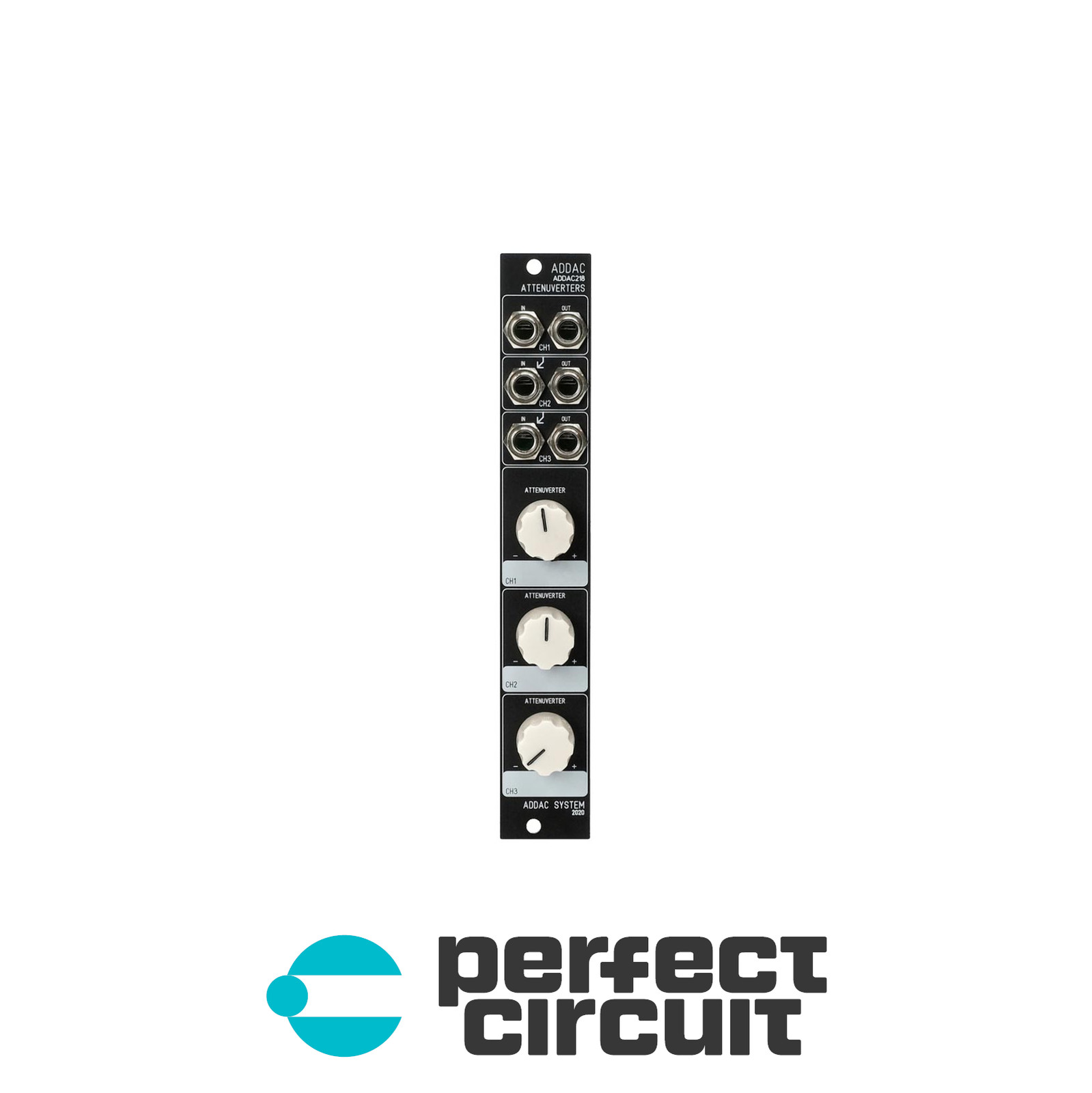
It’s easy to overlook a module like the ADDAC218 when you're chasing oscillators that scream or filters that howl. But plug it into your rack, and within minutes you’ll wonder how you ever patched without it. This isn’t a sound generator or a flashy processor—it’s the quiet architect behind half your best patches. The ADDAC218 Attenuverters is a 4HP slab of pure utility, packing three independent attenuverters into a space smaller than a matchbox. Each channel scales a control voltage or audio signal down in level, or flips its polarity entirely—hence "attenuverter." That might sound mundane, but in the hands of someone who understands voltage flow, this module becomes a secret language. Want to invert the direction of an LFO sweeping a filter? Channel 2’s got you. Need two subtly different versions of the same envelope, one inverted, one half-strength? Patch into channel 1, let it normal to 2 and 3, tweak the knobs, and voilà—modular alchemy with zero extra modules.
What elevates the 218 from mere function to quiet brilliance is its normalled design. Channel 1 feeds into channels 2 and 3 by default, so a single incoming CV splits into three parallel paths, each with its own level and polarity control. This turns one modulation source into a small constellation of variations—perfect for creating evolving, organic movement across multiple parameters. It’s the kind of feature that feels obvious in hindsight, but rare in execution. And unlike some attenuverters that skimp on usability, ADDAC left white labeling zones next to each knob, inviting users to scribble in patch notes directly on the panel. It’s a small touch, but one that speaks volumes about who this module is for: the tinkerers, the patch-documenters, the ones who build systems that live and breathe over weeks, not just jam sessions.
Despite its simplicity, the 218 carries the quiet confidence of ADDAC’s design philosophy—clean layouts, robust build, and thoughtful integration into a larger ecosystem. It’s part of the ADDAC200 series, their line of analog CV utilities, and slots in beside modules that do more flashy jobs. But in a world where digital modules offer endless modulation matrices, there’s something grounding about reaching for a physical knob to invert a gate or scale down a random voltage. It forces intention. You turn the knob, you see the change, you hear the shift in behavior. No menus, no presets, no hidden algorithms—just voltage, resistance, and control.
Specifications
| Manufacturer | ADDAC System |
| Production Years | 2010s–present |
| Original Price | 90€ (assembled), 61€ (DIY kit, excl. VAT) |
| Width | 4HP |
| Depth | 25mm |
| Power Consumption | 40mA @ +12V, 40mA @ -12V |
| Function | 3-channel attenuverter |
| Normalization | Channel 1 normalled to Channels 2 and 3 |
| Controls | 3x 13mm knobs (one per channel) |
| Inputs | 3x input jacks (one per channel) |
| Outputs | 3x output jacks (one per channel) |
| Panel Labeling | White areas for user annotations |
| DIY Availability | Yes, SMD pre-soldered kit |
| Series | ADDAC200 Series (Analog CV Utilities) |
| Format | Eurorack |
| Panel Color | Black (standard), custom colors available |
| Customization | Custom front panels in Red, Green, Blue, White, Silver Gray, Yellowed Silver, Dark/Light Bronze |
| Assembly Guide | Available as PDF from manufacturer |
Key Features
Normalization as a Creative Tool
Most attenuverters treat each channel as isolated—patch in, turn the knob, done. The ADDAC218 flips that script by normaling channel 1 to 2 and 3. That means a single CV source, like a slow LFO or an envelope, can be split and shaped independently across all three outputs without additional multiples. This isn’t just about saving space; it’s about encouraging layered modulation. One output might slightly open a filter, another could invert the same LFO to close a VCA in opposition, and the third could be barely touched to nudge a pitch down a few cents. The result? Movement that feels alive, not mechanical. It’s the difference between a robot waving its arm and a human gesturing with nuance. And because the normalization is passive, inserting a cable into channel 2 or 3 breaks the chain cleanly—no jumpers, no rerouting, just intuitive patching.
Panel Design That Works With You
In a genre where black panels with cryptic labels are the norm, the ADDAC218’s white annotation zones are a quiet act of rebellion. They invite you to personalize the module, to turn it from a generic utility into a documented part of your system. Write “ENV → FILT” next to channel 1, “INV TO PAN” by channel 2, and suddenly the module becomes a reference point, not just a processor. This is especially valuable in semi-permanent patches or live setups where you need to recall configurations quickly. The 13mm knobs are small but positively damped, with enough grip to adjust precisely without taking up real estate. And while the panel is minimalist—no LEDs, no extra switches—that’s the point. There’s nothing to distract from the core function: shaping voltage with your hands.
DIY Accessibility Without the Pain
ADDAC offers the 218 as a DIY kit with all surface-mount components pre-soldered—a rare and welcome compromise between affordability and accessibility. For beginners, this removes the most intimidating part of module building: tiny SMD parts that vanish into carpet fibers. What’s left are through-hole components—jacks, pots, power connector—that are straightforward to solder with basic tools. The included assembly guide is detailed and illustrated, making it a solid first build for someone stepping into Eurorack DIY. At 61€ (excl. VAT), it’s also one of the more affordable entry points into ADDAC’s ecosystem. For experienced builders, it’s a quick weekend project. For shops or educators, it’s a reliable, low-risk kit to stock or teach with. And because the module draws a modest 40mA on both rails, it won’t tax even the smallest power supplies.
Historical Context
The ADDAC218 emerged during a period when Eurorack was shifting from boutique curiosity to mainstream staple. Around the early 2010s, as more musicians built racks, the demand for utility modules exploded. You could have the most beautiful oscillator in the world, but without attenuverters, multiples, and mixers, it was just noise without control. ADDAC, already known for hybrid digital-analog designs like the ADDAC112 Looper/Granulator, recognized that the glue between modules was just as important as the modules themselves. The 200 series—dedicated to analog CV utilities—was their answer. The 218 wasn’t revolutionary in concept; attenuverters had existed for decades, from Serge to Doepfer. But ADDAC refined the idea with modern build quality, smart normalization, and user-centric design. It arrived at a time when skiff-builders and minimalists were optimizing every HP, and 4HP for three useful functions was a compelling pitch. Competitors like Intellijel and Mutable offered similar functions, but often with more features—and more space. The 218 carved its niche by being ruthlessly focused: no added noise, no extra circuitry, just clean, reliable voltage manipulation.
Collectibility & Value
The ADDAC218 isn’t a “collector’s item” in the traditional sense—nobody’s hoarding it for resale value, and it doesn’t have limited editions or gold plating. But that doesn’t mean it lacks worth. On the used market, assembled units typically trade between €70 and €90, depending on condition and whether they include the original packaging. DIY kits in unopened condition can fetch €50–€60, especially if they’re older versions with slight component differences. Because the module is passive and solid-state, failure rates are extremely low. There are no ICs to fail, no complex circuits—just pots, jacks, and resistors. The most common issue reported is pot scratchiness from dust or infrequent use, easily fixed with contact cleaner. Given the pre-soldered SMD design, DIY builds rarely suffer from assembly errors, though buyers should still check for cold solder joints if purchasing a used kit-built unit. The real value of the 218 lies in its ubiquity and reliability. It’s the kind of module you buy once and keep forever, the way you’d keep a favorite screwdriver. It doesn’t age, it doesn’t go out of style, and it doesn’t get replaced. If anything, its value increases the more your system grows—because the older your rack gets, the more you appreciate the quiet, dependable ones.
When buying, the only real concern is panel condition. The black anodized aluminum is durable, but the white labeling areas can yellow or scratch over time, especially if written on with permanent markers. Custom panels, while beautiful, are not commonly found on the secondhand market due to their made-to-order nature and 4–6 week lead time. If you see one, expect a premium—up to €120 for a rare color like Dark Bronze. For DIY buyers, the kit remains available directly from ADDAC, though international shipping can add significant cost. Given the low risk and high utility, it’s often smarter to buy new if you’re building from scratch. But for those hunting for a bargain, the 218 is one of the few modules where used and new prices are close enough that condition becomes the deciding factor.
eBay Listings
As an eBay Partner, we earn from qualifying purchases. This helps support our independent vintage technology research.