ADDAC System 203 (2010–Present)
A quiet workhorse in black FR4, the 203 slips into your rack like a utility knife—unassuming, essential, always sharp when you need it.
Overview
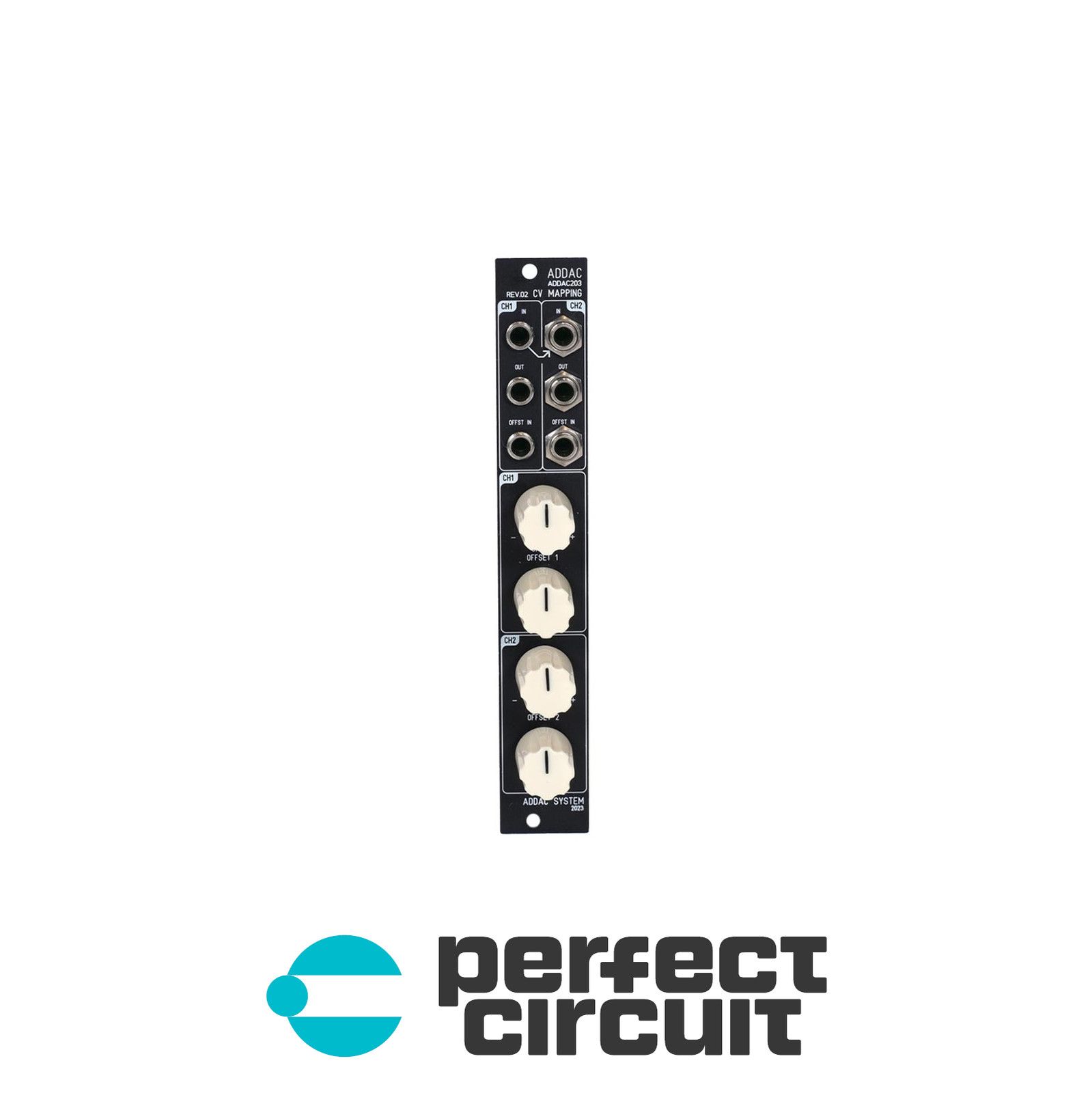
You don’t buy the ADDAC System 203 for glamour. You buy it because at 3 a.m., halfway through a patch that’s spiraling into chaos, you realize your LFO is screaming at +8V when your filter cutoff only wants a gentle nudge of +2V, and you don’t have time to rebuild the whole thing. That’s when the 203 earns its keep. It’s not a sound generator, not a modulator with character—this is voltage plumbing. Dual channels of offset and attenuversion, each with its own input, output, gain knob, and offset knob, all packed into a svelte 6 HP. The front panel is stark black FR4, no flashy graphics, just clean white silkscreen telling you exactly what does what. It looks like a module that knows its job and intends to do it without fuss.
And it does. The gain section is an attenuverter, meaning you can scale a CV down or flip its polarity entirely—critical when you’re trying to make a rising envelope close a filter instead of open it. After that, the offset stage lets you slide the entire signal up or down by ±5V, which sounds modest until you’re trying to shift a bipolar LFO into unipolar territory to modulate something that only accepts positive voltages. The module’s simplicity is its strength. There are no bells, no whistles, no CV inputs on the first rev—but the Rev.02 adds an offset CV input, which opens up dynamic remapping on the fly. Want your pitch CV to drift higher as your sequence progresses? Patch an envelope into the offset CV input. Need to modulate how much an inverted envelope affects your panner? There’s your path.
It’s also a survivor. First introduced around 2010 as one of ADDAC’s earliest Eurorack modules, the 203 has stuck around not because it reinvented the wheel, but because it never needed to. The circuit is straightforward analog utility: passive scaling, active offset, solid op-amp buffering. It draws a modest 40mA on both +12V and -12V rails, fits in shallow skiffs at just 25mm deep, and uses a standard Doepfer-style power cable. No exotic chips, no firmware, no hidden modes. What you see is what you get—and in a format increasingly cluttered with overdesigned, overpriced “utility” modules, that’s a rare comfort.
Specifications
| Manufacturer | ADDAC System |
| Production Years | 2010–Present |
| Original Price | €97 (kit), ~$163 (assembled) |
| Format | Eurorack |
| Width | 6 HP |
| Depth | 25 mm |
| Power Supply | ±12V |
| Current Draw +12V | 40 mA |
| Current Draw -12V | 40 mA |
| Bus Board Cable | 8×2 IDC (Doepfer style) |
| Channels | 2 |
| CV Input Range | ±10V |
| CV Output Range | ±10V |
| Attenuverter Range | 0 to ±10V (adjustable via jumper to x1 or x10 max gain) |
| Offset Range | ±5V |
| Offset CV Input | Yes (Rev.02) |
| Panel Material | Black FR4 |
| Assembly Option | DIY kit (SMD pre-soldered) |
Key Features
Dual-Channel Voltage Taming
Each of the two channels on the ADDAC203 functions as a complete CV scaler and shifter. The signal enters, hits the attenuverter—which can reduce amplitude or flip polarity—then passes through the offset stage, where a knob adds a fixed DC voltage between -5V and +5V. This isn’t just trimming; it’s repositioning entire control voltages into usable ranges. A slow LFO that swings from -5V to +5V can be offset to 0V to +10V, making it perfect for modulating a VCA that expects unipolar CV. Or you can knock a +10V envelope down to +3V to gently nudge a filter without slamming it open. The dual-channel layout means you can do this for two critical signals at once—say, scaling a random voltage for pitch while offsetting an envelope for amplitude. No normalization between channels keeps them independent, which is exactly how utility modules should behave.
Offset CV Input (Rev.02)
The original 203 was purely manual—set your offset and leave it. The Rev.02 upgrade added a CV input for the offset stage, which transforms the module from static scaler to dynamic mapper. Now, instead of a fixed offset, you can modulate the offset itself. Patch an envelope into the CV input and watch your LFO’s center point rise over time. Feed in a sequencer step and shift each note’s modulation baseline. This turns the 203 into a kind of “CV transformer,” capable of complex, evolving control voltage behavior without needing a microprocessor or patch memory. It’s a small addition that dramatically expands the module’s role in a patch, especially in generative or evolving textures.
DIY-Friendly Build
ADDAC released the 203 as a DIY kit, and it’s a thoughtful one. All surface-mount components come pre-soldered; users only need to attach through-hole parts like jacks, pots, and the power cable. The build is rated “easy/medium,” making it accessible to intermediate builders. The FR4 panel doubles as the circuit board, a space-saving and cost-effective design common in early Eurorack but now rare. Documentation is clear, and the module’s simplicity means fewer points of failure during assembly. For tinkerers, there’s even a jumper to set the maximum gain to either x1 (unity) or x10, letting you decide whether you want subtle scaling or extreme attenuation/inversion. It’s a module built for modularity in every sense—both in the rack and on the workbench.
Historical Context
When ADDAC System launched the 203 around 2010, Eurorack was still a niche within a niche. The format had escaped its boutique origins but hadn’t yet exploded into the crowded, trend-driven market it is today. Modules were simpler, often designed by engineers for engineers, and utility functions like voltage scaling were frequently left to the user to patch together with op-amps or repurpose from other modules. ADDAC, founded in 2009 with a focus on bridging analog and digital synthesis, saw a gap: a dedicated, reliable, no-nonsense module for CV manipulation. The 203 wasn’t revolutionary—it echoed functions found in Doepfer’s A-183 or Intellijel’s uScale—but it offered a clean, compact, and affordable solution at a time when such tools weren’t standardized. Its release coincided with a growing demand for “patch essentials,” as more musicians moved from desktop synths to modular systems and realized they needed infrastructure to keep their patches coherent. The 203 filled that role with quiet efficiency, becoming a staple in early ADDAC adopters’ racks. Over time, as ADDAC expanded into more complex modules like the Vintage Clip and Vintage Pre, the 203 remained a foundational piece—a reminder that sometimes the most important tools are the ones you don’t notice until they’re gone.
Collectibility & Value
The ADDAC203 isn’t a collector’s item in the traditional sense. It doesn’t appreciate, it doesn’t have rare revisions with mythical sound qualities, and you won’t find people hunting for “NOS” units on forums. But that doesn’t mean it lacks value—it’s just practical value. New assembled units sell for around $160–$180, while the DIY kit goes for about €97. Used prices hover between $80 and $120, depending on condition and whether it’s assembled. Since it’s a passive utility module with no moving parts beyond the pots, failure points are minimal. The most common issues are dirty or scratchy potentiometers, which can usually be cleaned with contact cleaner, or cold solder joints on the power cable—especially in user-assembled kits. The FR4 panel is durable but can crack if over-tightened, so check the mounting screws when buying used. Because the circuit is so simple, repairs are straightforward for anyone with basic soldering skills. There’s no obsolescence risk—no chips to go out of production, no firmware to update. If you find a working 203 from 2012, it’ll perform exactly like a new one. For this reason, it’s not worth chasing “new old stock” or paying a premium for early versions. Buy it for function, not nostalgia. And if you’re building a skiff or a travel system, the 25mm depth and 6 HP width make it a space-saving essential. It’s the kind of module you don’t appreciate until your rack has one—and then you realize you need two.
eBay Listings
As an eBay Partner, we earn from qualifying purchases. This helps support our independent vintage technology research.