ADDAC System 102 (2020–Present)
A tiny Eurorack radio that turns static into symphony — and your patchbay into a live broadcast of the electromagnetic universe.
Overview
You’re not imagining it — that faint hiss under the pop song bleeding through your speakers is alive. The ADDAC System 102 VC FM Radio doesn’t just tune in stations; it listens to the world’s secret conversations. Slide the Tune knob past the last clear channel, and the silence starts talking back: ghostly whistles, distant chatter, the hum of power lines, the digital chatter of cell towers — all of it becomes raw sonic material. This isn’t background noise. It’s a living, breathing sound source that changes with the weather, the time of day, and where you’ve mounted your rack. In a modular system full of predictable oscillators and pristine waveforms, the 102 is the wildcard that reminds you music doesn’t have to be designed — sometimes it just needs to be discovered.
And yes, it actually works as a radio. From 87.5 to 108 MHz, it pulls in FM stations with surprising clarity, especially when you’ve got a decent external antenna plugged into the 2.5mm jack. But the real magic kicks in when you stop trying to find a song and start hunting for texture. The static between stations is rich, complex, and endlessly variable — far more interesting than most dedicated noise modules. It’s like having a contact mic on the atmosphere itself. Whether you’re sampling eerie drifts for ambient work or feeding bursts of interference into a granular processor, the 102 delivers unpredictability you can’t fake with algorithms. It’s not a gimmick. It’s a field recorder in module form.
Positioned in the ADDAC 100 series as a sound generator with a twist, the 102 sits between the purely synthetic sources and the utility modules that shape them. It’s not a workhorse like the 106 T-Noiseworks, nor is it a precision tool like the 207 Intuitive Quantizer. Instead, it’s a character module — the kind you reach for when your patch feels too clean, too controlled, too safe. It’s the sonic equivalent of throwing a handful of sand into the gears. And while it doesn’t generate traditional control voltages, its audio output is deeply responsive to voltage control: you can sweep through frequencies with a sequencer, mute it with a gate, or jump between stations via CV. That interactivity is what elevates it from novelty to instrument.
Specifications
| Manufacturer | ADDAC System |
| Production Years | 2020–Present |
| Original Price | €315 / $399 |
| Format | Eurorack |
| Width | 8 HP |
| Depth | 5 cm (50 mm) |
| Power Supply Compatibility | ±12V and ±15V |
| Max Current Draw | 100 mA (+12V), 100 mA (-12V) |
| Bus Board Cable | 8×2 IDC (Doepfer style) |
| Frequency Range | 87.5 – 108 MHz (standard), 76 – 96 MHz (Japan firmware available) |
| Channel Spacing | 100 kHz (EU), 200 kHz (US) — jumper selectable |
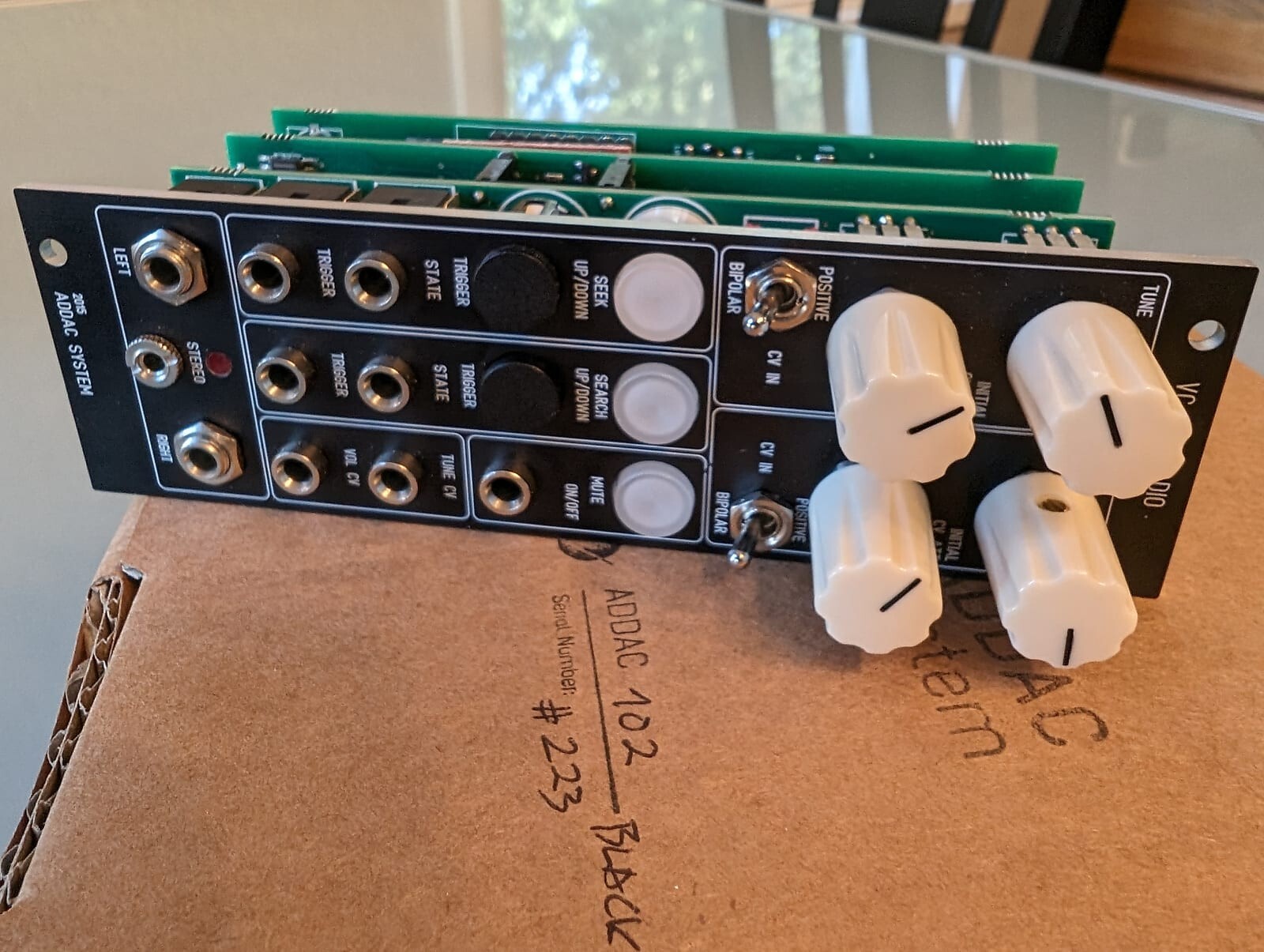
| CV Inputs | Tune, Volume, Seek Up/Down, Search Up/Down — all with attenuators |
| CV Range | ±10V |
| Gate Input Threshold | 2.5V |
| Outputs | Stereo audio (two separate jacks) |
| Mute Function | Manual button and gate input |
| Soft Mute Feature | Configurable via jumper — disables automatic muting when no station is detected |
| Antenna | External wire antenna via 2.5mm jack |
| LED Indicators | Stereo output status, station lock |
| Custom Panel Options | Available in multiple colors and finishes — direct order only |
Key Features
Voltage-Controlled Tuning with Precision Search
The Tune knob sets your base frequency, but the real performance control lives in the CV input with attenuator — sweep through the dial with an LFO for slow drifts, or jump across the spectrum with a sequencer for abrupt, radio-surfing transitions. The Search Up/Down inputs are particularly clever: they let you nudge the frequency in 0.1 MHz (EU) or 0.2 MHz (US) steps, making it easy to hunt for weak stations without overshooting. Unlike older radio modules that just coarse-tune, the 102 gives you surgical control over where you land. And because the Search function can be CV-triggered, you can automate station-hopping patterns that feel almost algorithmic, even though they’re pulling real-world signals.
Soft Mute Jumper — The Secret to Noise as a Feature
Most FM modules silence the output when no station is locked, which kills the ambient noise floor. The 102 flips this: it includes a jumper to disable the soft mute, letting static and interference bleed through continuously. This is critical for experimental use. Leave the jumper off, and you’ve got a constant stream of electromagnetic texture — perfect for feeding into filters, delays, or resonant circuits. Flip it on, and it behaves like a conventional radio, muting between stations. The choice is yours, and it transforms the module’s character from passive receiver to active sound generator. Service technicians note that users in urban areas often disable soft mute entirely, treating the module more like a noise oscillator than a tuner.
Skiff-Friendly Redesign and Antenna Flexibility
The Version 2 update wasn’t just cosmetic — it shaved down the depth to 50mm, making it one of the few radio modules that won’t bulge out the back of a travel skiff. That’s a big deal for touring modular artists who want real-time radio integration without sacrificing portability. The external 2.5mm antenna jack is equally important: a simple wire — even a few inches of stripped cable — dramatically improves reception. Some owners report wrapping the antenna around the rack frame for better coupling. There’s no internal antenna, so without a wire, the module is nearly deaf. But that also means you can experiment with different lengths and placements to sculpt the kind of interference you pick up — turning physical setup into part of the sound design.
Historical Context
The ADDAC 102 arrived in late 2020, a time when Eurorack was deep into its golden age of utility and abstraction. Most new modules focused on complex modulation, generative sequencing, or digital wavetable synthesis — clean, controlled, and repeatable. The 102 stood out by embracing chaos. It wasn’t the first radio module (early DIY builds and niche brands had dabbled), but it was the first to offer full voltage control, stereo output, and thoughtful design in a commercially available format. At a time when many patches sounded increasingly digital and sterile, the 102 reintroduced the unpredictability of the analog world — not through modeling, but by literally tuning into it.
It arrived alongside a broader trend of “found sound” integration in modular synthesis: contact mics, cassette interfaces, and field recording modules were gaining traction. The 102 fit perfectly into that ethos, offering a way to bring the outside world into the patch without additional gear. Competitors like Intellijel’s Uurke or the now-discontinued Critter & Guitari Pocket Operators offered radio-like functions, but none matched the 102’s level of CV integration or build quality. It wasn’t trying to be a standalone instrument — it was a bridge between the electromagnetic environment and the modular ecosystem.
Collectibility & Value
The ADDAC 102 is still in production, so it’s not a vintage item in the traditional sense, but it’s already developed a cult following. New units sell for around €315 direct from ADDAC, with dealers like Perfect Circuit and Thomann listing them at $399 — a premium that reflects import costs and demand. Used prices hover between $250 and $325, depending on condition and whether the seller includes a custom panel. Because it’s a modern module, there are no widespread reliability issues, but collectors do report a few quirks. The 2.5mm antenna jack is fragile — repeated plugging can loosen it, and replacements are not standard. Owners recommend leaving a wire permanently attached or using a strain-relief sleeve.
The jumper settings on the back PCB are another point of attention. Misconfigured jumpers (especially EU/US spacing) can make the module seem “broken” when it’s just set for the wrong region. Buyers should verify the firmware and jumpers match their location — particularly if sourcing from overseas. Units with custom panels command a 20–30% premium, especially in rare colors like Dark Bronze or Yellowed Silver, but these are made to order and take 4–6 weeks to produce.
For live performers, the mute gate input is a lifesaver — it allows silent station surfing until the perfect audio snippet appears. But because the module relies on real-world signals, its usefulness varies by geography. In dense urban areas, it’s a goldmine of content. In rural or shielded environments, it may require an external antenna boost. That variability isn’t a flaw — it’s part of the module’s identity. If you want predictable noise, get a dedicated source. If you want something that changes with the city, the weather, or the time of day, the 102 delivers in ways no synth can replicate.
eBay Listings

As an eBay Partner, we earn from qualifying purchases. This helps support our independent vintage technology research.