Moog Memorymoog (1982–1985)
A six-voice analog synth with three oscillators per voice, released too late for the golden age of analog.
Overview
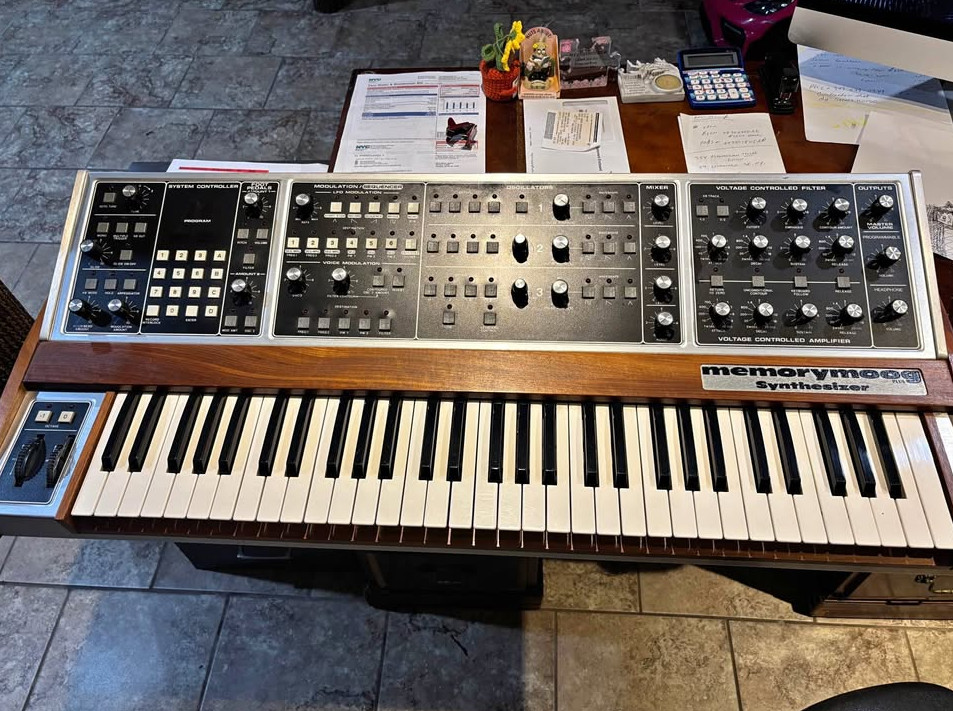
In 1982 the music world was heading for clean, cold digital synthesis. Moog Music went the other way and built a 70-pound analog synth. It has six voices, each with three discrete oscillators and a genuine Moog ladder filter. Few polyphonic synths, then or now, match that kind of density. It was built for composers who wanted huge pads and basslines heavy enough to liquefy concrete, and for players with strong wrists.
The launch price was $9,800 (over $30,000 in today's money). It still found its way into elite studios. Film composer Gary Chang used it on Blade Runner-adjacent projects for its eerie, breathing textures. Adrian Belew of King Crimson praised its chaotic edge for guitar-like synth leads. It was unpredictable and temperamental. Programmable memory stores 100 patches across 10 banks, which was unprecedented recall for a Moog, and it kept the hands-on, cable-free immediacy that analog purists demanded.
Specifications
| Voices | 6 |
| Oscillators per Voice | 3 |
| Waveforms | sawtooth, square/pulse, triangle |
| Filters | Moog ladder filter (24dB/octave low-pass per voice) |
| Filter Frequency Range | 10 Hz - 20 kHz |
| Envelope Generators | 3 per voice (ADSR for filter, amplifier, modulation) |
| LFO | 1 per voice (triangle, square, random/s&h, sample & hold) |
| Keyboard | 64 keys (touch-sensitive, aftertouch capable) |
| Aftertouch | Yes (mono aftertouch) |
| Memory | 100 programmable patches (10 banks of 10) |
| Pitch Bend Range | ±2 octaves |
| Modulation Wheel | Yes |
| Audio Outputs | 1 x 1/4" (unbalanced) |
| Audio Inputs | 1 x 1/4" (external audio input per voice) |
| CV/Gate | Yes (multiple CV in/out, Gate in/out, Sync in/out) |
| MIDI | No (pre-MIDI standard) |
| Power Requirement | 120 VAC, 60 Hz, 120 watts |
| Dimensions | 38.5" x 15.5" x 5.5" (97.8 x 39.4 x 14 cm) |
| Weight | 70 lbs (31.8 kg) |
| Country of Manufacture | United States |
| Original MSRP | $9,800 (1982) |
Key Features
- Six Voices, Three Oscillators Each: Unlike most polyphonic synths of the era (including Moog’s own Polymoog), the Memorymoog gave each voice three independent analog oscillators. That’s 18 oscillators in total—more than some modular systems. This allowed for absurdly thick unison patches, detuned chorusing, and complex harmonic layering that could fill an entire frequency spectrum with one chord.
- Per-Voice Moog Ladder Filters: Each voice had its own discrete 24dB/octave low-pass filter, the legendary Moog ladder design known for its smooth resonance and creamy saturation. This wasn’t a shared filter bus like on some polysynths—it meant every note could be dynamically shaped independently, preserving clarity even in dense chords.
- Programmable Memory with Full Parameter Control: With 100 user-programmable patches stored in 10 banks of 10, the Memorymoog was Moog’s first polyphonic synth to offer comprehensive patch memory. Every parameter—from oscillator tuning to envelope timing—was recallable. This was revolutionary for live performance and studio repeatability, finally bringing Moog into the modern era without sacrificing analog integrity.
- External Audio Input per Voice: A rare and powerful feature: each of the six voices had its own 1/4" input, allowing external signals (like a guitar or drum machine) to be routed through the Moog ladder filter and envelope. This turned the Memorymoog into a six-voice analog processor, capable of filtering six different external sources simultaneously—a feature still rare today.
- Touch-Sensitive Keyboard with Aftertouch: The 64-note keyboard wasn’t just velocity-capable (a rarity in 1982); it also supported mono aftertouch, letting players modulate parameters like filter cutoff or vibrato by pressing harder after striking a key. Combined with the modulation wheel, this gave expressive control that rivaled high-end keyboards years ahead of their time.
Historical Context
The Memorymoog arrived in 1982 like a steam locomotive at an electric car show. Yamaha had just released the Yamaha DX7, a digital FM synth that stored 32 patches, weighed half as much, cost less than half the price, and didn't need a forklift to move. It sold over 200,000 units. The Memorymoog was hand-built in Buffalo, New York, with point-to-point wiring and discrete components.
It was the spiritual successor to the Polymoog (1975-1980). The Polymoog was quirky and unreliable, and Parliament-Funkadelic famously used it for its unstable, warbly sound. The Memorymoog was engineered for stability and precision, but it still carried Moog's DNA: fat bass, singing leads, and a filter that felt alive. It competed directly with the Sequential Circuits Prophet-5, which had already proven that programmable analog polysynths could succeed. The Prophet-5 had two oscillators per voice. The Memorymoog had three, which made it sonically denser and less nimble.
In 1985 a final revision came out, the Memorymoog+. It added MIDI, improved the power supply, and fixed some of the reliability issues that plagued early units. By then the analog era was effectively over. Moog Music filed for bankruptcy in 1987, and the Memorymoog became the last true polyphonic analog synth from the original company.
Collectibility & Value
Today the Memorymoog is a very high desirability item, with working units trading between $15,000 and $25,000 in 2025. Its rarity comes from low production numbers (fewer than 1,000 units estimated), high failure rates over time, and the sheer impracticality of its design. Finding one that powers on reliably is an event. The biggest red flags are capacitor leakage and power supply failures, common in units that sat for decades. The original power supply used selenium rectifiers, which degrade into toxic goo. A proper restoration almost always includes a full recapping and a modern power supply retrofit.
Keyboard issues are equally notorious. The touch-sensitive keybed relies on fragile carbon contacts that wear out or oxidize. Aftertouch often fails silently, and cleaning the contacts requires a full disassembly - a 12-hour job. When buying, insist on verified, stable tuning across all 18 oscillators (drift of more than ±20 cents is a red flag) and confirmed aftertouch. Units with the Memorymoog+ MIDI retrofit are more usable in modern setups but may be less desirable to purists.
Market Value
┌──────────────────────────────────────────────────────────────────────────┐
│ MOOG MEMORYMOOG                                                 Aug 2026 │
├──────────────────────────────────────────────────────────────────────────┤
│ High      $9,947                                  Latest          $7,247 │
│ Median    $7,247                                  Trend             ▲ Up │
│ Low       $13                                     Volume           ~1/mo │
├──────────────────────────────────────────────────────────────────────────┤
│$10,000 ┤                                                                 │
│        │                                .                                │
│        │                                                                .│
│ $5,714 ┤                                                                 │
│        │                                                                 │
│        │                                                                 │
│        │                                                                 │
│     $0 ┤.        .                                                       │
│        ├─────────────────────────────────────────────────────────────────│
│    vol │█        █                      █                               █│
│        └─────────────────────────────────────────────────────────────────│
│         2026-04                      2026-06                      2026-08│
└──────────────────────────────────────────────────────────────────────────┘
eBay completed sales. Excludes accessories, parts, and non-working units. Hover points for details.
eBay Listings


As an eBay Partner, we earn from qualifying purchases. This helps support our independent vintage technology research.
Service Manuals & Schematics
- Service Manual — archive.org
- Service Manual — archive.org