Kurzweil K2000 (1991–1993)
A 26-pound black box that promised an entire studio in one keyboard, and for once mostly delivered.
Overview
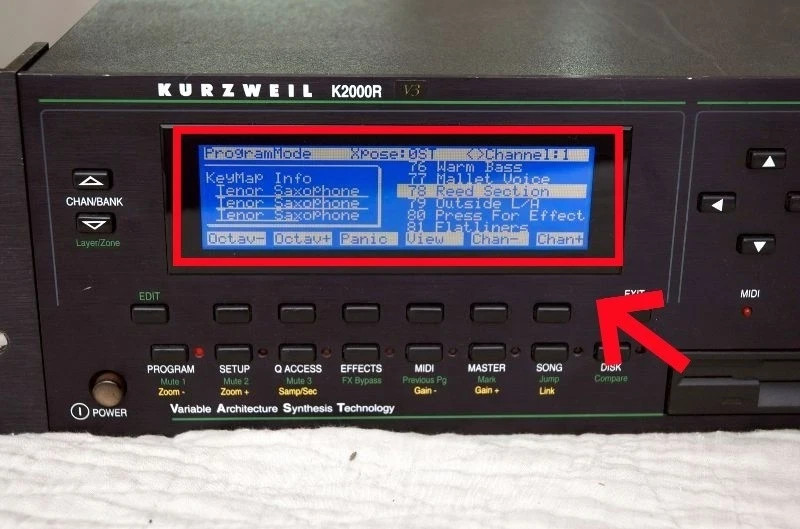
Lift a K2000 and the first thing you notice is the mass: 26 lb. (11.8 kg) spread across a 40 15/16-inch chassis that is only 4 1/8 inches tall. That shallow profile gives it away. Underneath the plastic sits a computer, not a synth. It has a 240 x 64-pixel backlit graphic display with adjustable contrast, a 3.5-inch floppy drive that reads both DD and HD disks in DOS format, and a pair of SCSI buses for external disks, CD-ROM drives, or a Macintosh. This was not a keyboard that happened to have a screen bolted on. It was a keyboard built around a screen.
The engine is Kurzweil's proprietary VAST - Variable Architecture Synthesis Technology, the term the company's engineers coined for a system that combined sample playback from ROM and RAM with waveform generation and a deep array of processing functions. The manual's glossary describes preset algorithms containing filters, distortion, panning, EQ, waveform oscillators, a waveform shaper, hard sync oscillators, amplitude modulation, gain, and crossfade. Thirty-one sound-shaping algorithms shipped in the box, with three programmable DSP functions available for each voice. Owners who dug into the architecture found that a single layer's algorithm determined its entire synthesis method.
The factory sound set runs to 199 preset programs and 100 preset setups, drawing on 8 Megabytes of 16-bit ROM samples. Polyphony is 24 notes with dynamic voice allocation, and the instrument is multi-timbral for multi-track sequencing and recording. Each program can stack up to 3 layers. Programs assigned to the drum channel can stack up to 32. It receives both mono (channel) pressure and poly (key) pressure, and 3-zone setups can transmit on three MIDI channels with independent programmable controls. A 15,000-note scratchpad sequencer handles recording from the keyboard or via MIDI and can load and play MIDI Type 0 sequences. The rated maximum bandwidth is 20 kHz. The manual's glossary notes that the human ear spans roughly 20 Hz to 20 kHz, so the K2000 covers the full range of hearing.
Storage and expansion are where the K2000 separated itself from the workstation pack. ROM can be expanded internally from 8 to 24 Megabytes via two 8 Megabyte sound blocks, ROM-1 and ROM-2, sold and installed separately. Sample RAM takes four standard SIMM modules, up to 64 Megabytes. The DP-RAM option pushes battery-backed program and sequence memory from 120K to 760K. An optional internal hard drive can be fitted, up to 240 Megabytes or more. The DSMP-R Sampling Option Kit adds user sampling through analog, digital, or optical inputs, along with AES-EBU and SPDIF digital ins and outs. It shipped with version 2.0 software, which brought graphic waveform editing on that 240 x 64 display: time compression and expansion, sample rate conversion, mixing and splicing, normalizing, audible sample cueing, crossfade looping, auto looping, and fade in/out. Version 2.0 also reads Ensoniq EPS and Akai S1000 disks, pulling in samples, keymaps, and constructed programs. Even without the sampling kit, the standard version 1.27 software can port stereo samples over the SCSI bus using the SMDI protocol with Passport's Alchemy, or through sample dump over MIDI, and can read sample data from Akai S1000 hard disks. CD-ROM compatibility covers Sony and Toshiba drives.
Outputs run to ten analog jacks: four stereo pairs plus a stereo master pair. The MIX outputs carry programmable stereo multi-effects, including simultaneous reverb, chorus, delay, flanging, and EQ, all controllable in real time from the panel or over MIDI. The K2000R packs the same feature set into a 3-space rack module weighing 22 lb. (10 kg), measuring 16.9 inches wide excluding the rack brackets. Both units carry MIDI In, Thru, and Out with an activity LED.
Power is selectable at 100V, 120V, 220V, or 240V, drawing .75 amps at 120 volts nominal, with the selector visible through a small panel next to the AC connector. The manual is unusually candid about the machine's tolerance for dirty power. The input line filter and grounded cable are said to shrug off noise from motors and the like, and at the 120-volt setting the K2000 keeps running down to 90 volts. Below that, a protective circuit halts all activity to guard against software crashes or damage, then restarts automatically once voltage holds steady for at least a second, which is effectively a soft reset. The manual's warning is blunt: do not run the unit on any AC voltage other than the one selected, or extensive damage may result. Environmental limits are 41° to 104° F (5° to 40° C) for operation, -13° to 186° F (-25° to 85° C) for storage, and 5 to 95 percent non-condensing humidity.
Contemporary UK pricing put the K2000 V3 at £1899 in a January 1997 dealer listing in Sound-on-Sound-UK (January 1997, p.55), which also placed the instrument among the keyboards sharing dealer shelf space with the Alesis QS8 and Novation Drumstation. The same publication ran Kurzweil dealer listings for the K2000 as early as its January 1996 issue (p.52).
The manual devotes real space to maintenance, because the K2000 is a computer wearing a keyboard's clothes. It must sit on its rubber feet and never on the bottom panel. The rear panel needs at least four inches of clearance from any vertical surface. If an internal hard drive is fitted, the underside ventilation opening has to stay clear so the cooling fan can do its job. There are no user-serviceable parts, and the manual states plainly that opening the unit except for battery replacement risks severe electrical shock and voids the warranty. Cleaning means a vacuum brush worked gently into the gaps between keys and buttons, and a soft damp cloth with mild detergent for fingerprints. No solvents, and nothing sprayed at the front panel or into the vents. The same care applies to the floppy drive: dust is the enemy, and dismantling the drive is explicitly forbidden.
Battery health is worth checking on any survivor. The diagnostic display reports battery voltage at power-up, and the manual notes that new batteries read about 4.5 volts, declining gradually until warnings begin at 3.2 volts. The Alpha Wheel and Controller Slider can both be checked through the diagnostics, with the wheel's numbers running 0-1-2-3-0-1-2 clockwise and 3-2-1-0-3-2 counterclockwise. A soft reset, pressing +/-, 0, and CLR simultaneously, clears many problems, and a hard reset wipes RAM objects after a confirmation prompt. The manual also flags a quirk in the sustain pedal path: a highly nonlinear pedal with a so-called audio-taper potentiometer may need replacement with a linear-taper part between 10K and 100K.
The expansion path - ROM blocks, SIMMs, DP-RAM, hard drive, sampling kit - means no two surviving examples are necessarily configured alike. Buyers should ask about battery voltage, floppy drive condition, and whether the unit has ever been opened. The rack version, the K2000R, carries the identical feature set at 22 lb. against the keyboard's 26.
eBay Listings



As an eBay Partner, we earn from qualifying purchases. This helps support our independent vintage technology research.