Korg Trident (1980, 1982)
An 8-voice polyphonic synthesizer with integrated synthesizer, brass, and strings sections, released in two distinct models.
Overview
The Korg Trident is an 8-voice polyphonic synthesizer developed as a flagship instrument for professional musicians, combining a fully programmable analog synth engine with dedicated brass and strings sections in a single 61-key keyboard. Introduced in 1980 as the Mk I and updated in 1982 as the Mk II, the Trident was designed to deliver rich, layered orchestral textures and stage-ready versatility. It emerged as a direct evolution of Korg’s PS series, aiming to compete with high-end contemporaries like the Sequential Circuits Prophet-5. The instrument features a multi-sectional architecture that allows for keyboard splitting and simultaneous use of its three sound modules, making it ideal for live performance and complex arrangements.
Specifications
| Manufacturer | Korg |
| Model | Trident |
| Product type | 8-Voice Polyphonic Synthesizer |
| Production years | 1980 (Mk I), 1982 (Mk II) |
| Original price | $4,595 USD |
| Polyphony | 8-voice polyphonic |
| Voice architecture | Brass and strings operate in paraphonic mode, sharing voices for ensemble effects |
| Synthesizer section oscillators | Dual voltage-controlled oscillators (VCOs) per voice in the synthesizer section |
| Synthesizer section waveforms | Sawtooth, triangle, square, and pulse-width waveforms |
| Synthesizer section filter | Resonant low-pass filter based on the SSM 2044 chip |
| Envelopes | Dual ADSR envelope generators |
| Modulation | A modulation generator for LFO duties |
| Brass section | Provides a dedicated filter with cutoff, resonance, and envelope controls |
| Strings section | Offer attack/release envelopes, EQ shaping, and a unique 'bowing' effect to simulate bowed instrument articulation |
| Effects | Built-in effects such as a bucket-brigade device (BBD) flanger, ensemble chorus for strings, and joystick-controlled pitch bend and vibrato |
| Memory | 32 programmable memories (expanded from 16 in the original Mk I) for storing patches across four banks |
| Keyboard | 61-note keyboard spanning five octaves |
| Keyboard action | Standard non-velocity-sensitive key action |
| Keyboard splitting | Supports keyboard splitting for assigning sections to different ranges |
| Dimensions | Approximately 1012 mm in width, 524 mm in depth, and 52 mm in height |
| Weight | 21 kg |
| Mk II filter upgrade | Upgrading to a 24 dB/octave filter |
| Mk II oscillator upgrade | Adding detunable oscillator banks for thicker sounds |
| Mk II memory | Improving memory and envelope options |
Design
The Korg Trident features an innovative multi-sectional design that integrates a programmable synthesizer bank, a dedicated brass ensemble, and a string machine into a single 61-key instrument, enabling versatile sound layering and split-keyboard performance. It is housed in a robust wooden cabinet with a front panel layout emphasizing intuitive access, divided into distinct sections for Synthesizer, Brass, and Strings. Development began in late 1979 under secretive conditions and spanned over a year of intensive engineering led by Korg engineer Mr. Mori. Parallel research into sampling technology produced a four-voice prototype, but it was shelved in favor of the Trident's analog design.
Context
The Trident project emerged as a direct evolution of Korg's PS series, including the PS-3100 (1977) and PS-3300, positioning the Trident to challenge instruments like the Sequential Circuits Prophet-5 in both sound versatility and onstage efficiency. It was positioned as Korg's flagship instrument, aimed at professional musicians, and entered a competitive landscape alongside other high-end polysynths of the early 1980s.
Reception
The Korg Trident gained a cult following among progressive rock and synth-pop artists, including Rick Wakeman of Yes and Paul Humphreys of Orchestral Manoeuvres in the Dark. A February 1982 review in *Electronics & Music Maker* praised the instrument's ability to produce a "big orchestral sound" through powerful section blending and built-in effects like flanging, highlighting its suitability for emotional, classical-style performances, while noting minor drawbacks such as the lack of keyboard touch-sensitivity and limited waveform options.
eBay Listings
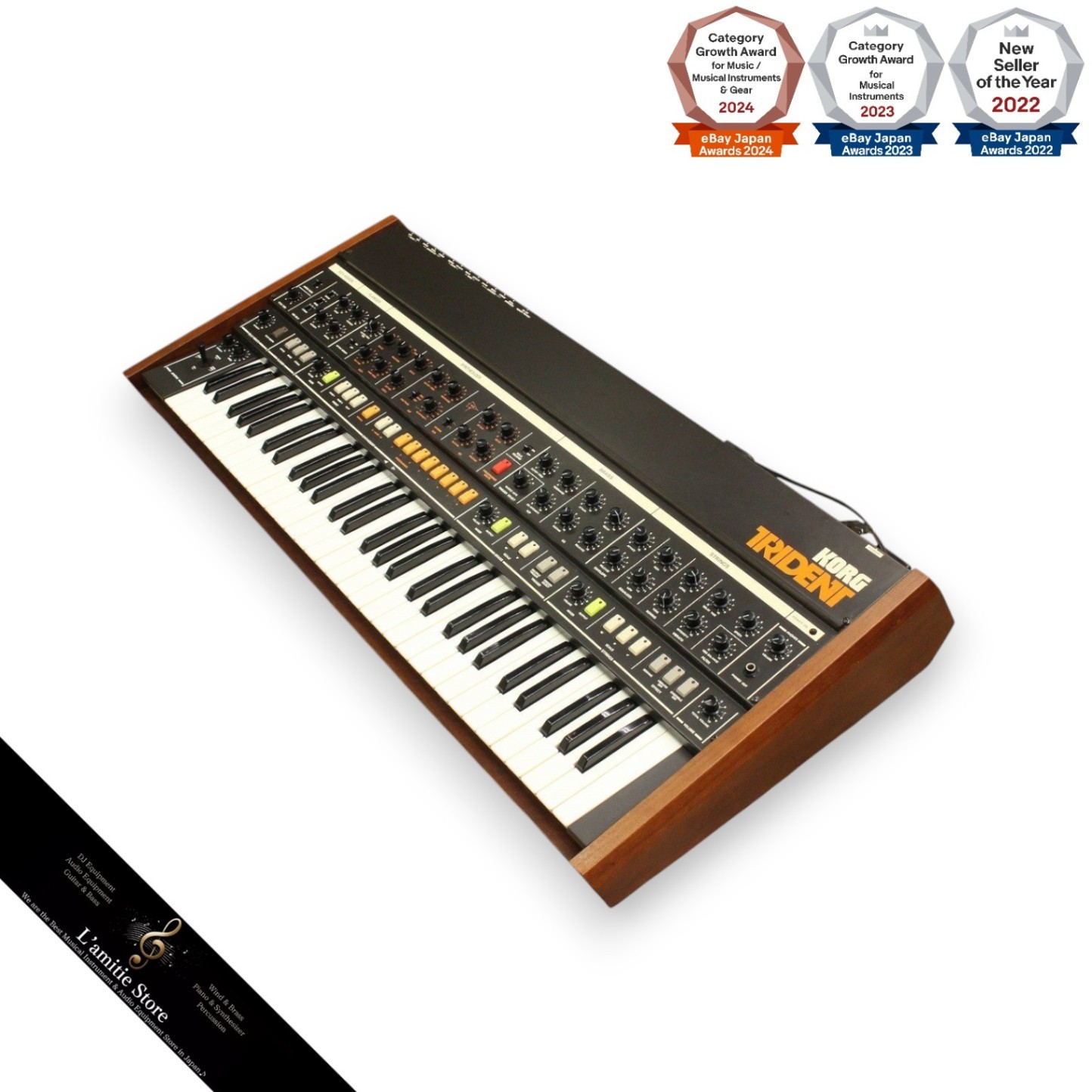


As an eBay Partner, we earn from qualifying purchases. This helps support our independent vintage technology research.
Related Models
- Korg miniKORG (1973)
- Korg Minilogue
- Korg Monologue
- Korg Poly 800
- Korg Volca Keys
- ARP Explorer 2900
- ARP Odyssey Model 2800 (1972)
- ARP 2823 (1978-1981)
- ARP Explorer I (1974)
- ARP Rhodes Chroma