Korg miniKORG 700 (1973)
At $995, it shattered the price barrier for analog synthesis—Korg’s first mass-produced synth wasn’t flashy, but it was finally within reach.
Overview
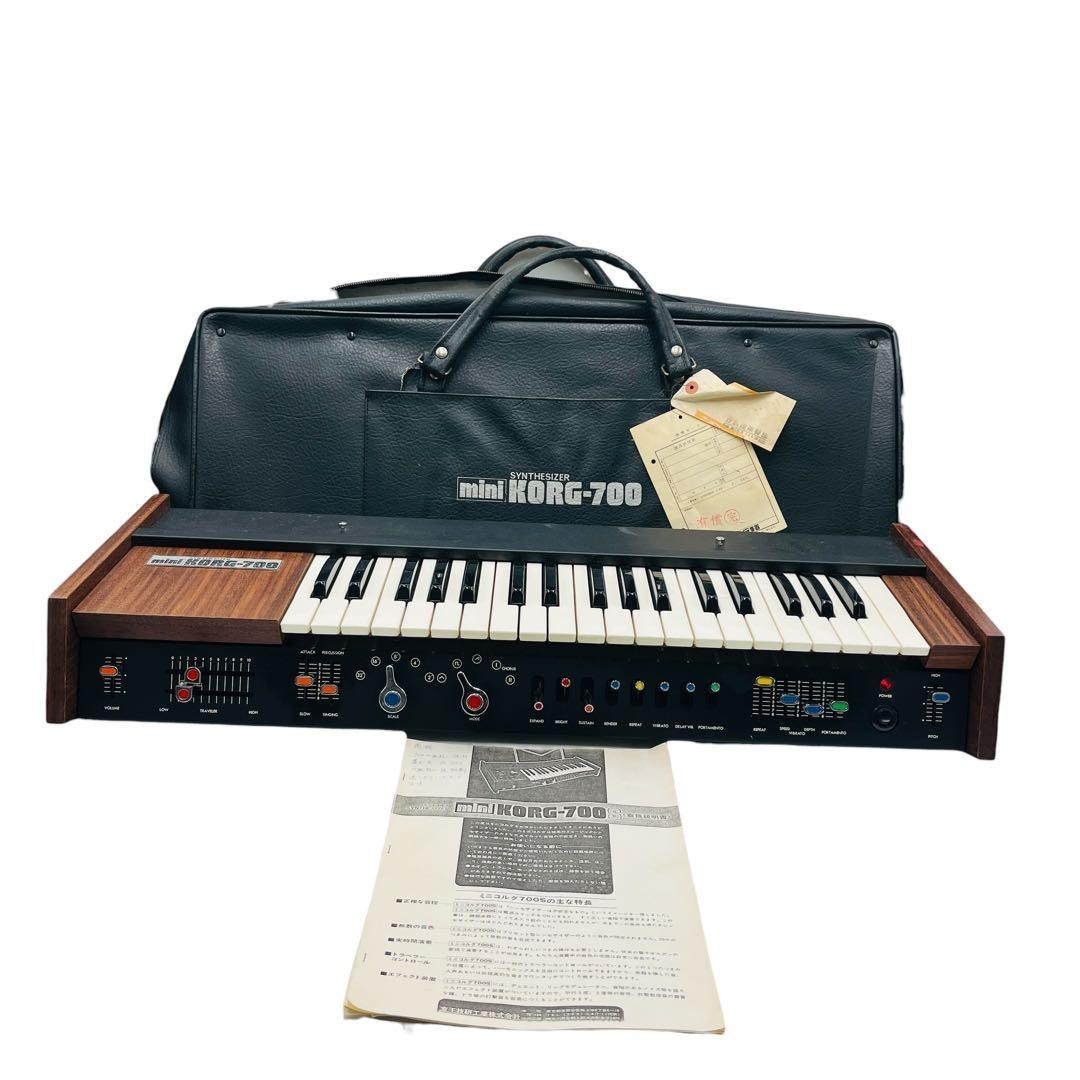
The Korg miniKORG 700 wasn’t designed to win beauty contests. It arrived in 1973 as a no-frills, monophonic analog synthesizer aimed squarely at musicians who wanted hands-on sound design without the bank-breaking cost of Moog or ARP systems. With 37 full-sized keys and a fully analog signal path, it offered real subtractive synthesis in a compact form. What it lacks in features it makes up for in immediacy: every knob and slider directly manipulates the sound, making it a tactile gateway into analog synthesis. Despite its modest footprint, the miniKORG 700 carries a legacy far beyond its original price point.
This was Korg’s first foray into mass-produced synthesizers, and it showed. The build is utilitarian, the layout functional rather than intuitive. But beneath the plain metal case lies a capable analog engine. It features a single voltage-controlled oscillator (VCO) generating triangle, sawtooth, and square waveforms—standard fare for the era, but tuned with a character that some describe as sharper than Moog, less rounded than Roland. An LFO is present, enabling vibrato and basic modulation, and the filter section, though unspecified in detail, delivers the expected sweep and snarl of early '70s subtractive design. The synth is fully editable, meaning players can craft their own sounds from scratch, a rare and valuable feature at this price in 1973.
One persistent point of confusion among collectors is the relationship between the original 700 and the later 700S. According to available documentation, the 700S added a second oscillator and other refinements, but the core circuit design remained fundamentally the same. The original 700, however, stands on its own as a minimalist statement: one VCO, one chance to get it right. It runs on AC power only, with no battery option, and outputs a line-level signal—users must provide their own amplifier or recording interface. There are no built-in speakers, no audio input for processing external signals, and no pedal inputs. It is, in every sense, a dedicated monophonic synth.
Specifications
| Manufacturer | Korg |
| Model | miniKORG 700 |
| Type | Monophonic analog synthesizer |
| Production Year | 1973 |
| Number of Keys | 37 |
| Key Size | Full |
| Key Weight | Synth |
| Touch Sensitive | no |
| Aftertouch | no |
| Polyphony | 1 |
| Sound Generation | Analog |
| Synthesis Type | Subtractive |
| Oscillator | 1 VCO |
| Oscillator Waveforms | triangle, sawtooth, square |
| LFO | yes |
| Timbrality | 1 part |
| Sounds Editable | yes |
| Recorder/Sequencer | no |
| MIDI | no |
| USB | no |
| Tablet Connectivity | no |
| AC Power | yes |
| Batteries | no |
| Speakers | no |
| Audio Out | yes |
| Audio In | no |
| Sustain Pedal | no |
| Soft Pedal | no |
| Expression Pedal | no |
| Original Price | $995 |
Key Features
Single VCO with Core Waveforms
The miniKORG 700 relies on one voltage-controlled oscillator, a deliberate limitation that defines its sonic footprint. It generates triangle, sawtooth, and square waveforms—each with a distinct character when fed through the filter. The sawtooth delivers a bright, brassy edge ideal for leads and basses, while the square wave provides a hollow, reedy tone that cuts through mixes. The triangle wave, softer and more mellow, works well for sub-bass or flute-like tones. Though some sources mention “two oscillators,” this appears to refer to the later 700S model; the original 700 is consistently documented as having a single VCO. This constraint forces players to focus on modulation and envelope shaping rather than layering.
Subtractive Analog Architecture
As a subtractive analog synthesizer, the miniKORG 700 follows the classic signal path: oscillator → filter → amplifier, with modulation routed via LFO and envelope. The absence of detailed filter specifications in the documentation leaves some ambiguity, but The entire system is entirely analog, with no digital components in the signal chain, contributing to its warm, slightly unpredictable character.
Built-in Analog Modulation Effects
Beyond standard synthesis controls, the miniKORG 700 includes what some describe as “strange analog effects.”
Historical Context
The miniKORG 700 marked Korg’s official entry into the synthesizer market as a mass-producer. Priced at $995—under £350 in the UK—it was the first synthesizer to break the $1,000 barrier, making analog synthesis accessible to gigging musicians and home studios. It arrived at a time when synths were still exotic, expensive instruments dominated by American and German brands. By offering a functional, editable analog synth at half the price of its rivals, Korg carved out a new market segment. The 700, 700S, and 800DV formed a family of sibling models, each refining the formula, but the original 700 remains the pioneer.
Collectibility & Value
The miniKORG 700 has grown in reputation among vintage synth enthusiasts. As of June 2012, market prices were reported to exceed $1,000, reflecting its status as Korg’s first synth and a milestone in affordable analog design. A serviced unit with serial number 50267 was listed by Soundgas as “fully serviced and in excellent working order,” indicating that professional restoration is available, though details on common failures or maintenance needs are sparse. One owner recounted buying a Mini-Korg grudgingly for $200 as a placeholder, only to discover its unique character—suggesting that undervalued units may still surface. Given its historical significance and limited technical documentation, well-maintained examples command strong interest.
eBay Listings
As an eBay Partner, we earn from qualifying purchases. This helps support our independent vintage technology research.