Korg Monologue (2017)
At 1.7 kg and just $299, this pocket-sized monosynth punches far above its weight—though not without quirks.
Overview
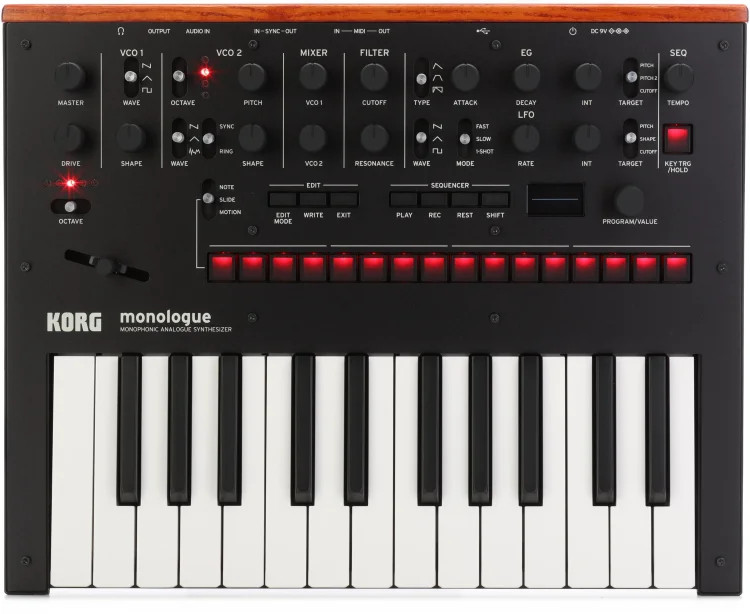
The Korg Monologue isn't just another budget analog—it’s a tightly focused, no-compromise monosynth that arrived in January 2017 with a mission: deliver real analog character and deep programmability in a compact, battery-powered chassis. Marketed at a street price of $299 (or $299.99 USD), it targeted newcomers and tinkerers alike, quickly earning a reputation as a "gateway synth" for those stepping into hands-on synthesis. Despite its modest footprint—350 x 276 x 76 mm—the Monologue feels substantial, built with a mix of metal, plastic, and an unexpected touch of wood on the back panel, lending it a subtly organic presence on a desk or stage. The 25 mini-keys won’t satisfy piano purists, but they’re responsive and laid out for performance, not just programming.
What sets the Monologue apart isn’t just its price or portability, but its voice architecture. Two voltage-controlled oscillators (VCOs) provide the foundation, with Oscillator 1 offering saw, triangle, and square waves, while Oscillator 2 swaps the square wave for white noise—adding immediate texture for percussion, wind, or grit. That choice sacrifices some harmonic symmetry but opens up sonic territory where noise integration is key. The VCOs naturally drift, giving the synth a living, slightly unstable character that many find appealing—especially when compared to the clinical precision of digitals. Automatic tuning kicks in when no sound is active, helping keep things in check without requiring manual intervention.
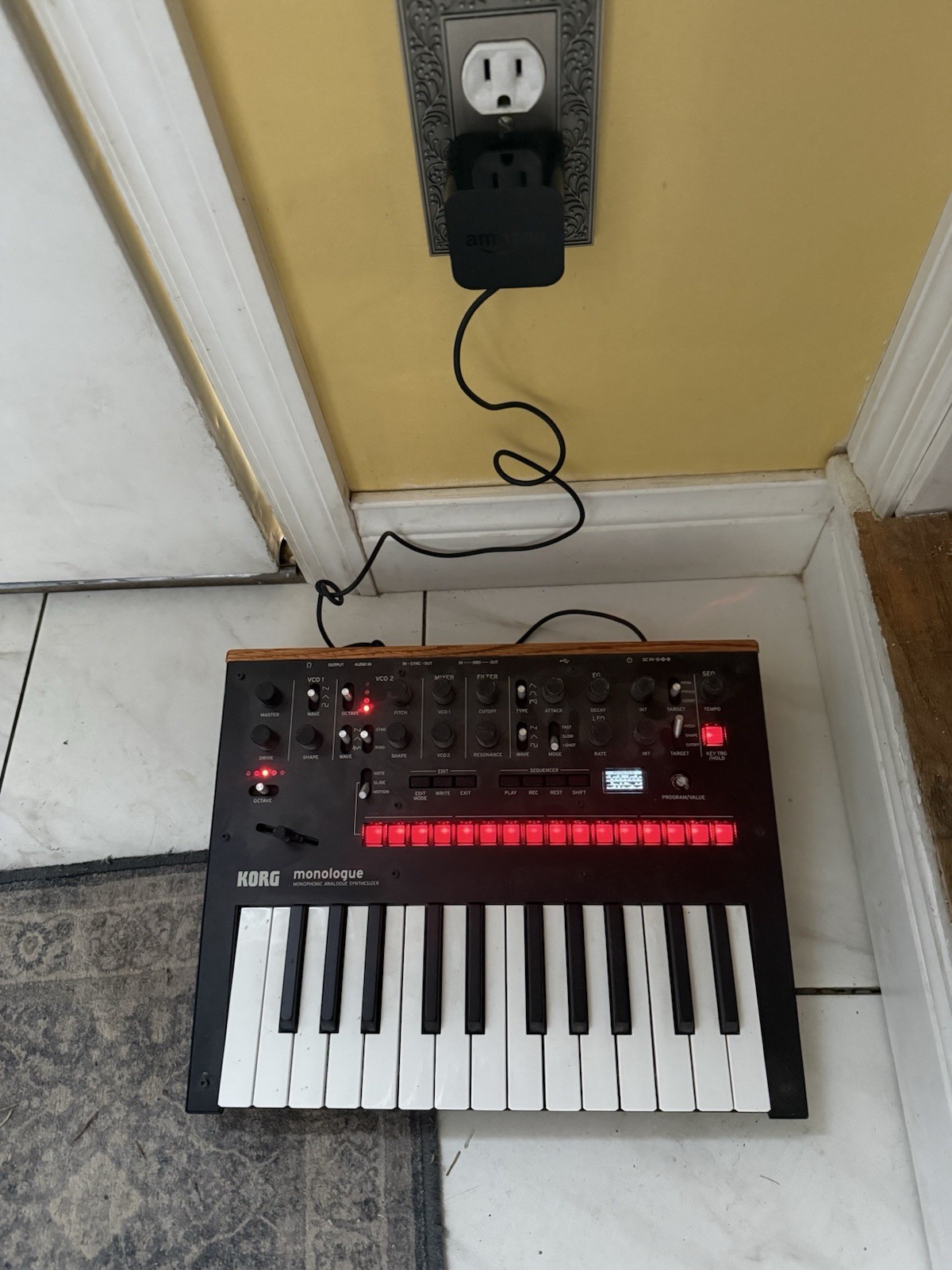
Korg didn’t skimp on control either. A full complement of knobs and switches covers every parameter, all feeling solid underhand, according to user reports. The OLED screen, while small, serves double duty: it displays patch parameters and, post-firmware 2.00, doubles as an oscilloscope for visualizing waveforms and output. That feature can be deactivated, letting users prioritize interface over spectacle. The inclusion of a dedicated Drive circuit adds harmonic richness and distortion—ideal for pushing basslines or leads into overdriven territory without external gear.
Still, not everyone’s convinced. One user on Gearspace called it the “worst $300 I’ve ever spent,” reflecting a minority but real frustration—possibly tied to the instrument’s limitations or build quirks. Others praise its “very solid” knobs and switches, its “ARP-like” oscillators, and a filter that “sounds very impressive for a synth in this price range.” The motion sequencer, with its 4-lane capability, is frequently cited as one of the Monologue’s strongest features, enabling complex, evolving sequences that feel more advanced than the synth’s entry-level positioning might suggest.
Specifications
| Manufacturer | Korg |
| Product type | monophonic analogue synthesizer |
| Dimensions | 350 x 276 x 76 mm (W x D x H) |
| Weight | about 1.7 kg |
| Oscillators | two VCOs |
| Oscillator 1 waveforms | saw, triangle, and square |
| Oscillator 2 waveforms | saw, triangle, and white noise (replaces square wave) |
| Filter | 2-pole analog filter |
| LFO modes | Fast, Slow and 1-Shot |
| LFO rate (Fast) | up to 2.8 kHz |
| LFO rate (Slow) | down to 0.05 Hz |
| Envelope Generator modes | Attack/Decay (A/D), Attack/Gate/Decay (A/G/D) and Gate |
| Sequencer | 16-step sequencer |
| Motion Sequencer | 4 lane motion sequencer |
| Connections (rear panel) | Power Socket, On/Off knob, USB-B – MIDI, MIDI Out on DIN, MIDI In on DIN, Sync Out (3.5 mm), Sync In (3.5 mm), Audio In (1/4" TS), Audio Out (1/4" TS), Headphone Output (1/4" TRS) |
| Power | runs on batteries (AA) |
| Display | OLED screen |
| Keys | mini-keys |
| Construction materials | metal, plastic and even some wood on the back |
| Polyphony | 1 Voice |
| Keyboard | 25 keys |
| Patch Memory | 100 patch memories |
Key Features
2-Pole Analog Filter with MS-20 DNA
The filter is where the Monologue truly sings. Described as reminiscent of the Korg35 chip found in the MS-20, it delivers a raw, characterful tone that remains present even at high resonance. According to user discussion on Reddit, the filter was specifically designed not to lose low end when resonance is cranked—avoiding the thinning effect common in many analog filters. This makes it exceptionally effective for aggressive basslines and screaming leads that retain body and weight, even when pushed into self-oscillation.
VCOs with Natural Drift and Automatic Tuning
True to its analog roots, the Monologue uses voltage-controlled oscillators that exhibit natural pitch drift—adding warmth and unpredictability. This behavior, while musically desirable in many contexts, could lead to tuning instability. Korg addressed this with an automatic tuning function that engages when no sound is active, helping maintain tuning between sessions without requiring manual calibration.
4-Lane Motion Sequencer
Far beyond a basic step sequencer, the Monologue’s 4-lane motion sequencer allows users to record parameter changes across four separate automation lanes. This enables complex, evolving patches where filter sweeps, pitch bends, and modulation shifts unfold over time—transforming static notes into dynamic performances. Coupled with the 16-step framework, it becomes a powerful tool for live jamming and sound design, often cited as one of the synth’s most compelling features.
Dedicated Drive Circuit for Harmonic Distortion
The Drive circuit is a standout addition, offering a dedicated knob to introduce harmonic saturation and distortion directly into the signal path. Unlike simple overdrive effects, this circuit is tightly integrated into the synth’s voice architecture, This makes the Monologue not just a sound generator, but a tone shaper—ideal for fattening up weak signals or adding grit to drum machines.
Customizable Mod Slider
The mod slider, while initially described as “a bit strange” by some users, is fully customizable. It can be assigned to control any parameter, turning it into a real-time performance tool for pitch bends, filter sweeps, LFO depth, or any other modulatable destination. This flexibility elevates it from a gimmick to a functional expression controller, especially in live settings.
OLED Oscilloscope Display
Since firmware version 2.00, the OLED screen gained the ability to function as an oscilloscope, visually representing the waveform of the oscillators or final output. This feature aids in sound design by providing immediate visual feedback on wave shaping, phase relationships, and distortion characteristics. While not essential, it’s a rare inclusion at this price point and appreciated by tinkerers. It can be deactivated for users who prefer a cleaner interface.
Collectibility & Value
Original pricing settled around $299–$299.99 USD at launch, with one user reporting a $300 purchase in 2018—consistent with street pricing. While no current market data is available, the Monologue has developed a cult following, particularly among synth newcomers and DIY modifiers. A known issue involves sticky knobs, reported in user groups, which may affect long-term usability if not cleaned or replaced. A full service manual is publicly available, including schematic diagrams, block diagrams, and parts lists—making repairs and modifications feasible for technically inclined owners.
eBay Listings


As an eBay Partner, we earn from qualifying purchases. This helps support our independent vintage technology research.
Related Models
- Korg miniKORG (1973)
- Korg Minilogue
- Korg Poly 800
- Korg Volca Keys
- ARP Explorer 2900
- ARP Odyssey Model 2800 (1972)
- ARP 2823 (1978-1981)
- ARP Explorer I (1974)
- ARP Rhodes Chroma
- Akai Ax73