E-mu Emulator (1981–1984): The Sampler That Broke the Bank—And the Bankrupt
For under $8,000, the E-mu Emulator put digital sampling within reach of working musicians, shattering the Fairlight’s stranglehold on sonic revolution.
Overview
If you’ve ever heard the crisp snap of a sampled snare in a 1980s pop anthem or the eerie loop of a piano stab in an early hip-hop track, there’s a solid chance you’re hearing the ghost of the E-mu Emulator. Launched in 1981, the Emulator wasn’t the first digital sampler—far from it—but it was the first one that didn’t require a record label advance or a second mortgage. At $7,995, it cost less than a tenth of the Fairlight CMI Series II, which dominated studios with its astronomical $100,000 price tag. Suddenly, studios in basements and garages could capture real-world sounds, store them on floppy disks, and play them back across a keyboard. It was alchemy for the working musician.
The Emulator found its voice in genres that thrived on sonic innovation: early hip-hop producers used it to freeze drum breaks; synth-pop acts like Herbie Hancock and Depeche Mode wove its gritty 8-bit textures into their sonic tapestries; film composers exploited its ability to mimic orchestral hits without hiring an orchestra. It wasn’t pristine—its 8-bit resolution gave samples a lo-fi, almost pixelated character—but that grit became its signature. The Emulator didn’t just democratize sampling; it redefined what “professional” gear could look like. It was heavy (35 lbs), beige, and looked like a repurposed office terminal, but inside beat the heart of a revolution.
Specifications
| Sample Rate | 27.7 kHz |
| Bit Depth | 8-bit |
| Memory | 128 KB RAM (expandable to 512 KB) |
| Storage | 5.25-inch floppy disk drive |
| Polyphony | 8 voices |
| Filter | 12 dB/octave low-pass filter with resonance |
| Envelope Generators | Two ADSR envelopes (amplitude and filter) |
| Keyboard | 61 keys (velocity-sensitive on later units) |
| Dimensions | 34.5 x 14.5 x 6 inches |
| Weight | 35 lbs |
| Display | 16-character alphanumeric LCD |
| Audio Outputs | 1/4-inch unbalanced (2) |
| Audio Inputs | 1/4-inch unbalanced (2) |
| MIDI | No (added in later models) |
| Country of Manufacture | United States |
| Original MSRP (1981) | $7,995 |
Key Features
- 8-bit digital sampling at 27.7 kHz: While primitive by today’s standards, this spec was revolutionary in 1981. It allowed for recognizable playback of short sounds—drum hits, vocal stabs, piano chords—with enough fidelity to pass in a mix. The 8-bit coloration added a warm, crunchy texture that many now seek to emulate digitally.
- Floppy disk storage: This was the Emulator’s killer feature. Unlike earlier samplers that stored sounds in volatile memory, the Emulator used standard 5.25-inch floppies to save and load samples. Musicians could build libraries, share disks, and recall sounds reliably—something the Fairlight CMI Series II could do, but few others. It turned sampling into a practical workflow, not just a lab experiment.
- 8-voice polyphony with analog filtering: Despite its digital core, the Emulator routed samples through a genuine analog 12 dB/octave low-pass filter with resonance. This allowed for expressive shaping—think of the filter sweep on a sampled brass hit. Combined with two ADSR envelopes (one for amplitude, one for filter), it gave users real-time control over attack, decay, and timbre.
- 61-key velocity-sensitive keyboard (on Emulator I+): The original 1981 model lacked velocity sensitivity, a glaring omission. E-mu corrected this in 1982 with the Emulator I+, which added dynamic response—finally letting players shape volume and timbre by touch. It wasn’t just a keyboard; it was an instrument.
Historical Context
Before the Emulator, digital sampling was the domain of the elite. The Fairlight CMI Series II, introduced in 1982, was the gold standard—but at $100,000, it was more a status symbol than a tool. Its light-pen interface and 8-bit sampling dazzled, but only a handful of artists (Peter Gabriel, Kate Bush) could afford one. E-mu, founded by Dave Rossum and Scott Wedge after their work on the E-mu Modular System, saw an opening: what if sampling could be stripped down, made reliable, and sold at a fraction of the cost?
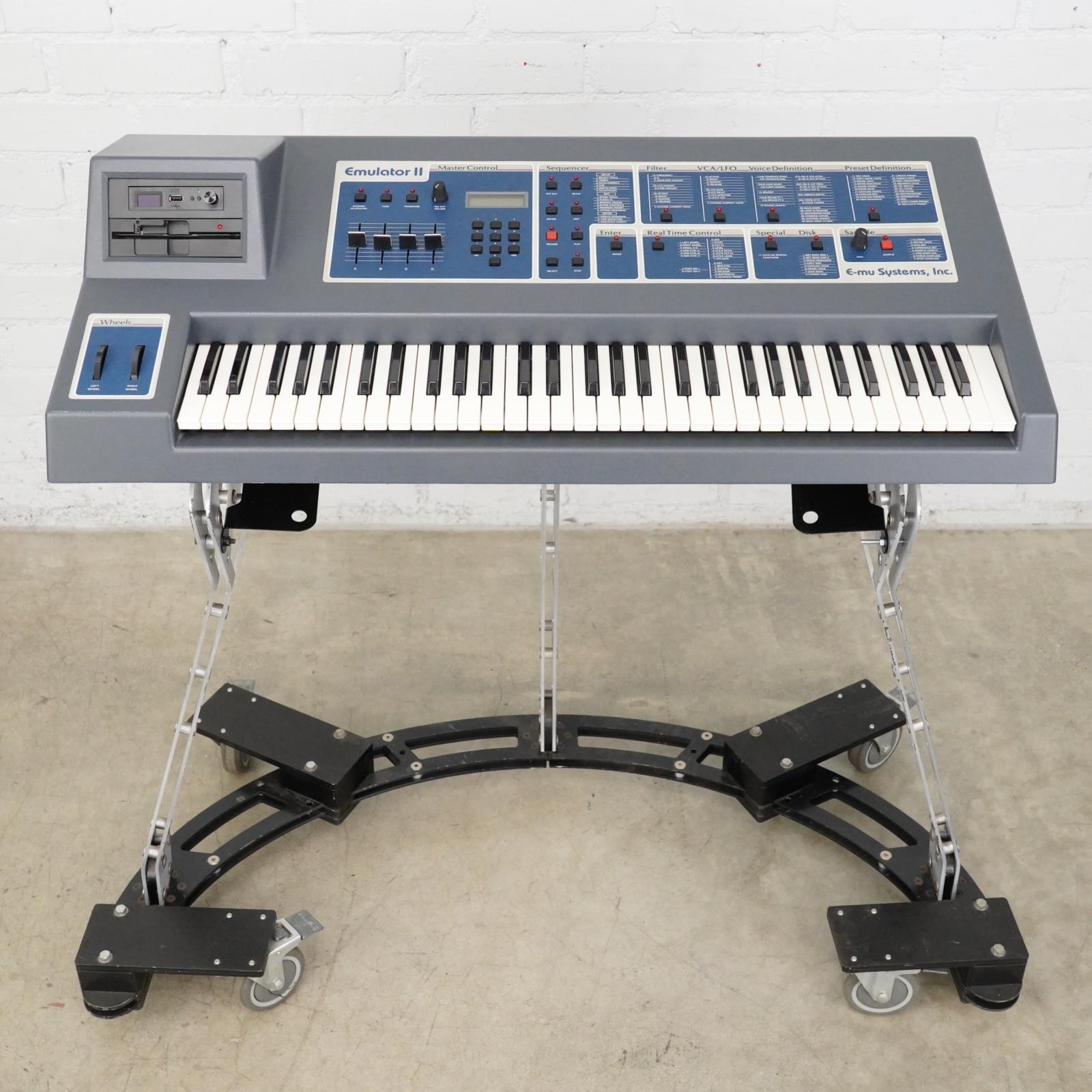
The 1981 Emulator was that answer. Built in California with off-the-shelf components and a no-nonsense design, it sacrificed the Fairlight’s graphical interface for affordability and practicality. No light pen, no touchscreen—just a 16-character LCD and a membrane keypad. But it worked. And it worked reliably. By 1984, E-mu had refined the concept into the Emulator II, which jumped to 16-bit sampling at 44.1 kHz, added MIDI, and included analog filters that became legendary. The original Emulator, though quickly overshadowed, had already changed the game. It proved that sampling wasn’t a luxury—it was the future.
Collectibility & Value
Today, the E-mu Emulator is a rare beast. Fewer than 500 units were reportedly produced between 1981 and 1983, and many have succumbed to the ravages of time. As of 2025, working units command between $3,000 and $6,000 on the vintage market, with fully restored models at the upper end. Collectors prize original packaging, floppy disks (especially factory sample sets), and units with the velocity-sensitive keyboard of the I+ revision.
But buying one is not for the faint of heart. The 5.25-inch floppy drive is a common failure point—belts dry out, heads corrode, and replacement drives are scarce. Worse, the analog audio boards are prone to capacitor leakage, which can silently destroy circuitry. Keyboard contacts degrade over decades of dust and humidity, leading to dead or sticky keys. A smart buyer insists on a fully functional unit with recent servicing. Still, for those who crave the raw, unvarnished sound of early digital sampling—the grit, the warmth, the imperfection—the Emulator is worth the hunt. It’s not just a sampler. It’s the machine that made the future affordable.
eBay Listings



As an eBay Partner, we earn from qualifying purchases. This helps support our independent vintage technology research.
Service Manuals & Schematics
- Service Manual — archive.org
- Schematic — archive.org
- Manual — archive.org
Related Models
- E-mu Emax (1986-1990)
- E-mu Emulator II (1984-1987)
- E-mu SP-1200 (1987-1998)
- Akai S612 (1985-1986)
- Akai S700 (1987)
- Akai CD3000XL
- Akai MPC Element
- Akai MPC Key 61
- Akai MPC One
- Akai MPC Touch