Akai S612 (1985–1986)
Akai's first rack sampler: 12 bits, six voices, and two sliders that let you trim a sample by ear in real time.
Overview
Akai's S612 is a 12-bit digital sampler built by Akai Electric Co., Ltd. in Japan and released in 1985 as the first entry in the company's "S" series of samplers. It is a 2U-high 19-inch rackmount unit with no keyboard, no sequencer, and no built-in effects. It is a sampler and nothing else, and it expects to be driven from outside over MIDI. Six-voice polyphony from a machine this early is the headline. The sampling rate is variable from 4kHz to 32kHz, and that is where the S612's sound comes from: the lower you set the rate, the longer you can record, and the grittier it sounds.
Memory is 128 KB and the machine holds one sample at a time. That works out to a maximum of roughly eight seconds at the lowest 4kHz rate, or about one second if you push all the way to 32kHz. The trade between length and fidelity is entirely in the user's hands, and there is no way around it. Playback frequency response is quoted at 25Hz to 20kHz. The front panel carries microphone and line inputs on 1/4-inch jacks, and a single output jack with its own level control.
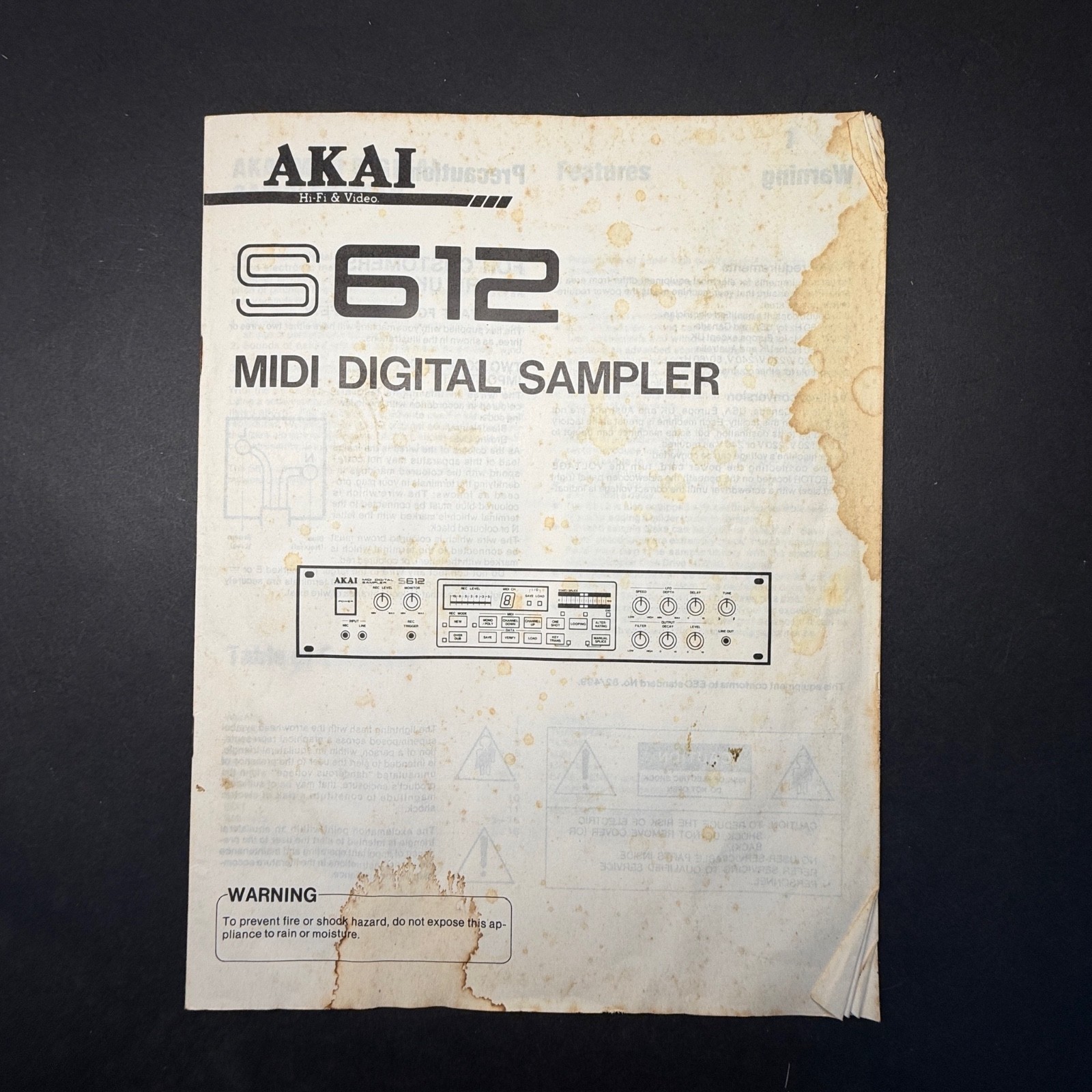
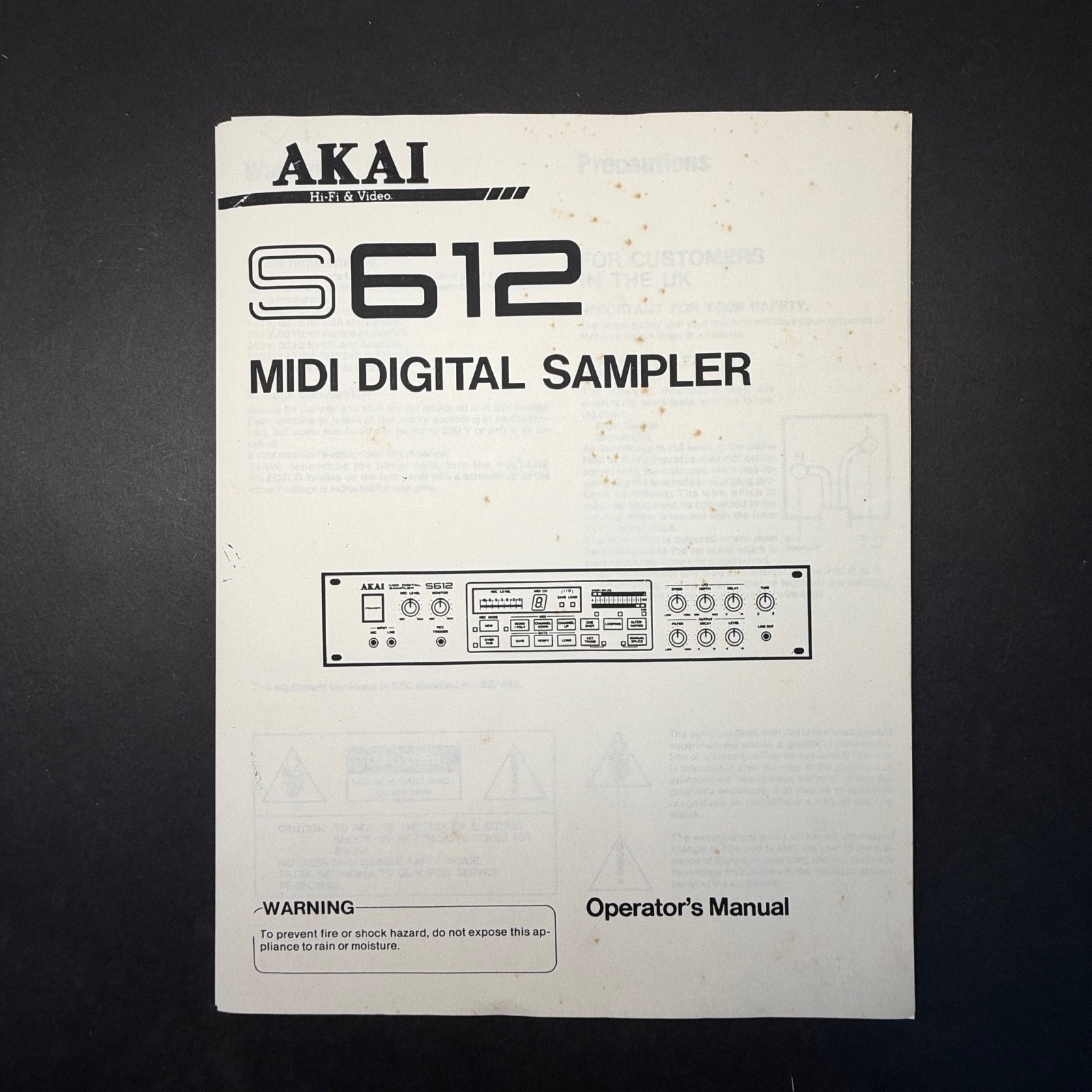
The control surface is what separates the S612 from a lot of early sampling hardware. Start Point and End Point are on real sliders, adjusted in real time while the sample plays, and the fact sheet calls that arrangement "a rare and praised interface element." Trimming a sample by eye and ear on a slider beats menu-diving, and it is the single biggest reason the S612 still has defenders. The rest of the front panel reads like a small analog synth: Tuning, Filter, Decay, LFO Rate/Depth/Delay, Record Level, and Monitor Level, all on knobs. The filter is a continuous variable analog low-pass. The LFO is a sine wave with speed, depth, and delay controls, and it can add vibrato. Its waveform is fixed, which is one of the machine's acknowledged limitations.
Akai marketed the S612 as "a real advance in accessible polyphonic sound sampling," and at the time that was fair. It was one of the first genuinely affordable studio samplers on the market, and it combined the three words the industry was chasing in the mid-1980s - digital, MIDI, sampling - in one compact rack unit. Under the lid, the sampling engine uses licensed Replay circuitry from Syco Systems/Electro-Harmonix, and the design is credited to David Cockerell, working in the early 1980s.
One clarification, because spec sheets around the web disagree: the S612 is a 12-bit, six-voice machine. Some listings and aggregator pages claim 16-bit resolution at 44.1kHz and anywhere from twelve to sixteen voices. The owner's manual and the bulk of contemporary documentation describe 12-bit sampling at 4kHz to 32kHz with six-voice polyphony, and that is the version this page follows.
Key Features
Real-Time Start and End Point Sliders
The two sliders that set the start and end points of the sample are the S612's signature. They move in real time, so the sample can be trimmed while it plays. The machine also has an automatic splicing system that picks a loop point for you, with a manual splice mode for when the automatic choice isn't what you want. The fact sheet describes the arrangement as a rare and praised interface element, and that reputation has held up.
12-Bit Sampling from 4kHz to 32kHz
The sampling rate is continuously variable across a 4kHz to 32kHz range, and that one control defines how the S612 sounds and what it can do. Drop to 4kHz and the machine holds roughly eight seconds of audio in its 128 KB of memory. Push to 32kHz and you get about one second. Everything between is a negotiation. The manual's own feature list notes that frequency response varies with sample time and can reach up to 14kHz in practice. The lo-fi reputation the S612 carries today is just what the machine sounds like when you trade fidelity for time, which is what most users did.
Analog Low-Pass Filter and LFO
A continuous variable analog low-pass filter sits in the signal path, and it does more than shape tone. The manual points out it can be used to strip quantization noise and hiss out of a sample, which is a useful trick on a 12-bit machine. The LFO adds vibrato with a delay, using a sine waveform and controls for speed, depth, and delay. The waveform is fixed. There is no selection of triangle, square, or random.
Looping, Truncate, and Overdub
Sample manipulation covers adjustable start and end points, three looping modes (One Shot, Looping, and Alternative sustain), truncate, and overdub. The overdub function allows samples to be accumulated on top of one another, and the manual describes the ability to reproduce a sample in reverse after trimming off unwanted portions. A short sample can be looped continuously without sounding awkward, and the automatic splicing system will find a loop point instantly if you don't want to hunt for one manually.
MD280 Quick Disk Storage
The S612 has no internal storage beyond its 128 KB of RAM. The manual is blunt that the machine will not remember anything after it is switched off. Permanent storage requires the optional MD280 Sampler Disk Drive, which uses 2.8-inch Quick Disk media and stores one sample per disk side. The MD280 must be connected before the S612 is powered on. Plugging or unplugging it while the machine is running will destroy whatever is in memory. Sample transfer over SysEx is supported from ROM version 1.1 onward. The drive itself was reviewed in the period press: Studio-Sound (January 1986, p.50) noted that loading a sample takes about five seconds and that the sampler's looping settings are retained unless the start and end sliders are moved.
MIDI Control and the AX60 Voice Cable
The S612 is designed for external MIDI control and responds to MIDI velocity information, though the fact sheet describes its MIDI implementation as "ultra basic." There is no deep modulation matrix or extensive controller mapping. The unusual connection is a 13-pin DIN "Voice cable" that pairs the S612 with the Akai AX60 synthesizer, letting the AX60 process sampled sounds through its own analog architecture. The AX60's manual describes it as the preferred controller for the S612 because of that processing capability. Setup requires both a standard MIDI cable from the AX60's MIDI OUT to the S612's MIDI IN and the special voice cable between the S612's Voice Out and the AX60's Sampler In.
Historical Context
The S612 arrived in 1985 as Akai's first rackmount sampler and the opening entry in what became the S series. It was praised at release as the first affordable polyphonic MIDI sampler, and it directly preceded the S900. Studio-Sound (September 1986, p.78) framed the S900 as the follow-up that would compete on versatility, attention to detail, and sheer quality where the S612 had competed on speed and efficiency.
It was Future Sound of London's first sampler, and it was used by artists including Depeche Mode, The Prodigy, and The Chemical Brothers. It let early hip-hop and electronic producers work with sampled sounds in a compact, MIDI-compatible format at a time when that was not a given.
Collectibility & Value
The S612 sits in an odd spot. It is the earliest Akai S-series sampler, and its lo-fi sound and analog filter have increased its collectibility over time. The machine has become popular again thanks to that sound and to the real-time knobs. But it is also a very basic and pretty limited vintage sampler, and the fact sheet notes plainly that it is not particularly prized as a vintage unit. Many S612s have been plundered for parts or left at electronics recycling over the years, so clean working examples are less common than the model's profile might suggest.
Known failure points are the power supply, the MD280's drive belts, and aging capacitors. Repair parts are available for ICs, slide pots, transistors, regulators, and capacitors, and replacement slide potentiometers are sold new - 10KB, 45mm travel, with a metal stem rather than the plastic stem with an indicator line. Rebuilt power supplies with all capacitors, transistors, and regulators replaced are a common sight on the used market. Modifications exist too: a "MIDI Front Panel Animator" variant turns up, and at least one unit has been fitted with a USB sample save/load kit.
Pricing is difficult to pin down. The fact sheet contains no reliable figure for a working S612 itself. The $800 eBay listing that appears under the S612 search is a MEZZO professional audio amplifier whose model number happens to contain "S612," and the $23.99 battery listing is a generic rechargeable whose part number coincidentally matches. Owner's manuals trade in the $8.50 to $12.75 range. Anyone shopping for the sampler should treat the amplifier and battery results as noise and price the unit on condition, PSU history, and whether an MD280 comes with it.
eBay Listings


As an eBay Partner, we earn from qualifying purchases. This helps support our independent vintage technology research.
Related Models
- Akai MPC2000 (1997-2000)
- Akai S1100
- Akai S700 (1987)
- Akai CD3000
- Akai CD3000XL
- E-mu Emulator III (1987-1991)
- Akai MPC 4000
- Akai MPC 60-II
- Akai MPC Element
- Akai MPC Key 61