E-mu Emulator II (1984–1987): The Warm Heart of 80s Sampling
A groundbreaking 8-bit sampler that traded clinical precision for soulful grit, the Emulator II became the secret weapon of pop, hip-hop, and film composers who wanted their digital samples to feel analog.
Overview
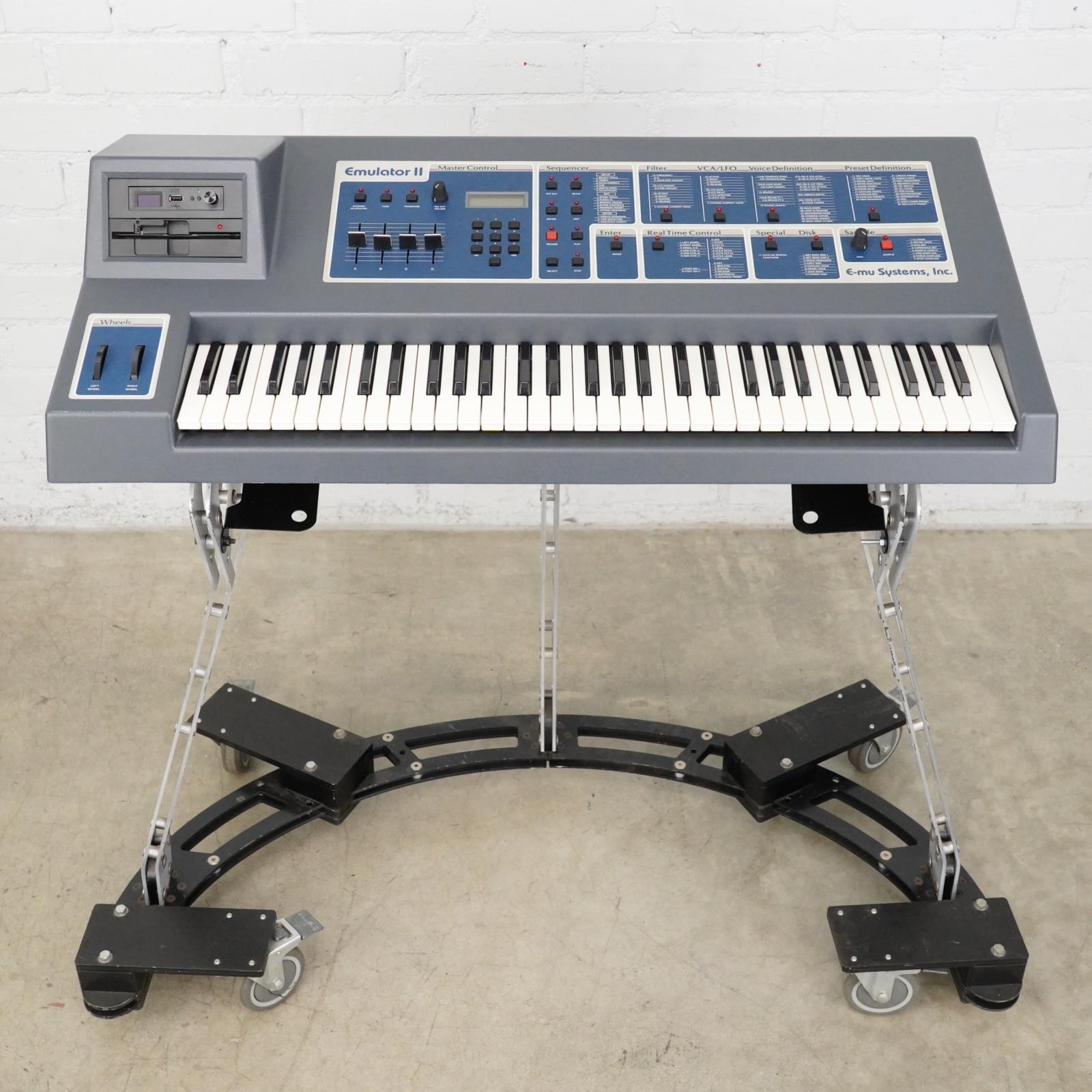
If the Fairlight CMI was the Lamborghini of early samplers—exotic, expensive, and intimidating—the E-mu Emulator was the reliable station wagon. But the E-mu Emulator II, released in 1984, was that station wagon retrofitted with a turbocharger and a Moog filter. At $7,995, it wasn’t cheap, but in an era when the Fairlight CMI Series II cost over $30,000, the Emulator II was a revelation: a professional-grade sampler that fit in a mid-tier studio. It brought sampling out of the elite few and into the hands of working musicians, producers, and film composers who shaped the sound of the mid-1980s.
What made the Emulator II truly special wasn’t just its accessibility—it was its sound. With 8-bit sampling at 27.7 kHz and an analog 12 dB/octave low-pass filter with resonance, it didn’t try to be transparent. Instead, it colored everything it touched. Trumpets got a gritty snarl, pianos took on a lo-fi halo, and drum hits emerged with a punchy, almost tape-saturated character. This wasn’t a bug—it was a feature. Artists like Herbie Hancock (who used it on his Future Shock album), Depeche Mode (on Some Great Reward), and Jan Hammer (yes, that Miami Vice guy) embraced its sonic imperfections as texture. The built-in 5.25-inch floppy drive wasn’t just convenient—it was revolutionary. For the first time, you could save and share samples like data files, enabling a nascent sample library culture that would explode in the decades to come.
Specifications
| Sample Rate | 27.7 kHz |
| Bit Depth | 8-bit |
| Polyphony | 8 voices |
| Memory | 128 KB to 512 KB (expandable with memory boards) |
| Storage | 5.25-inch floppy disk drive (360 KB) |
| Filter | Analog 12 dB/octave low-pass filter with resonance |
| Keyboard | 16-note velocity-sensitive keyboard (C to D) |
| Display | 2-line x 40-character LCD |
| Audio Inputs | 1 x 1/4-inch unbalanced (line level) |
| Audio Outputs | 2 x 1/4-inch unbalanced (left/right) |
| MIDI | MIDI In, Out, Thru |
| Frequency Response | 20 Hz to 12 kHz |
| Signal-to-Noise Ratio | 70 dB A-weighted |
| Total Harmonic Distortion | < 0.5% |
| Dimensions | 26.5 x 15.5 x 4.5 inches (67.3 x 39.4 x 11.4 cm) |
| Weight | 35 lbs (15.9 kg) |
| Power | 100–120 VAC, 60 Hz, 60 watts |
Key Features
- 8-bit sampling with analog filter character: While 8-bit resolution might sound like a limitation today, it was the Emulator II’s secret sauce. The coarse, crunchy texture of its samples, when run through the warm analog filter, gave it a sonic personality that stood in stark contrast to the sterile clarity of later 16-bit samplers. This wasn’t about fidelity—it was about vibe. The filter allowed for expressive sweeps and resonant squelches, turning static samples into evolving textures.
- Built-in 5.25-inch floppy disk drive: This was a game-changer. Before the Emulator II, samplers either had no storage (like the original Emulator) or relied on tape or proprietary cartridges. The floppy drive let users save and load samples in seconds, share them with other Emulator II owners, and build personal libraries. It also stored entire setups—patches, keymaps, and system settings—making it far more practical for real-world studio use.
- Velocity-sensitive 16-key keyboard: Compact but functional, the C-to-D keyboard wasn’t meant to replace your piano but to trigger samples with dynamic expression. Combined with the velocity-sensitive sampling engine, it allowed for nuanced performances—soft hits for breathy flutes, hard strikes for snappy snares.
- Expandable memory via plug-in boards: Starting at 128 KB (a mere 1.2 seconds of mono audio at max sample rate), the Emulator II could be expanded to 512 KB with optional memory boards. While that still sounds laughable today, it was enough for essential drum kits, bass hits, and melodic stabs. The later Emulator II+ pushed this to 1.5 MB, a massive leap.
Historical Context
The Emulator II didn’t emerge in a vacuum. It followed the original E-mu Emulator (1981–1984), a pioneering but limited machine with only 2 seconds of sample time and no floppy drive. The Emulator II was E-mu’s answer to both user demand and the high-end competition—most notably the Fairlight CMI Series II, which, while revolutionary, was priced out of reach for most musicians. The Emulator II carved a middle path: not as flashy as the Fairlight, but infinitely more practical and affordable.
It also arrived at the perfect cultural moment. The early 1980s saw a surge in digital experimentation—MIDI was standardized in 1983, and studios were hungry for new textures. Sampling was still novel, and the Emulator II democratized it. Hip-hop producers began sampling breakbeats directly into the machine, pop artists used it for orchestral stabs and synth pads, and film composers exploited its eerie textures for sci-fi scores. The machine’s limitations—short sample times, low bit depth—became creative constraints that inspired innovation. And while it was quickly succeeded by the 16-bit Emulator III in 1987, the Emulator II’s warm, gritty character ensured it never faded into obscurity.
Collectibility & Value
Today, the Emulator II is a prized piece of 1980s sonic archaeology. With a rarity rating of “uncommon” and desirability “high,” working units routinely sell for $3,000 to $5,000 as of 2025. Its cult status is driven by both nostalgia and sonic uniqueness—few modern plugins perfectly replicate its blend of digital roughness and analog warmth. However, buying one requires caution. The most common failure points are the floppy disk drive (prone to belt degradation and head misalignment), memory board corrosion (especially in humid environments), and aging power supply capacitors that can leak and damage the motherboard.
When shopping for an Emulator II, prioritize units with documented service history. Look for clean key contacts, a responsive display, and—critically—a functioning floppy drive. Some owners have retrofitted modern SD-card adapters, which improve reliability but may affect resale value among purists. If you’re lucky enough to find a mint-condition Emulator II+ with 1.5 MB of memory, consider it a holy grail: faster disk access, expanded sample time, and the same beloved sound engine, all in a slightly more robust package. Just don’t drop it—35 pounds of vintage electronics is no joke.
eBay Listings


As an eBay Partner, we earn from qualifying purchases. This helps support our independent vintage technology research.
Service Manuals & Schematics
- Service Manual — archive.org
- Schematic — archive.org
Related Models
- E-mu Emax (1986-1990)
- E-mu Emulator (1981-1984)
- E-mu SP-1200 (1987-1998)
- Akai S612 (1985-1986)
- Akai S700 (1987)
- Akai CD3000XL
- Akai MPC Element
- Akai MPC Key 61
- Akai MPC One
- Akai MPC Touch