E-mu Emax (1986–1990): The Blue-Curtain Workhorse That Democratized Sampling
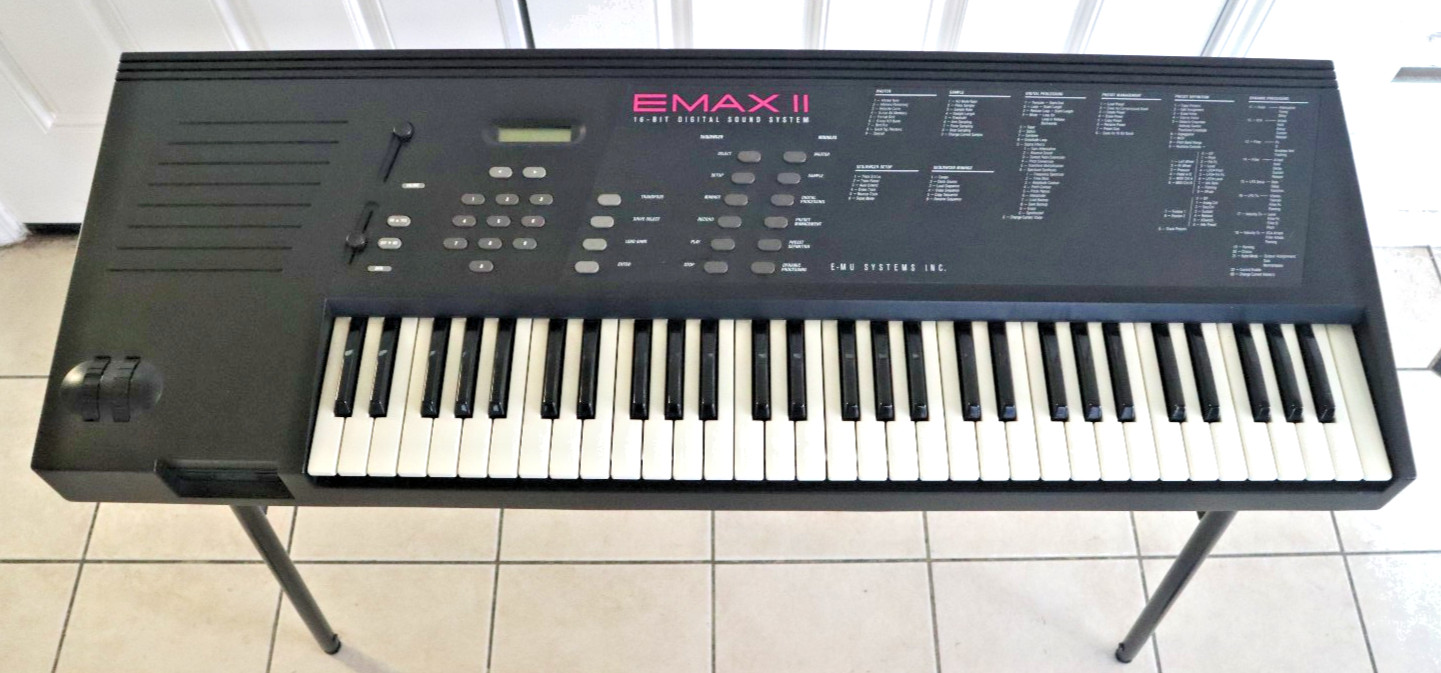
With its distinctive blue LCD backlight and unapologetically utilitarian design, the E-mu Emax brought 16-bit playback and professional sampling within reach of the working musician—without requiring a Fairlight-sized budget.
Overview
If the E-mu Emulator II was the sampler for the elite studio, the E-mu Emax was its scrappy younger sibling that showed up to the session with a bag of samples and a hunger to prove itself. Introduced in 1986 at a then-aggressive $2,995, the Emax wasn’t just a budget sampler—it was a calculated strike at the heart of the digital audio revolution, offering musicians a legitimate path into the world of sampling without selling a kidney or maxing out three credit cards. It arrived at a pivotal moment: the mid-80s synth explosion had peaked, MIDI was finally reliable, and producers were hungry for new textures. The Emax delivered, packing 12-bit sampling (with 16-bit playback interpolation) into a rugged 18-pound chassis that felt like it could survive a tour bus crash.
What made the Emax special wasn’t raw power—it had only 8-voice polyphony and a base 512 KB of RAM (expandable to 1.5 MB, if you had the cash and the patience to source the proprietary memory boards)—but its balance of affordability, expandability, and sonic character. Unlike the sterile precision of later 16-bit samplers, the Emax’s 12-bit engine imparted a subtle grit, a kind of digital warmth that somehow made sampled strings, drums, and even vocals sit better in a mix. It became a staple in late-80s pop, new wave, and early hip-hop production, showing up on records by artists who couldn’t afford a Fairlight CMI but still wanted that cutting-edge sampled sound. It wasn’t just a tool; it was a statement: sampling was no longer just for the rich.
Specifications
| Brand | E-mu |
| Model | Emax |
| Category | Samplers (Synthesizers) |
| Years Produced | 1986–1990 |
| Country of Manufacture | United States |
| Original MSRP | $2995 (1986) |
| Bit Depth | 12-bit sampling, 16-bit playback |
| Sample Rate | 22 kHz to 50 kHz (variable) |
| Polyphony | 8 voices |
| Memory | 512 KB RAM (expandable to 1.5 MB) |
| Storage | 3.5-inch floppy disk drive |
| Display | 2-line x 16-character LCD (blue backlight) |
| MIDI | MIDI In, Out, Thru |
| Audio Inputs | 1 x 1/4" unbalanced (line/mic switchable) |
| Audio Outputs | 2 x 1/4" unbalanced (left/right) |
| Headphone Output | 1 x 1/4" stereo |
| Dimensions | 17.5 x 13.5 x 3.5 inches (44.5 x 34.3 x 8.9 cm) |
| Weight | 18 lbs (8.2 kg) |
| Power | 100-120 VAC, 60 Hz, 30 W |
| Frequency Response | 20 Hz to 20 kHz (±1 dB) |
| Signal-to-Noise Ratio | 90 dB A-weighted |
| Total Harmonic Distortion | < 0.05% at 1 kHz |
Key Features
- 12-bit sampling with 16-bit playback interpolation: This hybrid approach was E-mu’s clever workaround to deliver perceived 16-bit clarity while using cheaper 12-bit ADCs. The result? A slightly colored, warm character that many engineers and producers now describe as “musical” rather than “accurate.” It’s the sonic fingerprint that made Emax strings lush and drums punchy, even with limited memory.
- Variable sample rate (22–50 kHz): Unlike fixed-rate competitors, the Emax let you dial in the sample rate based on your needs. Need maximum fidelity for a vocal stab? Crank it to 50 kHz. Recording a low-frequency bass hit and saving memory? Drop to 22 kHz. This flexibility was a godsend in an era where every kilobyte counted.
- 3.5-inch floppy disk storage: In 1986, this was modern. While some samplers still used cassette tapes or proprietary cartridges, the Emax embraced the emerging standard, making sample exchange and backup far more practical. The drive became a point of failure over time, but at the time, it felt like progress.
- Expandable memory up to 1.5 MB: Base memory was tight—512 KB gave you maybe 10 seconds of stereo at 50 kHz—but E-mu offered expansion boards (EMX-MEM1 and EMX-MEM2) that let you stretch to 1.5 MB. It wasn’t cheap, but it meant the Emax could grow with your needs.
- Integrated MIDI implementation: With full MIDI In, Out, and Thru, the Emax slotted seamlessly into the burgeoning MIDI studio ecosystem. You could sequence it from a Sequential Circuits Studio 440 or trigger samples live from a keyboard controller—essential for live performance and studio workflow.
Historical Context
The Emax didn’t emerge in a vacuum. It followed the E-mu Emulator II (1984–1987), a machine revered for its sound but priced beyond most musicians’ reach at over $7,000. E-mu clearly saw a gap: a professional-grade sampler that didn’t require a corporate sponsorship. The Emax was their answer—a streamlined, cost-reduced instrument that retained the core DNA of the Emulator line but made no apologies for its compromises.
Its main competitor was the Akai S900, released the same year (1986). The S900 offered true 12-bit sampling with 12-bit playback, 12-voice polyphony, and a more intuitive interface. But the Emax had E-mu’s reputation, better interpolation, and—critically—a warmer, more “analog” character that many producers preferred for musical textures. Where the S900 felt clinical, the Emax felt alive. It wasn’t faster or more powerful, but it had soul.
The Emax’s reign lasted until 1989, when E-mu released the Emax II—a massive leap forward with 32-voice polyphony, sample rates up to 48 kHz, and support for up to 8 MB of memory. The Emax II was faster, more stable, and more user-friendly, but it also marked the end of the original Emax’s era. By 1990, sampling was no longer a luxury—it was standard equipment, and the Emax had helped make that happen.
Collectibility & Value
Today, the E-mu Emax is uncommon but not rare. You won’t find one under every synth bench, but they surface regularly on Reverb, eBay, and vintage synth forums. In 2025, a working unit in good condition typically sells for $800 to $1,500, with fully expanded models (1.5 MB RAM, clean floppy drive) commanding the higher end. The blue LCD backlight remains a point of nostalgic affection—like the glow of a late-night studio session frozen in time.
However, buyers should be cautious. Two issues plague aging units: capacitor leakage on the analog output board (which can damage op-amps and require costly repairs) and floppy drive mechanism failure. The rubber pinch roller and drive belt often degrade after 30+ years, rendering the drive useless. Many owners now use Gotek floppy emulators with USB drives—a practical upgrade that preserves functionality without sacrificing authenticity.
If you’re hunting for an Emax, prioritize units with replaced capacitors and a tested floppy drive. Check for crackling in the outputs and ensure all keys on the membrane keypad respond. And if you find one with the original foam-lined shipping box? You’ve struck gold. The Emax wasn’t the most powerful sampler of its day, but it was one of the most important—and for those who appreciate the grit and charm of early digital sampling, it’s still worth every penny.
eBay Listings


As an eBay Partner, we earn from qualifying purchases. This helps support our independent vintage technology research.
Service Manuals & Schematics
- Service Manual — archive.org
- Owner's Manual — archive.org
- Service Manual — archive.org
Related Models
- E-mu Emulator II (1984-1987)
- E-mu Emulator (1981-1984)
- E-mu SP-1200 (1987-1998)
- Akai S612 (1985-1986)
- Akai S700 (1987)
- Akai CD3000XL
- Akai MPC Element
- Akai MPC Key 61
- Akai MPC One
- Akai MPC Touch