ADDAC 814 6x6 Stereo Matrix Mixer (2024–)
A tangle of patch cables leads to a moment of pure sonic alchemy—this is where chaos learns to sing in stereo.
Overview
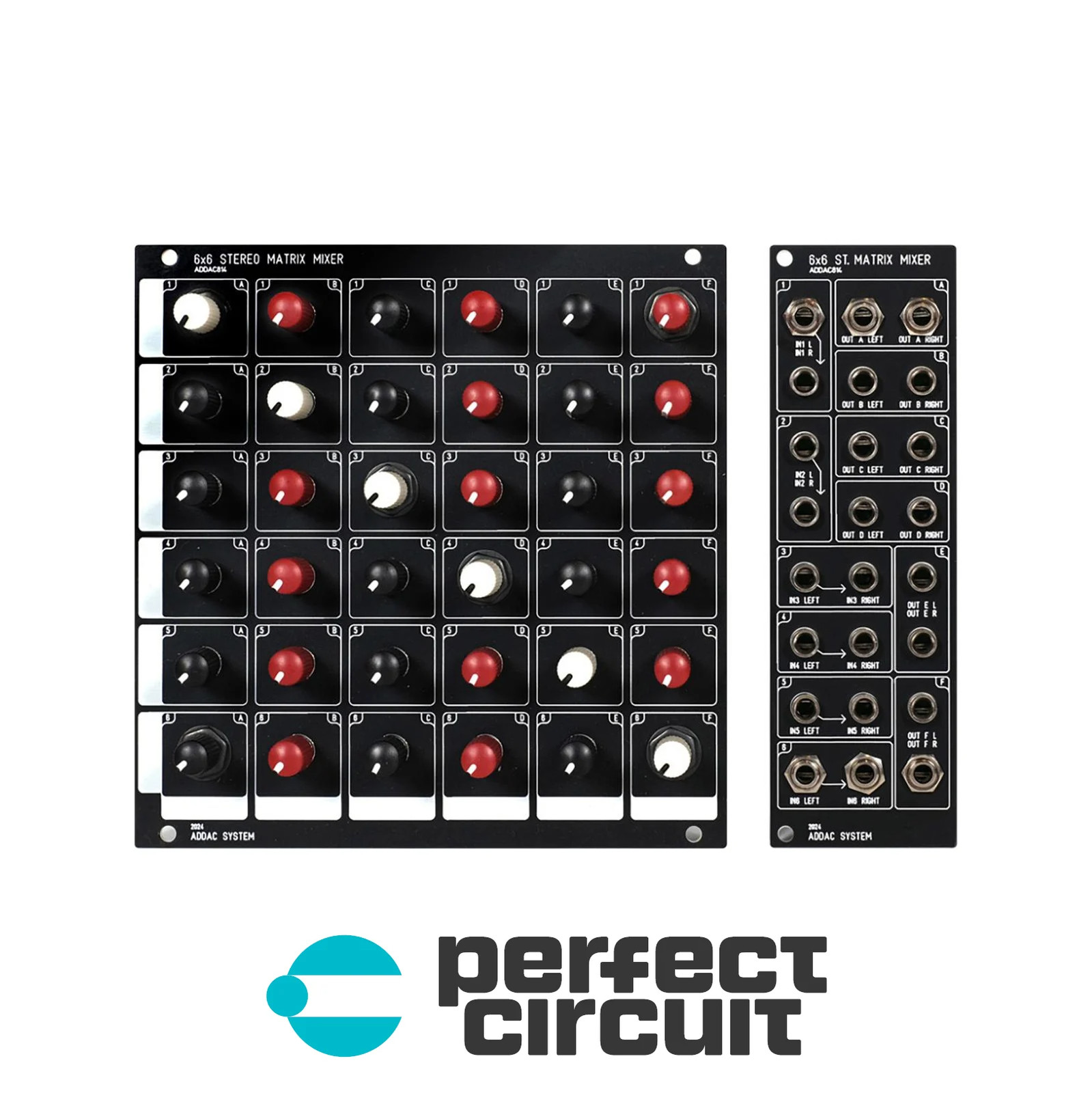
You know that feeling when you're elbow-deep in a modular patch, trying to route a feedback loop through three filters and a delay, only to realize your mixer can't handle the cross-connections without a nest of spaghetti? The ADDAC 814 6x6 Stereo Matrix Mixer doesn’t just solve that problem—it turns it into a playground. This isn’t a mixer that sits quietly in the background; it’s the conductor of a six-channel stereo orchestra where every instrument can play every part, simultaneously, if you dare. At first glance, the wall of 36 knobs might look like overkill—especially in a format where every HP counts—but spend ten minutes with it, and you’ll start to wonder how you ever patched without one. The genius isn’t just in the matrix concept, but in how ADDAC executed it: split into two modules, one for controls and one for jacks, so you can tuck the cable jungle off to the side and keep the performance surface clean. It’s like having a mixing console and patch bay fused into a single, expandable brain.
And expand it you can—this thing is built to grow. Need 12x12? Chain two together. Dreaming of a 24x24 monster for your studio centerpiece? ADDAC not only supports it, they encourage it, with expansion headers and full documentation on how to scale up. But even standalone, the 6x6 configuration offers more routing flexibility than most modular users will ever fully exploit. It’s DC-coupled, so it handles both audio and CV with equal ease, making it just as useful for sculpting modulation matrices as it is for blending oscillators or effects returns. The left inputs are normalled to the right, which simplifies stereo operation but doesn’t lock you in—patch the right side independently if you want true dual-mono or cross-panning madness. The colored knobs—black, dark red, and cream—aren’t just for show; they’re a visual language. The cream ones form the diagonal (1A, 2B, 3C, etc.), hinting at feedback paths, while the alternating black and red help you track output columns at a glance. It’s a small detail, but one that pays off every time you’re mid-patch and need to tweak without second-guessing.
This is not a “set and forget” module. It’s tactile, immediate, and demands interaction. Turn one knob, and you’re not just adjusting level—you’re reshaping the entire signal ecosystem downstream. Feedback loops bloom, modulations evolve, and stereo images shift in real time. It’s the kind of module that turns patching into performance, where the act of tweaking becomes part of the composition. And while it’s undeniably powerful, it’s not without quirks. The use of trimmer-topper knobs (Thonk’s Tall Trimmer Toppers, to be precise) means fingers need precision—no sweeping grabs here. Some users report they’d prefer full-sized knobs for live use, but ADDAC clearly prioritized space and density, and given the 33HP footprint, that makes sense. The pots themselves are high-quality Alpha T18s with metal shafts, so they’ll last, but replacing all 36 with larger knobs is a project in itself. Still, the trade-off is worth it: a module that doesn’t just mix, but redefines how you think about signal flow.
Specifications
| Manufacturer | ADDAC System |
| Production Years | 2024– |
| Original Price | 340€ (Control + Jacks modules) |
| Format | Eurorack |
| HP | 25HP + 8HP (33HP total) |
| Depth | 4.5 cm |
| Current Draw +12V | 140mA |
| Current Draw -12V | 140mA |
| Inputs | 6 stereo inputs (12 total jacks) |
| Outputs | 6 stereo outputs (12 total jacks) |
| Input Normalization | Left inputs normalled to right per channel |
| Signal Type | DC coupled (audio and CV capable) |
| Level Switching | Per-channel jumper selectable (Eurorack or Line level) |
| Internal Connection | 34-wire ribbon cable between control and jack modules |
| Expandability | Supports chaining for 6x12, 12x6, 12x12, 18x18, etc. |
| Expansion Headers | Extra IDC sockets for linking multiple units |
| Potentiometers | Alpha T18 with metal shafts, fitted with Thonk Tall Trimmer Toppers |
| Panel Features | Scribble strips for labeling inputs and outputs |
| Knob Colors | Black (A, C, E outputs), Dark Red (B, D, F outputs), Cream (diagonal feedback path) |
| Module Components | Control Module, Jacks Module, optional Expansion Module |
Key Features
A Split-Personality Design That Solves the Cable Chaos
Most matrix mixers cram all jacks and knobs onto a single panel, creating a dense thicket of cables that obscures the controls. The ADDAC 814 sidesteps this by splitting into two modules: the 25HP control unit with all 36 knobs, and the 8HP jack module housing all 24 input/output jacks. They connect via a 34-wire ribbon cable, allowing you to mount the jack module off to the side, below, or even in a different row. This isn’t just a cosmetic choice—it’s a workflow revolution. During live sets, you can keep the control panel clear and focused, while routing all cabling to a dedicated zone. It also makes servicing easier; no more unplugging half your system to reach a buried jack. The ribbon cable is long enough to allow flexible placement, and since only the control module needs bus power, the jack module installs anywhere. This modularity also enables stacking—place the jack module in a skiff or secondary row, preserving valuable front-panel real estate. It’s a solution so obvious in hindsight that you’ll wonder why more manufacturers haven’t adopted it.
Expandable to Monstrous Proportions
The 814 isn’t just a standalone module—it’s a building block. With extra IDC headers on the back, you can chain multiple units to create larger matrices: 6x12, 12x6, 12x12, even 18x18. ADDAC provides cabling for configurations up to 12x12; beyond that, custom cables are required, but the company offers guidance and discounts for large builds (7% off orders over 18x18). This scalability makes the 814 uniquely future-proof. Start with a single 6x6 for stereo effects routing, then expand as your system grows. The expansion isn’t just about size—it’s about complexity. A 12x12 matrix can handle entire synth layers, live processing chains, or even serve as a central nervous system for a multi-rack setup. The ability to mix and match configurations (like using one control module with multiple jack modules) adds further flexibility. It’s rare to see a Eurorack module designed with such long-term vision, where the initial purchase is just the first step in a modular journey.
Designed for Both Audio and CV Mastery
While many mixers are audio-only, the 814’s DC-coupled circuitry means it handles control voltages with the same finesse as audio signals. This opens up a world of modulation possibilities: blend LFOs, morph between envelope shapes, or create evolving CV textures by feeding outputs back into inputs. Patch a few slow LFOs into the top channels, route them through various feedback paths, and use the matrix to crossfade between modulation states—suddenly you’re not just controlling parameters, you’re composing them. The level jumpers (per-channel, on the back) let you switch between Eurorack and line level, making it easy to integrate external gear like guitar pedals, outboard effects, or audio interfaces. This dual-role capability—equal parts audio router and CV processor—makes the 814 more than a mixer. It’s a dynamic signal choreographer, capable of managing both sound and motion within your system.
Historical Context
Matrix mixers have always been niche in modular synthesis—not because they’re impractical, but because they demand a different way of thinking. Traditional mixers follow a linear path: input → channel → output. Matrix mixers break that mold, allowing any input to go to any output, with level control at every intersection. In the early days of Eurorack, space and cost limited their adoption. But by the mid-2020s, as systems grew larger and users sought more complex routing, the demand for flexible mixers surged. The ADDAC 814 arrived in 2024 as part of this wave, joining a small but growing field that included the AI Synthesis 018, Bear Audio Matrix, and SetonixSynth Shaka. What set the 814 apart was its expandability and split design—features that addressed real-world usability issues others had overlooked. At a time when many manufacturers were shrinking modules to save space, ADDAC went big, betting that users would value power and flexibility over footprint. That confidence paid off. The 814 wasn’t just another mixer; it was a statement that modular synthesis was evolving from simple voice stacking to complex, interconnected systems where signal flow itself became an instrument.
Collectibility & Value
As a 2024 release, the ADDAC 814 is too new to be considered “vintage” in the traditional sense, but its design and expandability have already made it a sought-after centerpiece in serious Eurorack rigs. New units sell for around €340 directly from ADDAC, with the jack and control modules available separately (€80 and €260 respectively) for custom builds. On the secondhand market, complete units list between $350 and $450, depending on condition and included accessories. The DIY kit option (€260 for the full 6x6) appeals to builders and keeps costs down, though assembly requires intermediate soldering skills and patience—36 pots and dense wiring aren’t for beginners. Failures are rare, but the ribbon cable connection should be checked if the module behaves erratically; loose connections here can cause intermittent signal loss. The Alpha pots are robust, but the trimmer-topper knobs can be fiddly—some users replace them with larger knobs, though this isn’t trivial given the tight spacing. When buying used, verify that all jacks are secure and that the level jumpers function correctly, especially if integrating with line-level gear. The module’s skiff-friendly depth (4.5cm) and solid build make it reliable for touring, but its size means it’s best suited for larger systems. For collectors, the 814’s real value lies in its potential—owning one isn’t just about the module, but about the larger system it enables. It’s the kind of piece that defines a rig, not just fills a gap.
eBay Listings
As an eBay Partner, we earn from qualifying purchases. This helps support our independent vintage technology research.