ADDAC 306 VC Transitions (2019–Present)
A five-channel CV morphing engine that turns a single slider into a live performance command center.
Overview
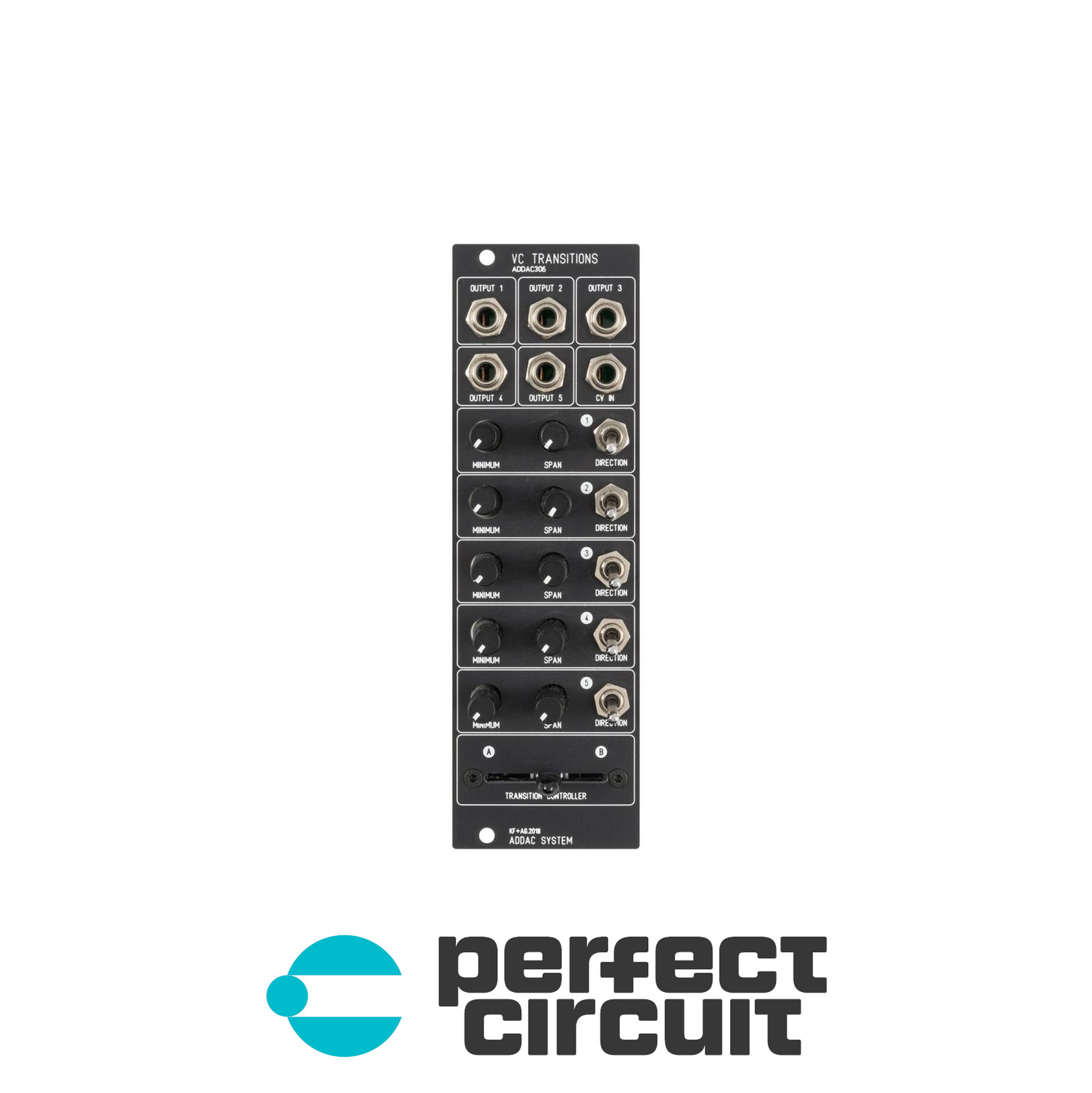
Slide your finger across the ADDAC 306’s central fader and watch five independent control voltages shift in real time—each moving from one state to another, but not necessarily in the same direction or at the same rate. It’s not a sequencer, not a random source, not a mere attenuator. It’s a macro controller disguised as a humble 8HP module, built for performers who want to morph entire patches with one hand while tweaking with the other. The magic lies in its simplicity: five channels, each with MINIMUM, SPAN, and DIRECTION controls, all governed by a single TRANSITION CONTROLLER slider. Set your endpoints—say, a filter sweep, a delay feedback climb, a resonance spike, a pitch bend, and an LFO rate increase—then slide from “calm” to “chaos” in one fluid motion. Or reverse the direction on one channel so it winds down while the others ramp up. It’s like having five tiny automation lanes under one fader, each customizable in range and polarity, all perfectly synchronized.
Despite its modest footprint, the 306 punches far above its weight in utility. It’s the kind of module you don’t know you need until you use it, then wonder how you ever patched without it. Need to smoothly transition between two completely different timbres during a live set? Patch the outputs to key parameters on your oscillators, filters, and effects, dial in your A and B states, and let the slider do the rest. Want to generate five different envelope shapes from a single ADSR? Route the envelope into the CV IN, set each channel’s SPAN and MINIMUM differently, and suddenly one transient becomes five evolving control voltages. It’s also a polyphony multiplier in disguise—pair it with a quantizer like the ADDAC207, feed it a single-note sequence, and you’ve got a way to morph between chord voicings in real time. The module doesn’t generate sound, but it shapes the behavior of everything around it, making it a silent conductor in a modular orchestra.
Specifications
| Manufacturer | ADDAC System |
| Production Years | 2019–Present |
| Original Price | €130 (assembled), €87 (DIY kit) |
| Format | Eurorack |
| Width | 8 HP |
| Depth | 40 mm |
| Power Consumption | +40mA / -20mA |
| Bus Board Connector | 8×2 IDC (Doepfer style) |
| CV Inputs | 1 (CV IN, accepts up to +5V) |
| CV Outputs | 5 (individual per channel) |
| Output Voltage Range | Jumper selectable: +5V or +10V maximum per channel |
| Minimum Voltage Control | Per channel, adjustable via front panel knob |
| Span Control | Per channel, sets voltage range above minimum |
| Direction Control | Per channel, toggle switch for min→max or max→min transition |
| Transition Control | Manual slider (0–10V range) or CV-controlled via CV IN |
| Attenuation | Slider acts as attenuator when CV IN is used |
| Jumpers | 5 rear-mounted jumpers to set max output range per channel |
| DIY Availability | Yes, full kit available |
Key Features
The Morphing Slider as Performance Interface
The heart of the ADDAC 306 is its central slider—a tactile, smooth-moving fader that feels more like a studio automation controller than a typical modular knob. This isn’t just for show; it’s the primary performance interface. Whether you’re using it manually or driving it with an external CV, the slider governs the transition state across all five channels simultaneously. Move it from bottom to top, and each channel moves from its MINIMUM to its maximum (or vice versa, depending on DIRECTION). The brilliance is in the independence: one channel might go from 1V to 5V (SPAN of 4V), another from 3V to 8V (SPAN of 5V), while a third drops from 6V to 2V. The slider doesn’t output a fixed voltage—it outputs progress, and each channel interprets that progress differently. This makes it ideal for complex, non-linear transitions that would take multiple sequencers or complex logic to replicate.
CV Input for External Automation
While the manual slider is expressive, the CV IN jack unlocks the module’s full potential as a signal processor. Feed it an LFO, envelope, or sequencer output, and the slider becomes an attenuator for that incoming signal. This means you can automate the entire morphing process—say, have an ADSR trigger a smooth shift from one patch state to another every time you hit a key. Because the slider attenuates the CV, you can scale the transition depth: set it halfway and only get a partial morph, even if the incoming CV swings full range. This adds a layer of dynamic control that’s rare in modules of this class. It also enables chaining—patch the output of one 306 into the CV IN of a second to create cascading transitions, or use multiple units under a single master slider for massive 10-channel control.
Jumper-Selectable Output Ranges
On the back of the module, five jumpers let you set the maximum output range for each channel independently—either +5V or +10V. This is a subtle but powerful feature. Need one channel to drive a 1V/oct pitch input? Set it to 5V range and dial in a 1V SPAN. Want another to modulate a filter with a wide 8V sweep? Set that channel to 10V and adjust accordingly. The jumpers make the module adaptable to a wide range of modular standards without needing external offset or attenuverters. It’s a design choice that reflects ADDAC’s focus on practicality—no wasted space, no unnecessary complexity, just precise control where it counts.
Historical Context
The ADDAC 306 arrived in 2019, a time when Eurorack was shifting from experimental hobbyism to serious performance instruments. Modularists were no longer just patching in the studio—they were taking systems on stage, and they needed tools that could handle real-time control with reliability and immediacy. The 306 answered that need with surgical precision. While modules like the Intellijel Metropolis or Make Noise Pressure Points offered deep performance control, they were complex and expensive. The 306 carved its niche as a focused, affordable utility that solved a specific problem: how to smoothly transition between two patch states without resorting to multiple sequencers, mixers, or logic modules.
It emerged alongside a wave of “macro control” modules—tools designed to manage multiple parameters at once. But where something like the ALM Trogotronic or the Qu-Bit Velocity offered digital scene recall or velocity processing, the 306 stayed resolutely analog and hands-on. It didn’t store presets or respond to MIDI; it responded to touch and voltage. This analog immediacy made it a favorite among performers who valued tactile feedback over digital recall. Its design was also a nod to the “patch programmability” ethos of modules like the Cold Mac, but without the steep learning curve. The 306 wasn’t trying to be a computer—it was trying to be a lever, a dimmer, a crossfader for your entire system.
Collectibility & Value
As of 2026, the ADDAC 306 remains in production and widely available, which keeps prices stable. New units typically sell for between €130 and €160, depending on region and distributor. DIY kits are available for €87, making it one of the more affordable entry points into ADDAC’s ecosystem. Used prices on the secondhand market hover between €90 and €120, with most units selling in “like new” condition due to the module’s solid build and lack of moving parts beyond the slider. The fader itself is the only wear item, and while it’s a high-quality component, heavy stage use over years could lead to scratchiness or dropouts. However, no widespread failure modes have been reported, and the PCB is straightforward with no known design flaws.
Because the module is still current, it’s not yet a “vintage collectible” in the traditional sense, but it has developed a loyal following among modular performers. Units with custom front panels (offered directly by ADDAC in colors like red, blue, or bronze) occasionally fetch a premium, especially if paired with matching cases or other ADDAC modules. For buyers, the main concern is verifying that all five outputs respond linearly to the slider and that the CV IN properly attenuates incoming signals. A quick test with a multimeter or oscilloscope will confirm functionality. Given its utility and reliability, the 306 is one of the safer buys in the Eurorack market—no ticking time bombs, no capacitor leaks, no firmware issues. It just works.
eBay Listings
As an eBay Partner, we earn from qualifying purchases. This helps support our independent vintage technology research.