ADDAC 304 (2010s)
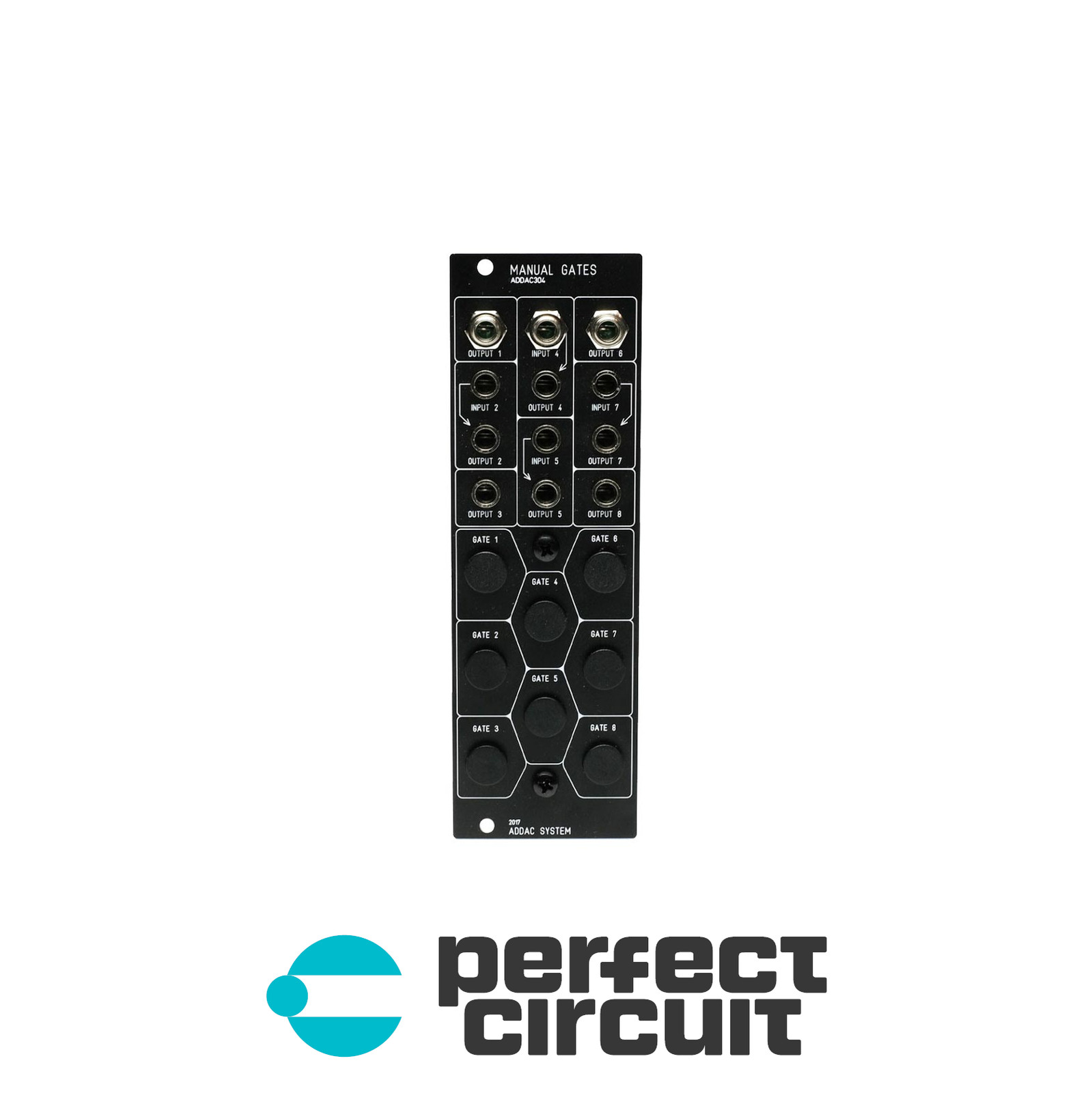
Eight tactile gate buttons in a svelte 8HP frame—one half doing double duty as momentary signal pass-throughs, the other half pure manual triggers—make this unassuming module a performance secret weapon.
Overview
It’s not flashy, doesn’t make a sound, and won’t generate a sequence—but plug in the ADDAC 304, and suddenly your modular isn’t just something you patch, it’s something you play. That first press of a rubbery, positive-action button delivering a crisp +5V gate feels like flipping a switch on immediacy. No menus, no screens, no MIDI latency—just eight physical triggers at your fingertips, each one a direct line to firing off envelopes, advancing sequencers, or slamming a sample trigger. It’s the kind of module you didn’t know you needed until you used it, and then you wonder how you ever performed without it.
But the 304 isn’t just a row of momentary buttons. Its real genius hides in plain sight: four of those eight channels double as momentary signal pass-throughs. When you plug a CV or gate into one of those inputs and press the corresponding button, instead of outputting a fixed +5V, it passes the incoming signal through—only while the button is held. This turns the 304 into a manual gate processor. Imagine holding down a button to let a slow LFO wiggle your filter only during a specific moment in a performance, or triggering a complex modulation chain with your finger instead of a clock. It’s a simple concept, but in practice, it adds a layer of tactile control that feels almost theatrical—like manually opening a gate in a dam, letting the signal flood through exactly when you want it.
Designed as part of ADDAC’s 300 series—focused on expressive, performance-oriented controls—the 304 fits neatly into the brand’s philosophy of blending utility with physical interaction. It’s not trying to be a brain; it’s the nervous system’s fingertips. The build is solid, typical of ADDAC’s no-nonsense Eurorack aesthetic: black or red anodized aluminum panel, cleanly labeled, no wasted space. At just 25mm deep, it tucks into even the most packed skiff or travel case without issue. And while it draws a trivial 10mA from the +12V rail (nothing from -12V or +5V), its impact on a patch is disproportionately large. It’s the module you reach for when you want to break out of the cycle of “patch, press play, adjust, repeat” and start performing—when you want to turn your modular setup from a laboratory into a stage instrument.
Specifications
| Manufacturer | ADDAC System |
| Production Years | 2010s |
| Original Price | €90 (assembled), €58 (DIY kit, excl. VAT) |
| Format | Eurorack |
| Width | 8 HP |
| Depth | 25 mm |
| Current Draw +12V | 10 mA |
| Current Draw -12V | 0 mA |
| Current Draw +5V | 0 mA |
| Gate Output | 0 to +5 V |
| CV Input Range | ±10 V |
| Button Type | Momentary switches |
| Channels | 8 manual gates |
| Momentary Pass-Through Channels | 4 (channels with inputs) |
| Power Connector | 8-pin IDC (Doepfer style) |
| DIY Availability | Yes, SMD and through-hole kit |
Key Features
A Split Personality: Trigger + Gate
The ADDAC 304’s standout feature isn’t just having eight buttons—it’s that half of them are smarter than they look. The first four channels (those with input jacks) don’t just output a static +5V gate; they act as momentary gates for whatever signal you patch into them. This means you can route a complex CV sequence, an LFO, or even an audio-rate pulse into one of these inputs, then use the button as a manual gate to let it through only when pressed. It’s like having four manual VCA gates built into a trigger panel. Want to bring in a stutter effect only during a solo? Patch a clock into input 2, press the button in time. Need to manually inject a modulation sweep at a dramatic moment? Route your envelope follower here and fire it by hand. It’s a small feature that opens up huge performance possibilities, turning passive modules into interactive ones.
Tactile, Reliable Switching
In a world of touch plates, ribbon controllers, and capacitive sensors, the 304’s physical momentary buttons feel refreshingly honest. They have a soft rubber dome under each cap, offering a satisfying tactile bump with a short travel—enough feedback to know you’ve triggered it, but not so much that it slows down rapid tapping. They’re not clicky like arcade buttons, nor mushy like some membrane switches; they strike a balance that works for both deliberate, dramatic triggers and quicker rhythmic patterns. And because they’re momentary, the gate only fires while the button is held—perfect for controlling gates that need variable duration, like percussive hits or filter sweeps. The panel layout is clean and logical, with inputs on the left, outputs on the right, and clear numbering. No guesswork, no hunting—just press and go.
DIY-Friendly Design
True to ADDAC’s roots in the DIY synth community, the 304 is available as a full build-it-yourself kit, complete with SMD and through-hole components. The assembly guide is well-documented, and the board layout is straightforward, making it a solid intermediate-level project. It’s a great way to get hands-on with Eurorack construction without diving into something overly complex. The kit includes everything needed—PCB, front panel, jacks, buttons, and all components—so there’s no scavenging required. For tinkerers, this also means the potential for panel swaps or even custom modifications, like adding LEDs or changing button colors. And given the low current draw and passive nature of the circuit (essentially just switches and protection diodes), it’s a reliable build with minimal risk of damage from soldering errors—assuming you test for shorts first.
Historical Context
The ADDAC 304 emerged in the early 2010s, right as Eurorack was shifting from niche hobbyist curiosity to a legitimate performance platform. Modules were getting smarter, more complex, and more digital—but with that came a certain detachment. Performers found themselves staring at sequencers, tweaking parameters on touch interfaces, or relying on external MIDI controllers. The 304 was a quiet rebuttal to that trend: a return to physical, immediate control. It didn’t try to do everything; it did one thing—manual triggering—and did it exceptionally well, with a clever twist.
At the time, dedicated manual gate modules were rare. Most performers relied on spare buttons on MIDI controllers, or worse, reached into their racks to press a cable into a jack. The 304 filled that gap with purpose-built design. It wasn’t the first button-based module, but it was among the first to integrate pass-through functionality so elegantly. Competitors like Intellijel’s Push 2 or Make Noise’s Pressure Points offered more features (like pressure sensitivity or CV output), but they were also larger, more expensive, and often overkill for simple triggering needs. The 304 carved out its niche as the no-frills, high-functionality option—small, affordable, and smart in its simplicity.
ADDAC itself was riding a wave of innovation during this period, releasing a mix of hybrid digital-analog modules and performance-focused utilities. The 304 fit perfectly into that ecosystem—a tool for musicians who wanted to keep their hands on the music, not buried in menus. It also reflected a broader trend in modular design: the rise of “utility” modules that weren’t sound generators or processors, but enablers of better performance and patching. In that sense, the 304 wasn’t just a button panel—it was a statement about how modular synthesis could—and should—feel in the hands.
Collectibility & Value
The ADDAC 304 isn’t a rare bird, but it’s not exactly common either. It’s been in steady production for over a decade, available both assembled and as a DIY kit, so finding one on the used market isn’t difficult. That said, it’s not a module that gets churned through the secondhand circuit often—once someone adds it to their system, they tend to keep it. Used prices typically range from $80 to $120, depending on condition and whether it’s assembled or a kit. Assembled units in good condition with no panel scratches or loose jacks tend to sit around $100–$110, while DIY kits sell for $60–$80.
Failure points are minimal, which is part of the 304’s appeal. There are no active components on the board—just switches, jacks, and protection circuitry—so there’s little to go wrong. The most common issue reported is a stuck or unresponsive button, usually due to debris under the cap or a failed switch. These are easy to fix: pop off the button cap, clean the switch, or replace it entirely. Jacks can loosen over time, especially with frequent plugging and unplugging, but a quick solder touch-up resolves that. Because the module draws no power from the -12V or +5V rails, power-related failures are nonexistent.
When buying used, check that all eight buttons actuate cleanly and return fully. Test each output with a multimeter or connected module to confirm it’s sending +5V when pressed. If it’s a DIY unit, ask whether it was built correctly—though given the simplicity of the circuit, even a novice build is likely to work if it powers up without shorts. Custom panel versions (available in green, blue, white, bronze, etc.) are slightly more desirable and may command a small premium, but they’re mostly cosmetic. The real value is in functionality: a working 304 is worth every penny in a live rig.
eBay Listings
As an eBay Partner, we earn from qualifying purchases. This helps support our independent vintage technology research.