ADDAC 221 (2016–)
A 16HP gateway between your modular’s squelches and the digital world’s control—turning CV into MIDI CC messages with surgical precision and zero fluff.
Overview
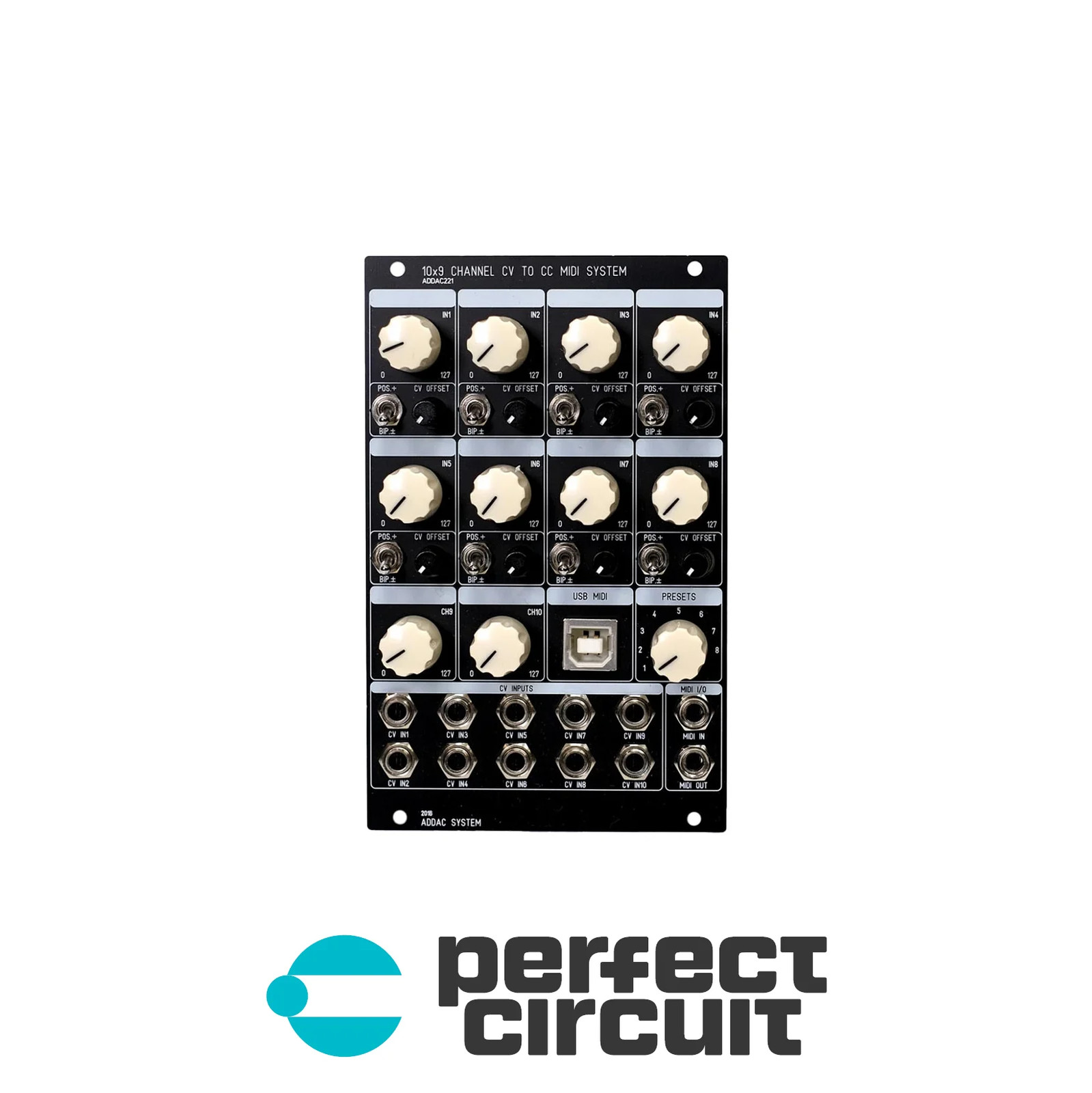
You’re knee-deep in a patch, modulating a filter cutoff with a slow LFO, and you want that same motion to tweak the reverb decay on your DAW plugin. Enter the ADDAC 221—a quiet workhorse that doesn’t make sound, but lets your modular rig boss around the rest of your studio. It’s not flashy, but if you’ve ever wished your Eurorack could talk to your software without a tangle of converters and code, this module is the translator you didn’t know you needed. It takes 10 channels of CV and converts them into MIDI Control Change messages, sending them out via both USB and 5-pin DIN MIDI, so your modular can ride shotgun on your soft synths, effects, or DAW parameters.
And it’s not just a dumb converter. The 221 is smart enough to let you map each CV input to any CC number and MIDI channel, store presets, and even offset or invert the signal before conversion. That means you can set up one configuration for tweaking a granular synth’s grain size and density, another for automating a filter bank in a plugin, and switch between them in seconds. It’s the kind of module that makes your system feel less like a lab experiment and more like a real instrument. The front panel is clean, industrial black with white labels and chunky knobs—nothing showy, but built like it’s meant to survive a tour. And at 16HP, it’s not the skinniest utility module out there, but you’re not going to weep over the space it takes.
What’s interesting is how it fits into ADDAC’s broader philosophy. This isn’t a company chasing digital wizardry or flashy interfaces. They’re deep into the analog ethos—warm preamps, vintage-style clipping, tactile control—but they’re not allergic to modern connectivity. The 221 is a bridge, not a compromise. It doesn’t digitize your sound; it digitizes your control. And in a world where more and more modular users are blending hardware with software, that’s not just useful—it’s essential.
Specifications
| Manufacturer | ADDAC System |
| Production Years | 2016– |
| Original Price | €335 |
| HP | 16 |
| Depth | 50 mm |
| Current Draw +12V | 70 mA |
| Current Draw -12V | 30 mA |
| Current Draw 5V | 0 mA |
| CV Inputs | 10 channels |
| MIDI Outputs | USB MIDI, 5-pin DIN MIDI |
| MIDI Inputs | 5-pin DIN MIDI |
| MIDI Thru Function | Yes, data routed between USB and DIN |
| Preset Storage | 8 user presets |
| CV Offset Knobs | 8 channels with manual offset and bipolar/positive toggle |
| Attenuverters | Small pots per channel for CV scaling |
| Software Configuration | Yes, via downloadable app (Windows/macOS) |
| Included Cables | 2 TRS to MIDI DIN cables |
| Firmware Updates | Supported via Teensy loader |
Key Features
CV to MIDI CC Conversion with Preset Intelligence
Most CV-to-MIDI converters do one thing: translate voltage into data. The 221 does that, but it also remembers how you like it. With eight user-configurable presets, you can save entire control mappings—say, routing CV 1 to CC 74 (filter cutoff) on MIDI channel 3, CV 2 to CC 1 (mod wheel) on channel 1, and so on. That’s huge if you switch between different setups. No more repatching or reprogramming every time you want to control a new synth. The presets are managed via a standalone app (Windows and macOS), which lets you set CC numbers, MIDI channels, and scaling for each input. It’s not browser-based, it’s not cloud-synced, it’s just a simple, functional tool that works. And because the module stores the presets locally, you don’t need your computer running to use them.
Flexible Signal Conditioning
The first eight channels each have a large white knob and a small pot. The big knob is a manual offset—think of it as a “bias” control that sets the baseline CV level before conversion. The small pot is an attenuverter, letting you scale the incoming CV up or down, even flip its polarity. This is critical when you’re working with bipolar LFOs or envelopes that swing positive and negative, but need to control a parameter that only responds to 0–127. The toggle switch next to each input lets you force the signal to unipolar (positive only), which is perfect for gates or triggers. It’s a level of control that turns a simple converter into a real utility module—one that can reshape your CV before it ever hits MIDI.
Dual MIDI I/O with Thru Functionality
The 221 doesn’t just send MIDI—it routes it. USB MIDI data is passed to the 5-pin DIN output, and incoming DIN MIDI is passed to both the USB port and the DIN output. That means you can daisy-chain multiple MIDI devices through the 221, or use it as a passive MIDI thru box. Want to send your modular’s clock to a drum machine while also controlling a plugin? Done. Need to merge MIDI from a keyboard into your modular’s MIDI stream? Plug it in, and the 221 handles the rest. It’s not a full MIDI merger or processor, but it’s smart enough to keep things flowing without a separate hub.
Historical Context
When the ADDAC 221 launched in 2016, the Eurorack scene was deep into the analog renaissance, but software integration was still a patchwork mess. Most CV-to-MIDI solutions were either clunky external boxes or modules with limited functionality. The 221 arrived at a time when modular users were increasingly relying on DAWs, VSTs, and digital effects, but lacked a seamless way to bring CV control into that world. ADDAC didn’t invent CV-to-MIDI, but they refined it—packing preset storage, bidirectional MIDI routing, and per-channel configuration into a single module. It wasn’t the first, but it was one of the first to feel like a complete solution.
Its closest competitors at the time were modules like the Kenton Pro Solo or the Expert Sleepers FH-2, but those were often more complex or required deeper technical knowledge. The 221 struck a balance—accessible enough for beginners, deep enough for pros. It also reflected a broader shift in modular design: the idea that utility modules could be just as important as sound generators. In a world where everyone was chasing new waveforms and modulation tricks, ADDAC quietly built the plumbing that made it all work together.
Collectibility & Value
The ADDAC 221 isn’t a rare bird, but it’s not disposable either. Built since 2016 with ongoing firmware updates, it’s a modern module by vintage standards, but it’s already earned a reputation as a reliable, no-nonsense workhorse. On the used market, it typically sells for $300–$380, depending on condition and whether it includes the original cables. Units with custom faceplates (available in colors like red, blue, or bronze) sometimes fetch a small premium, but most buyers care more about functionality than aesthetics.
Failures are rare, but when they happen, it’s usually related to the Teensy microcontroller or USB port. Firmware updates require physically pressing a button on the internal board, which means you have to pull the module from your case—annoying, but not a dealbreaker. The rotary switches for preset selection were changed from 9-position to 8-position in 2020 due to component shortages, so early units have one more preset slot. This isn’t a major functional difference, but collectors might note it.
If you’re buying used, check that all knobs turn smoothly, the USB connection is solid, and the MIDI outputs trigger external devices reliably. Test each CV input with a known source and verify that the CC messages are being sent correctly—some users report issues with stuck values if the firmware is outdated. A quick update usually fixes it. Overall, the 221 is low-risk: no electrolytic caps to dry out, no analog circuitry to drift, just solid-state logic doing its job. It’s not going to appreciate like a vintage Roland, but it’s not going to fail you either.
eBay Listings

As an eBay Partner, we earn from qualifying purchases. This helps support our independent vintage technology research.