ADDAC 203 (2010–2023)
Two channels of voltage taming, built for the long haul—simple, essential, and quietly brilliant in its precision.
Overview
Plug in a wonky LFO that swings from –3V to +7V and watch your oscillator go off the rails—until you route it through the ADDAC 203. Suddenly, that unruly signal gets reined in, scaled down, and nudged into the sweet spot where your filter cutoff actually responds musically. That’s the quiet magic of the 203: it doesn’t make noise, it makes everything else behave. Born in 2010 as one of ADDAC’s earliest Eurorack modules, the 203 CV Mapping unit was never meant to be flashy. It’s a utility—a voltage mechanic—but one built with such thoughtful architecture that it’s earned a permanent spot on countless racks, even as newer, fancier attenuverters hit the market.
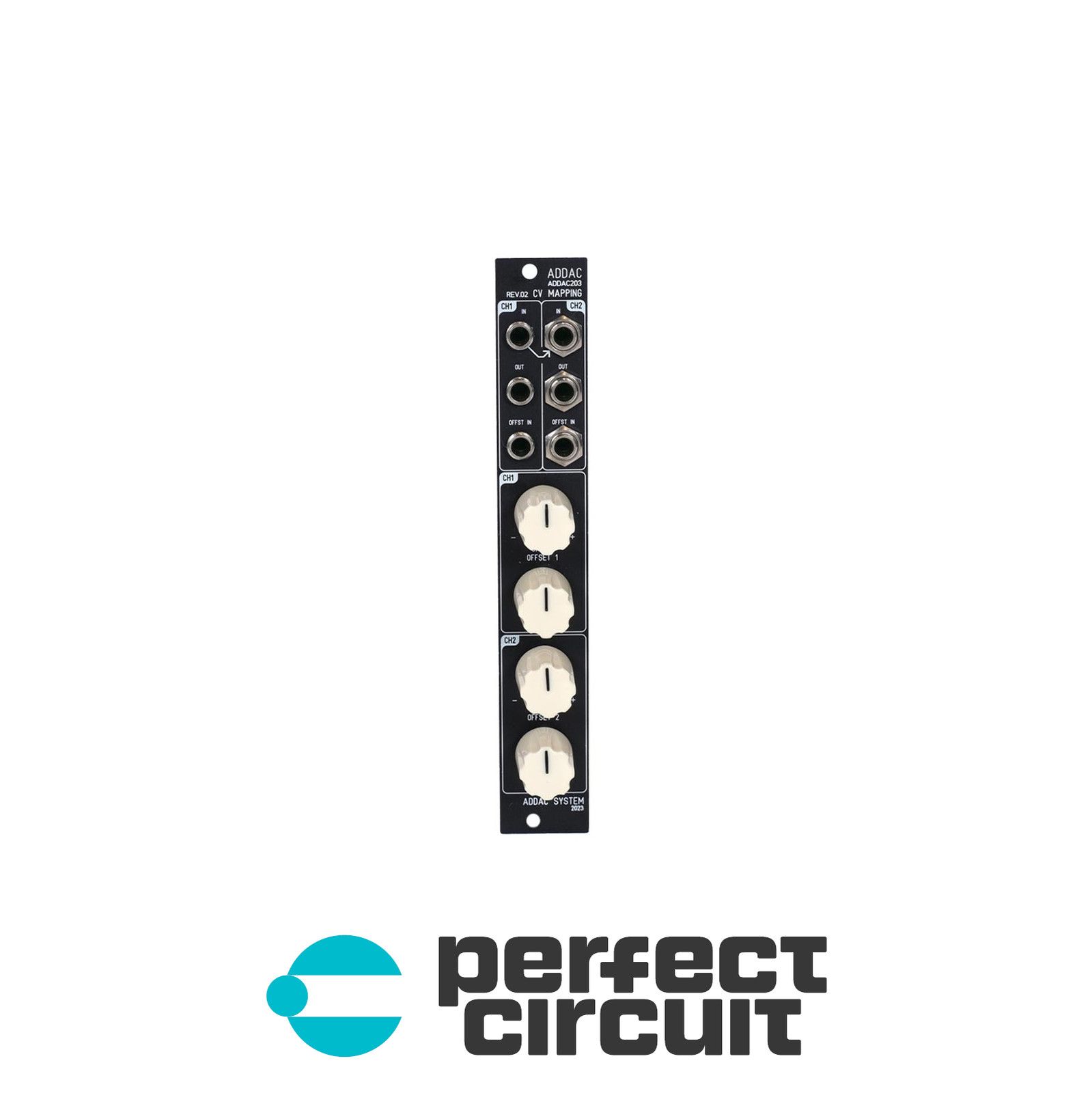
The module does two core things, and does them very well: attenuation with polarity control, and offset. Each of its two channels lets you scale an incoming CV signal using a gain knob that acts as an attenuverter—meaning you can reduce the signal’s amplitude or flip its polarity entirely. After that, an offset stage lets you shift the entire voltage range up or down between –5V and +5V, either manually or via a CV input. This isn’t just theoretical flexibility; it’s the difference between a sequencer that only half-opens your VCA and one that sweeps it cleanly from silence to full blast. And because the offset can be CV-controlled, you can modulate where a signal sits in its range—say, sliding a tremolo effect from positive-only to bipolar with an envelope.
While the original version occupied 4 HP, a later revision—dubbed Rev02—shrunk the module to a more compact 6 HP (despite the apparent contradiction in size, likely due to updated panel layout or power requirements) and added a dedicated CV input for offset, making modulation even more immediate. It’s also worth noting that the 203 was designed as a DIY kit, with surface-mount components pre-soldered and through-hole parts left for the builder. That hands-on origin story means many units in circulation were assembled by their owners, lending a personal touch but also introducing variability in build quality. Still, the circuit itself is robust, grounded in straightforward analog design that prioritizes reliability over novelty.
Specifications
| Manufacturer | ADDAC System |
| Production Years | 2010–2023 |
| Original Price | €97 (kit), €135 (assembled) |
| Format | Eurorack |
| Width | 4 HP (original), 6 HP (Rev02) |
| Depth | 25–30 mm |
| Power Supply | ±12V, +5V |
| Current Draw +12V | 40–50 mA |
| Current Draw -12V | 40–50 mA |
| Bus Board Connector | 8×2 IDC (Doepfer style) |
| Channels | 2 |
| Input Voltage Range | ±10V |
| Output Voltage Range | ±10V |
| Gain Control | Attenuverter with unity gain or ×10 max (jumper-selectable) |
| Offset Range | –5V to +5V |
| Offset CV Input | Yes (Rev02) |
| DIY Assembly Required | Yes (kit version) |
| Panel Color | Black FR4 |
Key Features
Dual-Channel Attenuversion with Full Polarity Control
The heart of the 203 lies in its gain stage: a true attenuverter per channel, not just a passive attenuator. This means you don’t just reduce the amplitude of a control voltage—you can flip its polarity, turning a rising envelope into a falling one, or inverting an LFO to create complementary modulation paths. This is indispensable when patching complex modulations, like using a single sine LFO to open one filter while closing another. The gain knob lets you dial from full negative to full positive output, with unity gain at the center. A jumper on the back lets you choose between a maximum gain of ×1 (unity) or ×10, giving you either precise scaling or signal boosting when needed—say, amplifying a weak envelope to fully drive a distant module.
Precise Offset with CV Modulation
After attenuation, the signal hits the offset stage, where you can shift its entire voltage range up or down manually or via CV. This is where the 203 shines in practical patching. Imagine a sequencer outputting 0–5V, but your oscillator’s frequency input expects a 2–7V range to stay in tune. The offset knob lifts the signal exactly where it needs to go. Better yet, the Rev02 version added a CV input for offset, so you can dynamically shift the baseline—use an envelope to slide a modulation range from positive to negative, or a slow LFO to drift a pitch sequence up and down an octave over time. This level of control turns static voltages into evolving ones, adding motion without needing extra modulation sources.
DIY-First Design with Real-World Flexibility
The 203 was released as a DIY kit, reflecting ADDAC’s roots in the hands-on Eurorack community. All surface-mount components came pre-soldered, leaving only through-hole parts—resistors, jacks, pots—for the builder. This lowered the barrier to entry while still giving users the satisfaction of assembly. The module’s FR4 black panel is minimalist but durable, with clearly labeled jacks and controls. Because it was designed for ±12V and ±15V systems, it integrates easily into most racks. And with current draw hovering around 40–50 mA per rail, it’s light enough for compact power supplies. While not the smallest CV utility out there, its layout is efficient, and the addition of CV control in Rev02 made it significantly more dynamic than early passive offset/attenuverter modules.
Historical Context
When the ADDAC 203 launched in 2010, Eurorack was still a niche within a niche—far from the explosion it would see in the 2010s. Most modules were built by small outfits in garages or small workshops, and utility modules like attenuators were often afterthoughts: passive, unipolar, and CV-starved. The 203 stood out by treating voltage control as seriously as sound generation. At a time when many builders were still figuring out what Eurorack needed, ADDAC was already thinking about signal integrity, flexibility, and modulation depth. The inclusion of CV-controllable offset in the Rev02 update—years after the original—showed a commitment to evolving the design based on user feedback, not just chasing trends.
It arrived alongside other foundational utility modules from brands like Intellijel and Mutable Instruments, but carved its own path by blending DIY accessibility with pro-grade functionality. While some competitors focused on digital precision or multi-function integration, the 203 stuck to analog simplicity. It didn’t try to be a mixer, a slew limiter, or a logic processor—it just mapped voltages, and did it reliably. That focus earned it respect among patchers who valued predictability over flash. In a format where novelty often overshadows necessity, the 203 proved that a well-executed utility could be as essential as a filter or oscillator.
Collectibility & Value
The ADDAC 203 isn’t a showpiece—it’s a workhorse. As such, it doesn’t command sky-high prices, but it holds steady value among Eurorack users who appreciate its build and functionality. Kit versions typically sell for €90–€110, while assembled units go for €130–€160, depending on condition and seller. Because many were built by owners, there’s some variability in solder quality and potentiometer feel, so buyers should inspect photos carefully or seek trusted resellers. Fully tested, working units are common, but untested kits carry risk—especially if the buyer lacks soldering experience.
Failures are rare but not unheard of. The most common issues stem from assembly errors: cold solder joints on jacks or power connectors, misaligned pots, or incorrect jumper settings affecting gain scaling. Once properly built, the module is remarkably stable—there are no ICs to fail, no firmware to corrupt. The FR4 panel is durable but can scratch if handled roughly. Because it draws modest current and runs cool, heat-related degradation isn’t a concern. For collectors, the Rev02 version is the definitive edition, thanks to its CV-controllable offset and updated layout. Original 4 HP units are slightly rarer but not significantly more valuable.
If you’re buying, prioritize tested, assembled units unless you’re comfortable with troubleshooting. Look for clean panel printing, firm potentiometer action, and no wobble in the jacks. Since the 203 was never discontinued abruptly, there’s no scarcity premium—prices reflect utility, not hype. It’s not a “grail” module, but it’s the kind of thing you buy once and keep forever, quietly thankful every time you need to fix a drifting pitch or tame a runaway modulation.
eBay Listings
As an eBay Partner, we earn from qualifying purchases. This helps support our independent vintage technology research.